
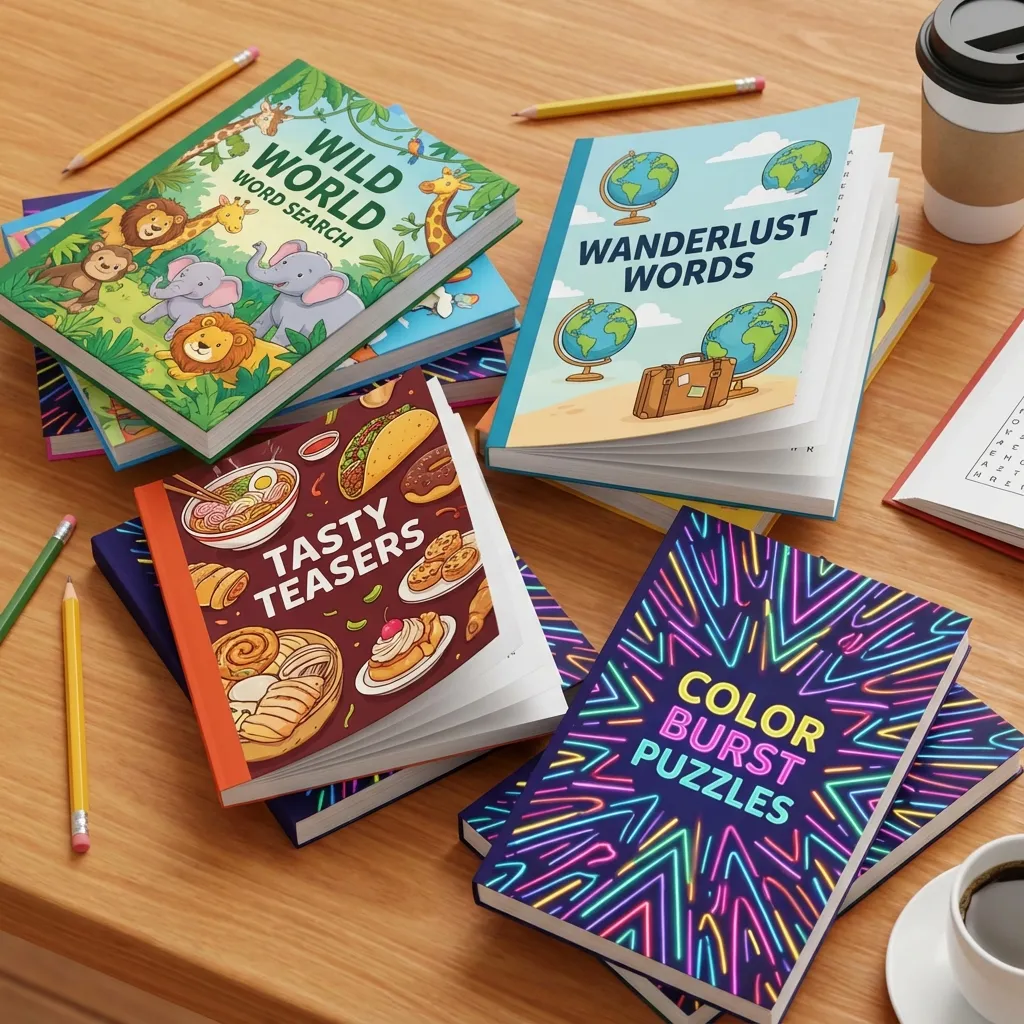
The single biggest difference between a word search book that earns ten dollars a month and one that earns a thousand is theme. Production quality matters, cover design matters, keyword stuffing matters at the margin. None of them matter half as much as the question, "is this a topic the buyer cares about enough to want a whole book of puzzles on it?" This guide is the working playbook for finding those topics: evergreen anchors, seasonal velocity plays, niche collector goldmines, and demographic compound themes, plus the exact research workflow we use to validate every theme before committing a single page.

The four theme families that actually move on KDP
Every word search book that sells consistently on Amazon falls into one of four theme families. Knowing which family a theme belongs to is the first step in pricing, timing the launch, and choosing a series strategy.
1. Evergreen interests
These are topics that sell every month of the year because the audience never disappears. Animals (especially specific dog and cat breeds), food and cooking, sports, nature, and travel anchor the evergreen family. The trade-off is competition density: the categories are well known so the saturation is real. You win by niching down two levels and pairing with a demographic axis.
2. Seasonal and holiday themes
Short windows of high velocity. Christmas, Halloween, Easter, Valentines Day, summer beach themes, fall autumn themes. The math here is different: a single Christmas word search book can do six months of an evergreen book's revenue in November and December alone, then go quiet. The trick is publishing six to eight weeks before the peak buying window so Amazon has time to index and the listing accumulates first reviews.
3. Niche collector themes
Hobby-coded topics that the audience identifies with. Quilting, knitting, gardening, fishing, golfing, beekeeping, woodworking, photography, vintage cars, sailing, fly tying. These are the highest leverage themes because most KDP publishers cannot fake the vocabulary. A quilter immediately spots a generic word list that confuses "applique" with "stippling". A fly fisherman knows the difference between a Royal Wulff and a Parachute Adams. Authentic theme execution earns repeat purchases.
4. Demographic themes
Buyer-coded themes that target a specific audience rather than a specific subject. Large print for seniors, word search for men, word search for women over 50, retirement gift word search, word search for teens. These themes work best when stacked with a topic theme (e.g., "Word Search for Men - Vintage Cars Edition"). Pure demographic books struggle because they are too broad.
Why solo themed volumes beat mixed bags
A "100 puzzles, 100 themes" sampler reads as filler to the audience because the buyer cannot find a coherent reason to recommend or gift it. A "100 puzzles, all gardening" book becomes a defined object: it is a gift for the gardener in your life, it is a book the buyer can show a friend, it has emotional clarity. The data backs this up. Across the top 200 word search ASINs we audited in early 2026, solo themed books generated roughly 3x the sales of generic mixed-theme titles at the same price point.
Evergreen theme deep dive: where the steady money lives
Six evergreen anchor themes produce most of the all-year royalty volume in the word search niche. Each one needs at least one level of niching to escape the saturated top of the category.
Animals: specific breeds win, generic loses
"Animals Word Search" has thousands of competitors. "Golden Retriever Word Search" has fewer than fifty. The breed level is where the niche economics work. Dog breeds, cat breeds, horse breeds, and bird species each have committed audiences that buy on identity. Pair with a demographic axis (large print for seniors, gift edition for dog moms) and you compound the advantage. Our guide on the best word search generators for KDP covers the production side.
Food and cooking: passion category, low competition
Surprisingly underserved relative to the audience size. Italian cuisine, French baking, BBQ and grilling, wine varietals, coffee culture, chocolate making, spice and herb vocabulary, holiday cookies. Sub-segment by cuisine, by technique, or by ingredient family. Cross-promote with cookbook readers on the same niche.
Sports: time it to the season
Baseball, football, soccer, golf, basketball, hockey, tennis, NASCAR, Olympics. Sports themes have predictable annual rhythms. Publish a football word search in August, baseball in March, hockey in September. Avoid using team names or trademarked logos. Use generic sport vocabulary: positions, equipment, terminology, famous stadiums.
Nature: educational lift, homeschool tailwind
Trees, flowers, butterflies, backyard birds, weather terms, rocks and minerals, the night sky, dinosaurs, mountain peaks. Strong with homeschool parents, retirees, and outdoor enthusiasts. Pair with regional specificity: "Birds of the Pacific Northwest", "Wildflowers of the American Southwest". Regional theming halves the competition in any nature category.
Travel and geography: armchair travelers buy in series
US states and capitals, European cities, world landmarks, national parks, cruise destinations, road trip routes. The armchair traveler audience overlaps strongly with the senior gift buyer described in our large print word search for seniors guide. Build a series by destination ("Route 66 Road Trip", "European River Cruises", "American National Parks Volumes 1 to 4").
Music and entertainment: stay in fair-use territory
Classical composers (public domain figures), jazz musicians, country music vocabulary, Broadway musical genres, classic Hollywood era films, golden age TV genres. The key is to reference categories, eras, and public figures, never trademarked properties or specific song titles. "Classic Country Music Word Search" is fine; "Top Country Songs of the 1990s Word Search" is asking for a takedown.
Seasonal themes: short windows, high velocity
Seasonal themes change the publishing math. Instead of steady all-year royalties, you are betting on a six to twelve week window of high concentration. Done well, a single seasonal title can outperform a full year of an evergreen book.

| Season | Peak window | Publish by | Theme angles |
|---|---|---|---|
| Christmas / Holiday | Oct - Dec (60% of annual) | Late August | Carols, decorations, traditions, foods, Nativity vocabulary |
| Halloween | Sep - Oct | Mid July | Costumes, spooky vocabulary, classic monsters, harvest themes |
| Easter | Feb - Apr | Mid January | Spring symbols, Bible vocabulary, traditional foods |
| Valentines Day | Jan - Feb | Late November | Love vocabulary, traditional gifts, romantic film genres |
| Summer / Beach | May - Aug | Mid March | Travel, beach, camping, summer foods, fishing |
| Thanksgiving | Oct - Nov | Mid August | Harvest, autumn vocabulary, traditional foods, gratitude |
| St. Patrick's Day | Feb - Mar | Mid December | Irish vocabulary, traditional symbols, folklore |
| Mother's Day / Father's Day | Apr - Jun | Mid March / Mid April | Family vocabulary, gift framing, hobby themes |
The publishing date in column three is roughly six weeks ahead of the start of the peak window. Six weeks is the minimum time Amazon needs to index a new title, accumulate the first dozen reviews, and start ranking for the seasonal keywords. Publish later and you miss the early shoppers; publish much earlier than that and the listing goes stale before the wave hits.
Generate seasonal puzzle books before the launch window closes
KDPEasy can produce a 60 puzzle themed book in an afternoon. The seasonal calendar does not wait.
Start freeNiche collector themes: where the margin actually is
Most KDP publishers chase the obvious themes. The publishers who quietly out-earn them work the niche collector shelves. The economics are simple: passionate hobby communities pay premium prices for content that gets their world right, and most competition is too generic to do that.
Quilting
American quilters spend an estimated $4 billion annually on the hobby. The vocabulary is rich and specific: applique, stippling, foundation paper piecing, log cabin, flying geese, batting weight, walking foot. A 60 puzzle quilting word search for a $9.99 price tag faces fewer than thirty direct competitors and gets passed around in Facebook quilting groups by word of mouth.
Gardening
The biggest hobby in the senior demographic. Subdivide by region (English cottage gardens, desert xeriscape, Pacific Northwest natives), by type (vegetable, herb, perennial border, pollinator garden), or by season (spring bulbs, summer annuals, autumn cleanup). Every sub-shelf has room for a thoughtful book.
Fishing
Strong male-skewing audience that buys hobby products in volume. Sub-segments include fly fishing (with its own deep vocabulary), bass fishing, saltwater fishing, ice fishing, kayak fishing, and species-specific (trout, salmon, bass, walleye). Fly fishing specifically has a small but rabid book buying community.
Golf
Recreational golfers buy gift books for each other constantly. Sub-segments by course type (links, parkland, desert), by famous courses (US Open venues are public domain references), by skill terminology, by equipment, by golf legends (public figures, not trademarked properties). Strong Father's Day window.
Other niche collector themes worth a look
- Knitting and crochet: stitches, yarn weights, patterns, fiber types. Loyal repeat buyers.
- Woodworking: joinery, hand tools, wood species, furniture styles.
- Beekeeping: small but rabid audience, almost no competition.
- Birdwatching: overlaps with both nature and hobby categories.
- Photography: equipment, composition vocabulary, photographer names.
- RV and camping: retirees buy stacks for road trips.
- Coin and stamp collecting: aging hobby with hardcover gift potential.
- Model trains: niche but passionate intergenerational audience.
Adjacent vocabulary: how to do TV and film themes legally
TV and movie themes are a perpetual gray area. Specific titled shows are trademarked. But the vocabulary world a show lives in is usually fair game. The trick is to theme around what the show is about, never around the show itself.
Adjacent vocabulary in practice
Instead of building a word search around a specific show, build around the world that show inhabits:
- Not safe: "Yellowstone Word Search" - trademarked show title.
- Safe: "Modern Ranch Life Word Search - Cattle, Cowboys, and Western Vocabulary".
- Not safe: "Downton Abbey Word Search" - trademarked.
- Safe: "Edwardian Country House Word Search - Servants, Manors, and Aristocracy".
- Not safe: "Friends Word Search" - trademarked.
- Safe: "Classic 1990s Sitcom Vocabulary Word Search - Coffee Shops, Apartments, and Office Life".
The viewer who loves the show finds the adjacent book naturally through Amazon's recommendation engine because shoppers who bought the trademarked-adjacent book also bought your safe one. No takedown risk.
Demographic themes: stack them, do not isolate them
A pure demographic theme is too broad. "Word Search for Men" hits a 100 million person audience and competes with hundreds of titles. The leverage comes from stacking demographic and topic axes together.
Men-targeted themes
- "Word Search for Men - Vintage Cars Edition"
- "Word Search for Men - Fishing and Hunting"
- "Word Search for Dad - Classic Sports Edition"
- "Word Search for Retired Men - Golf and Gardening"
- "Father's Day Word Search - Tools, Woodworking, and BBQ"
Women-targeted themes
- "Word Search for Women - Garden and Wildflower Edition"
- "Word Search for Women Over 50 - Classic Films Edition"
- "Word Search for Moms - Family and Home Edition"
- "Mother's Day Word Search - Tea, Roses, and Memories"
- "Word Search for Book Club Women - Classic Literature"
Retiree-targeted themes
- "Word Search for Retirees - Travel Destinations"
- "Retired Life Word Search - Hobbies, Grandchildren, and Quiet Mornings"
- "Word Search for Snowbirds - Florida, Arizona, and the Southwest"
- "Word Search for the Newly Retired - Bucket List Edition"
Teen-targeted themes
- "Word Search for Teens - Skateboarding, Music, and Coffee Shops"
- "Word Search for Teens - Fantasy and Mythology"
- "Word Search for Teens - Science Fiction Worlds (Fair Use Vocabulary)"
- "Word Search for High School - SAT Vocabulary Practice"
Notice that every example above stacks at least one demographic axis with one topic axis. That compound positioning is the single most important framing trick in this niche. We unpack the audience side further in kids word search books on KDP, which uses the same stacked approach for younger readers.

The four step theme validation workflow
Every theme idea should pass these four checks before you commit. The full workflow takes roughly fifteen to twenty minutes per theme and saves you weeks of wasted production on a niche that does not have buyers.
Step 1: Amazon search results count
Search "[theme] word search" on Amazon Books. Note the total results count in the top left.
- Under 200 results: open shelf, low competition, but verify there is real demand in step 2.
- 200 to 2000 results: the sweet spot. Real demand, beatable competition.
- 2000 to 5000 results: saturated, requires sharper niching or a demographic stack.
- 5000+ results: avoid unless you have a unique angle.
Step 2: BSR check on the top ten results
Click into the top ten search results and scroll to the Product Details section. Look at the Best Sellers Rank in Books. If most of the top ten sit under BSR 100000 there is real money in the shelf. If the top ten are all BSR 500000 or higher, even the winners are slow.
Step 3: Review mining for unmet needs
Read the one, two, and three star reviews on the top five competitors. Look for repeated complaints. Common patterns include "fonts too small", "not enough variety", "puzzles too easy", "no answer key", "word list font is tiny", "themes did not match the title". Each repeated complaint is a feature spec for your version of the book.
Step 4: Amazon autocomplete to surface long tail phrases
Type your theme phrase slowly into Amazon's search bar without hitting enter. The autocomplete suggestions are the literal long tail phrases real shoppers type. Capture every variant. These become your title structure, your subtitle, your seven backend keyword slots, and your A+ content phrasing. We cover this in much more depth in our KDP keyword research guide.
The four factor scoring shortcut
After running the four step workflow, score the theme on these four factors (1 to 5 each). Total 15 or more = publish.
- Passion - Will buyers identify with this topic enough to recommend the book?
- Searchability - Do real shoppers search for this on Amazon and Google?
- Competition gap - Are existing books mediocre? Are reviews complaining?
- Longevity - Will the theme still be relevant in two to three years?
Worked example. "Quilting Word Search for Senior Women". Passion 5/5 (quilters are fanatic). Searchability 4/5 (steady volume). Competition gap 5/5 (under 30 competitors and most are generic). Longevity 5/5 (quilting is timeless). Total 19/20. Publish it.
Building a theme pipeline instead of a one-off
One well-validated theme is a good first book. A pipeline of validated themes is a business. The publishers who build steady five-figure monthly royalty curves do not pick one or two themes and milk them; they run a continuous validation pipeline and ship the winners.
The 10-theme worksheet
Keep a running list of ten candidate themes at all times. Each theme has the four validation scores beside it. Every Friday, retire the lowest scorer and add a new candidate. By month three you have a queue of pre-validated themes ready to publish. By month six the calendar is a deliberate cadence of seasonal launches, evergreen anchors, and niche collector experiments.
The annual rhythm
A realistic year for a single publisher looks like two evergreen flagship launches (typically Q1 and Q3), four seasonal launches timed to the calendar (Valentines, Easter, Halloween, Christmas), and three to four niche collector experiments at any point in the year. That is roughly ten to twelve titles, which is sustainable solo, and produces the diversified royalty curve that survives Amazon's algorithm changes.
Validate themes faster than your competitors
KDPEasy ships with theme-coded word lists and pre-validated niche seeds. Pick a theme, generate a book, watch the validation work itself out in market.
Get startedTheme mistakes that quietly kill royalty curves
Eight theme mistakes to avoid
- Too broad. "Animals" or "Food" alone is competition suicide.
- Too obscure. "17th century Flemish painters" has no search volume.
- Trademarked properties. Specific TV shows, branded characters, sports teams, song titles.
- Negative emotional valence. Medical conditions, mortality, divorce. Word search is a pleasure object.
- Topical themes that age out. Cryptocurrency 2022. Pandemic vocabulary 2020. Current memes.
- Patronizing demographic framing. "Easy puzzles for elderly people" reads as condescending.
- Mixed bag samplers. 100 puzzles, 100 themes loses to 100 puzzles, one theme.
- Theme that requires illegal use. Lyrics, scripts, dialogue, character names. The KDP content guidelines will catch this.
Where to go next
Theme is where the commercial decisions live. Production quality matters, distribution matters, but if the theme is wrong nothing else compensates. Run the four step validation workflow on every idea before you commit a single page. Build a 10-theme pipeline so you are never short of validated options. And remember the single biggest rule: solo themed volumes beat mixed bags every time.
For the production side, see our full word search puzzle book creation guide and the puzzle book interior formatting playbook. For the listing side, the keyword research guide pairs naturally with the validation workflow above.
A FEW MORE ANSWERS
Frequently asked questions
Four theme families dominate the bestseller lists: evergreen interests (animals, food, sports), seasonal and holiday themes (Christmas, Halloween, Easter, summer), niche collector themes (quilting, gardening, fishing, golf, specific dog breeds), and demographic themes (large print for seniors, word search for men, retiree gift editions). The single best move you can make is picking a solo theme rather than a 100 mixed themes sampler. Solo themed volumes outsell mixed bags roughly 3 to 1.

ABOUT THE AUTHOR
Danielle Okonkwo
Marketing & Growth Lead at KDPEasy. Danielle is a published author with 12+ titles on Amazon KDP and a former book blogger. She draws on hands-on publishing experience and years of testing what works in the KDP marketplace.
Meet Danielle