

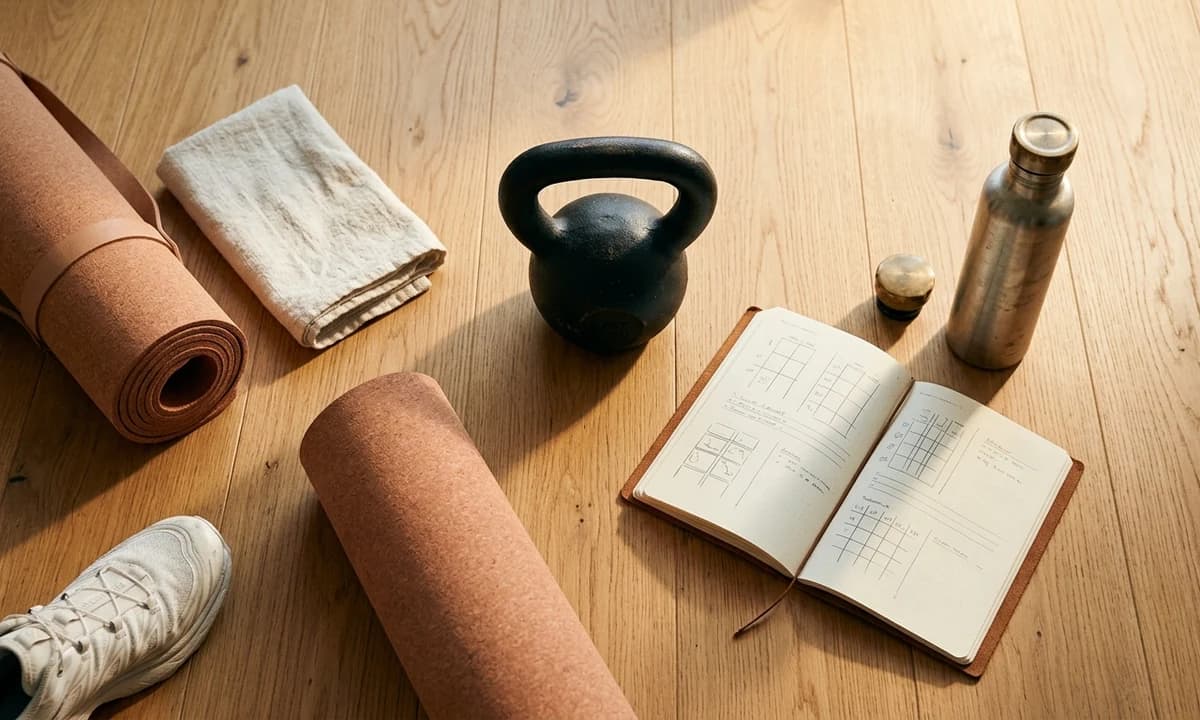
Fitness and health is a top three evergreen KDP niche with a $2.5 billion annual category footprint on Amazon and predictable January and September demand spikes. The catch in 2026: credibility expectations have hardened, photo quality cuts both ways, and the journal companion strategy quietly outperforms standalone program books. This guide is the operator playbook: niches that still work, the credibility framework, photo vs illustration economics, and a tested AMS launch sequence.
Why fitness and health remains a top three KDP category
Fitness behaves differently from most KDP niches because buyer intent is unusually high and unusually seasonal. People do not browse fitness books. They search them, after a doctor appointment, a New Year resolution, an injury, or a specific goal. That gives the category three structural advantages: predictable seasonal spikes (January up roughly 340 percent on average, September spike of 120 to 180 percent), high conversion rates (buyers are pre-qualified by the search query), and willingness to pay premium prices ($16.99 to $24.99 is normal here).
The 2026 catch: the category has become harder to win on author credibility alone. Reviewers read bios. Buyers screenshot certifications. AI-generated programs are spotted instantly. The path forward is either real credentials (NASM, ACE, ISSA, NSCA, certified PT) or a specific personal story that targets a specific audience. Generic "fitness for everyone" without either is the death zone of this niche.
The fitness category in one paragraph
KDP fitness and health does over $2.5 billion annually on Amazon across paperback, hardcover, and Kindle. Successful niche-specific books regularly earn $500 to $2,500 per month. Top-performing fitness journals (low-content) clear $3,000 to $8,000 per month. January surges +340 percent, September +150 percent. Repeat purchase rate among fitness buyers is high: they buy guides, journals, meal plans, and cookbooks in the same category.
The sub-niches that still work in 2026
Generic "weight loss" or "home workouts" is dead at the top of the category. What still works are narrow sub-niches built around method, audience, goal, or sport. Below is the current map.
Strong sub-niches (still rankable, growing or stable)
- Senior fitness: especially women 60+, balance and falls prevention, gentle strength. One of the highest-margin under-served audiences in the category.
- Kettlebell: enthusiast audience, premium pricing, low ad competition. Niche by goal (kettlebell for fat loss, kettlebell for posture).
- Mobility and flexibility for desk workers: remote-work driven demand. Stretches at the desk, hip mobility for sitters.
- Post-injury rehab: knee, shoulder, back, ankle, hip. Highest credibility threshold but also highest willingness to pay.
- Calisthenics: bodyweight-only, equipment-free. Strong with millennial men and beginners.
- Walking for weight loss: under-built versus search demand. Strong with 50+ audience.
- Sport-specific strength: golf, tennis, running, cycling, hiking. Crossover with hobby niches.
Saturated but viable with specificity
- Women's strength: dominated by big publishers, but rankable for specific audiences (over 40, postpartum, perimenopause).
- Home workouts: still has demand but requires equipment differentiation (resistance bands only, dumbbells only, no equipment).
- Beginner programs: works only if the beginner is specific (beginner over 50, beginner after injury, beginner with limited time).
- Marathon training: premium audience, willing to pay $24.99+.
Avoid
- Generic "lose 20 pounds fast" books. Algorithmic suspicion plus saturated.
- Abs-only or six-pack books. Audience is mostly browsing free YouTube content.
- Celebrity-style transformation books without a credibility anchor.
- Generic "fitness for everyone". The "everyone" niche serves no one.
Credibility: the framework that wins in 2026
Buyers in this category audit author credibility before purchase, especially for programs targeting health outcomes. There are three viable credibility paths. Pick one and lean into it on the cover, in the bio, and in the marketing.
Path 1: credentials
Recognized certifications carry weight: NASM (National Academy of Sports Medicine), ACE (American Council on Exercise), ISSA (International Sports Sciences Association), NSCA (National Strength and Conditioning Association), and licensed physical therapy or registered dietitian credentials for nutrition. If you have any of these, put them on the cover and bio prominently. They lift conversion 15 to 30 percent in cold traffic.
Path 2: personal story + specific case
If you do not have certifications, the working alternative is a personal story tightly matched to the audience: "I lost 65 pounds at 55 after my knee replacement". That story does not qualify you for everyone, but it qualifies you completely for the audience that shares your case. Niche down hard and your story becomes the credential.
Path 3: research and compile with expert review
If you have neither credentials nor a story, the working path is editorial: research thoroughly, write clearly, and pay a credentialed expert to review and contribute a foreword. This is the same model used by major fitness publishers. Expect to pay $300 to $1,500 for a credentialed forward and review.
The credibility test on the back cover
Before you publish, write your back cover bio. If it reads as generic ("I have always been passionate about health") you are in the death zone. If it includes a specific credential, a specific transformation, or a specific case ("former physical therapist for the Olympic ski team"), you have a viable book.
Generate a fitness book cover that signals credibility
KDPEasy renders fitness covers with the strong typography, athletic palette, and credentials placement this category demands.
Start free with KDPEasyPhoto vs illustrated exercises: the visual decision
Exercise visuals are the single most expensive production decision in a fitness book. Three strategies work. Two of them produce books that sell. One of them looks amateur and quietly kills your conversion rate.
Illustrated exercises (the dominant 2026 standard)
Line art or stylized vector illustrations of each exercise, typically showing two key positions (start and end) plus a directional arrow. Works in B&W which protects your print margin. Consistency is easy because one illustrator does the full set. This is what dominates the category in 2026.
- Cost: $300 to $1,200 for a 40 to 80 exercise set on Fiverr or Upwork.
- Time: 2 to 4 weeks.
- Trim: 7.5 x 9.25 or 8 x 10 inches.
- Retail: $16.99 to $22.99 standard paperback.
Photo demonstrations (high reward, high cost)
Real photographs of a model performing each exercise. The bar is professional: consistent background, consistent lighting, consistent attire, multiple angles for complex movements. If you can hit that bar, photo books look more authoritative than illustrated and justify premium pricing. If you cannot, illustrated wins every time.
- Cost: $1,000 to $4,000 (model fee, location, photographer, editing).
- Time: 3 to 6 weeks.
- Retail: $22.99 to $29.99 paperback, $29.99+ hardcover.
- Risk: inconsistent or amateur photos actively damage conversion.
Text-only with bold typography
No visuals, just clear written cues, structured tables, and disciplined whitespace. Works for quick reference guides, mobility protocols, and theory-heavy books. Rarely works for program books with novel exercises.
- Cost: under $200.
- Retail: $11.99 to $16.99.
- Risk: program-style buyers expect visuals. Use this only for advice or theory books.
The journal companion strategy (the quiet winner)
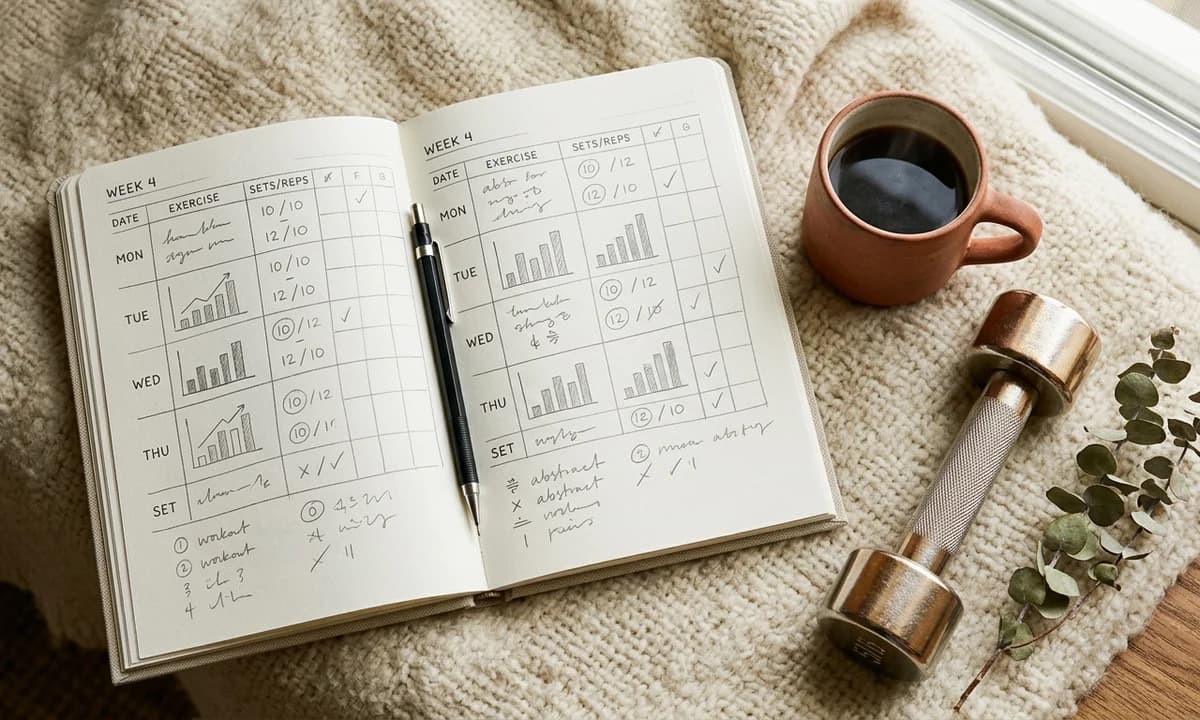
The single most under-deployed strategy in KDP fitness publishing is the journal companion. A fitness journal is a low-content book: 90 to 130 pages of repeating templates that the reader fills in. Production cost is essentially zero after the design phase. Royalty per copy is similar to a content book because of low print cost. And here is the key: journal buyers convert from program book buyers at high rates through Amazon also-boughts.
The pattern most successful publishers use:
- Publish one program book (the content anchor) at $19.99.
- Publish a matching journal designed specifically for that program at $9.99.
- Cross-link them in the back matter of each.
- Run AMS on the program book primarily. Journal sells through also-boughts.
- After 90 days, publish 2 or 3 more journals (different formats, same audience) to compound.
Top-performing fitness journal publishers run a 3:1 or 4:1 ratio of journals to content books. Some run pure-journal catalogs that clear $5,000 to $15,000 per month with no content books at all. The reason: journals have 80 to 90 percent margin and chronic demand from the same buyers who buy program books.
Interior features that consistently sell
Top-selling fitness and health journals share a predictable feature set. If you are designing a journal interior, include most of these:
- Daily workout log: exercise, sets, reps, weight (or duration), notes column.
- Weekly volume tracker: total sets per muscle group or total active minutes.
- Body measurement chart: weight, chest, waist, hips, arms, thighs. Body fat optional.
- Progress photo placeholders: framed boxes labeled front, side, back at weeks 1, 4, 8, 12.
- Sleep and recovery tracker: hours slept, energy 1 to 10, soreness 1 to 10.
- Water intake tracker: hash marks or droplet icons.
- Optional calorie or macro tracker: dedicated journals can include this; combined journals usually skip it.
- Weekly reflection prompts: 3 short prompts at the end of each week.
- 12-week or 90-day framework: built-in deload weeks at weeks 4, 8, 12.
For a deeper breakdown of journal interior design and sourcing, see our guide on publishing journals on Amazon KDP.
Pricing tiers and royalty math
| Format | Pages | Retail | Approx royalty (60% B&W) | Sales for $1k / month |
|---|---|---|---|---|
| Quick guide | 80 | $12.99 | ~$5.96 | ~168 |
| Complete program | 150 | $19.99 | ~$9.13 | ~110 |
| Comprehensive reference | 250 | $24.99 | ~$11.14 | ~90 |
| Fitness journal | 120 | $9.99 | ~$4.55 | ~220 |
| Premium journal | 180 | $14.99 | ~$6.85 | ~146 |
The bundle strategy that consistently wins: publish a $19.99 program plus a $9.99 matching journal. A buyer who picks up the program for $19.99 plus the journal for $9.99 generates about $13.50 in combined royalty per attached purchase, versus $9.13 from the program alone. That 50 percent revenue uplift per buyer is why journal companions are the quiet weapon in this category.
The Amazon Ads (AMS) launch framework
Fitness is a competitive category on Amazon Ads, but it is also a category where ads have a clear path to profitability because conversion intent is high. Here is the launch framework most successful publishers in the category run.
Days 0 to 14: discovery
- Sponsored Products Auto-targeting: $5 per day, default bid $0.50. Let Amazon discover keywords.
- Sponsored Products Manual Exact: $5 per day on 10 to 15 niche-specific keywords. Default bid $0.50 to $0.80.
- Goal: learn which keywords drive impressions and conversions. ACOS will be high (80 to 120 percent). That is fine.
Days 14 to 45: optimization
- Negate keywords with high spend, zero sales.
- Move converting keywords from auto to manual exact at higher bids.
- Add Sponsored Products Product Targeting on 30 to 50 competitor ASINs. $5 per day.
- Add Sponsored Products Category Targeting on your two top categories. $3 per day.
Days 45 to 90: scale or hold
- If ACOS is at 30 to 50 percent, scale daily budgets 25 percent every 7 days.
- If ACOS is above 60 percent, hold budget and refine bids.
- Add Sponsored Brands if you have a series (3+ books).
For a deeper breakdown of the AMS strategy applied across nonfiction, see our Amazon Ads for KDP strategy guide and the AMS keyword research playbook.
Structuring the program book
Most successful fitness program books follow the same structural arc. Use it. Buyers in this category expect a predictable rhythm.
- Introduction (4 to 8 pages): who this is for, what to expect, the author's qualification or story.
- Foundations chapter (8 to 12 pages): principles, warm-up, safety, equipment needed.
- Exercise library (30 to 50 pages): each exercise with illustration, instructions, common mistakes, modifications.
- Programs (40 to 80 pages): beginner, intermediate, advanced. Or 4-week, 8-week, 12-week.
- Nutrition chapter (8 to 15 pages): principles that support the training goal. Macros optional.
- Recovery and troubleshooting (6 to 12 pages): sleep, mobility, plateau breaking, common injuries.
- Tracking pages (4 to 10 pages): at minimum, a basic workout log. Better: a 12-week log.
- Appendix and resources: exercise index, conversion charts, recommended further reading.
The exercise template (every exercise, same structure)
- Exercise name and muscle group.
- Starting position (specific body cues).
- Movement (specific cues, breathing).
- Common mistakes to avoid (3 to 5 bullets).
- Modifications (easier, harder).
- Recommended sets, reps, or duration.
- Illustration showing two positions.
Cover conventions for fitness books
Fitness covers have stricter conventions than most nonfiction categories. Buyers scan the thumbnail in a 1.5-second window and look for three things: a strong typographic title with the specific benefit, a visual that signals the method or audience, and a credibility marker (certification, number of weeks, "doctor recommended" type sticker).
What works
- Bold sans-serif title: large, high contrast, single-line headline.
- Subtitle with audience and benefit: e.g. "12-Week Strength Program for Women Over 50".
- Visual: a single subject (the model, a kettlebell, an exercise silhouette) or a clean typographic system if you cannot get good photography.
- Color palette: high-energy options (red, orange, green for action) or calm options (navy, sage, cream for senior or rehab niches). Match the audience.
- Credibility sticker: certification logo, week count, or "doctor approved" style banner if accurate.
What fails
- Stock-photo gym shots with generic models.
- Photoshop-heavy "before and after" cover shots that read as scammy.
- Cluttered covers with five competing elements.
- Soft pastel palettes for programs aimed at men under 40 (audience mismatch).
For the broader cover design principles in nonfiction, see our perfect KDP cover guide. For series cover systems that compound, read book series cover design.
Build a fitness book + journal series cover system
Generate matched covers for your program book and journal companion in minutes with KDPEasy.
Try the cover generatorCommon mistakes that kill fitness books
The seven most expensive fitness book mistakes
- Generic positioning: "fitness for everyone" reaches no one. Niche by audience, method, or goal.
- No credibility anchor: missing certifications, no specific story, no credentialed reviewer. Conversion suffers in cold traffic.
- Amateur photos mixed with illustrations: visual inconsistency is the single fastest way to look self-published.
- Skipping medical disclaimers: legal risk and reader expectation. Required on every health book.
- Text-only program books: program buyers expect visuals. Text-only is fine for theory, fatal for programs.
- No journal companion: leaving 30 to 50 percent of audience revenue on the table.
- Wrong trim size: 6 by 9 inches crushes exercise illustrations. Use 7.5 by 9.25 or 8 by 10.
The 10-week launch sequence
- Week 1: niche audit. Pick audience, method or goal, and credibility path. Confirm rankability via competitor BSR and review counts.
- Week 2: outline and exercise list. Lock the program structure, exercise count, and journal pairing decision.
- Week 3 to 5: writing. Draft program chapters, exercise library, and supporting content.
- Week 6 to 7: illustration commission or photo shoot. Format manuscript.
- Week 8: cover design, back cover copy, journal companion interior design.
- Week 9: proofread, recipe and program review by a credentialed friend or hired expert, upload to KDP.
- Week 10: launch ads at $10 to $20 per day. Request early reviews from beta readers. Begin planning book 2 or journal 2.
What to publish next
Once your first fitness book is live, the highest-leverage next move is the journal companion (if you did not launch with one), then the second book in the same audience but addressing a different goal. After three titles for the same audience, you have a series that compounds through Amazon also-boughts and a credibility footprint that lifts conversion on every new title.
For broader nonfiction context, read the nonfiction books on KDP guide. For the niche research process that filters bad ideas before you commit, see the KDP niche research system. Many fitness publishers also publish meal prep companion books - our meal prep books guide covers that adjacent niche.
A FEW MORE ANSWERS
Frequently asked questions
No, but credibility is more important here than in any other nonfiction category. Buyers read author bios and reviews for credentials, especially for programs targeting weight loss or rehabilitation. If you have a certification, lead with it in the bio and on the back cover. If you do not, lean on a specific personal story (lost 60 pounds, ran a marathon at 50, recovered from a knee surgery) and let the program target your exact case. Generic "fitness for everyone" without credentials reads as low-trust.

ABOUT THE AUTHOR
Danielle Okonkwo
Marketing & Growth Lead at KDPEasy. Danielle is a published author with 12+ titles on Amazon KDP and a former book blogger. She draws on hands-on publishing experience and years of testing what works in the KDP marketplace.
Meet Danielle