

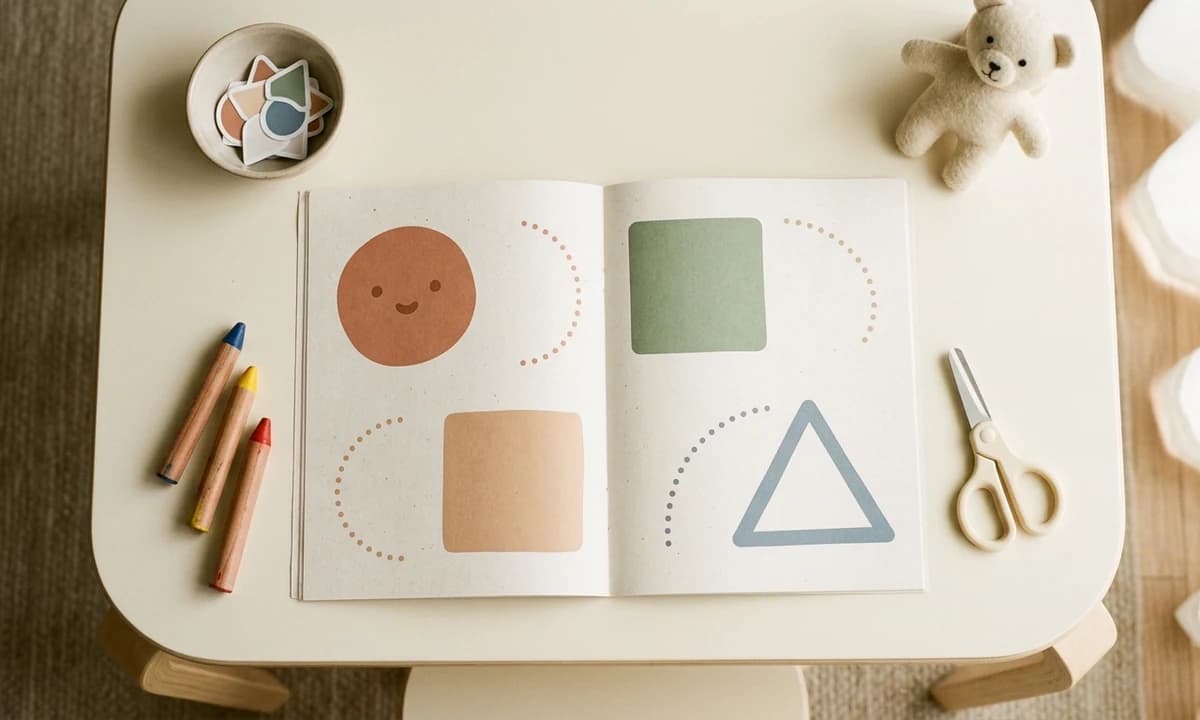
Preschool workbooks are the highest-volume kids non-fiction category on Amazon. They sell year-round to parents, every August to September for the back-to-school surge, every May to June for summer learning, and steadily in between as gifts, screen-time alternatives, and homeschool curriculum. The shelf is also one of the most competitive on KDP, which means there is no room for shortcuts. This guide breaks down the exact subject coverage, page conventions, pricing, cover system, and rejection traps for designing a preschool workbook that parents trust and Amazon promotes in 2026.
What "preschool workbook" actually means on Amazon
The preschool shelf is not a single market. Parents search with very specific age and skill phrasing, and Amazon's algorithm treats each phrasing as a distinct cluster:
- Toddler workbook (ages 2 to 3): Big stickers, simple matching, color and shape recognition. Less writing.
- Preschool workbook (ages 3 to 5): The volume center. Letter recognition, number 1 to 20, tracing, shapes, colors, fine motor.
- Pre-K workbook (ages 4 to 5): Overlaps with preschool but skews toward sight words and writing.
- Kindergarten prep workbook (ages 4 to 6): All-in-one. Letters, numbers, math to ten, scissors, beginning sounds.
- Kindergarten workbook (ages 5 to 6): Different shelf. Now school-aged. Sight words, addition, full sentences.
Pick one band per book. A "Ages 2 to 6 Workbook" is the single most common amateur mistake. It tries to please every parent and signals to all of them that the book is unfocused.
The ten subject domains a preschool workbook can cover
A complete ages 3 to 5 workbook draws from ten skill domains. An all-in-one covers six to eight. A single-subject deep dive covers one. Both are valid product strategies. The ten:
- Letter recognition and tracing. Uppercase first, lowercase second. A to Z, one letter per spread, with a featured illustration of an object that starts with the letter.
- Numbers 1 to 20 and counting. Number recognition, counting objects, tracing the numeral. Visual counting (count five apples) beats abstract math at this age.
- Basic shapes. Circle, square, triangle, rectangle, oval, diamond, star, heart. Recognize, trace, find in a scene.
- Colors and color sorting. Eight to ten primary and secondary colors. Match objects to their color, sort by color.
- Opposites. Big/small, in/out, up/down, hot/cold, happy/sad, fast/slow. Vocabulary plus visual reasoning.
- Patterns. Simple AB (red blue red blue) and ABC (red blue green red blue green). Continue the pattern is the standard task.
- Basic math to ten. Counting plus visual addition (3 apples plus 2 apples), one-to-one correspondence, simple subtraction (cross out 2 of 5).
- First sight words. Dolch Pre-Primer list (a, and, away, big, can, come, down, find, for, go) tied to large illustrations.
- Scissor skills. Straight lines, curved lines, simple shapes to cut out. Build fine motor control.
- Pre-writing fine motor strokes. Vertical lines, horizontal lines, diagonals, circles, waves. Foundation for handwriting later. For the full deep dive on letter writing, see our handwriting practice books for KDP guide.
Page conventions: one task, big and bold
The single biggest design difference between a preschool workbook that earns and one that bounces is page density. A 3 to 5 year old has roughly thirty seconds of focused attention per task. The page has to communicate the activity instantly.
The single-task rule
- One task per page. Not three. Not "complete the page". One thing to do.
- One large illustration as the anchor. Minimum 3 inches at its widest dimension. Some pages should fill 60 to 70 percent of the available space with one big image.
- One short instruction. "Trace the letter A." "Color the circle red." "Count the bears." 18 to 24pt rounded sans-serif. Parents read the instruction aloud; the words are not for the child.
- Three to five visual elements maximum. A counting page with three apples works. The same page with twelve apples becomes chaos at this age.
- Generous white space. Twenty-five percent of the page should be empty. White space is the cue that says "this is preschool, not first grade".
Typography conventions
- Instruction text: Rounded sans-serif (Nunito, Quicksand, Poppins, Comic Neue), 18 to 24pt, 1.5 line height, sentence case.
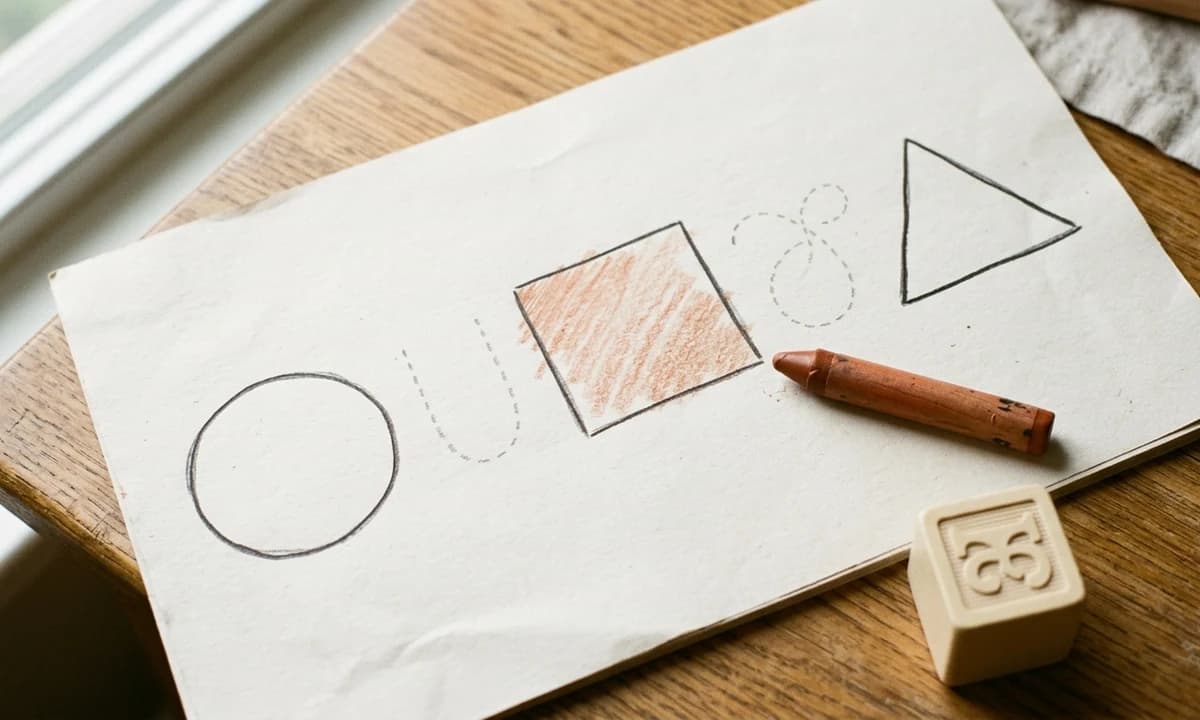
- Featured letter or number: Bold sans-serif at 5 to 7 inches tall, dotted outline for tracing pages, solid outline for coloring pages.
- Page number: 10 to 12pt, bottom outer corner. Not necessary on every page (some publishers skip them for cleanliness; either choice is fine).
- Avoid: Cursive script anywhere on the page (a preschooler cannot read cursive), italic body text, justified columns, decorative letter pairs in the title.
Line and outline weights
Outlines on illustrations need to be thick enough to read at a glance and survive print-on-demand. Use 3 to 5 pt outlines on coloring pages and 4 to 6 pt on featured letter and number outlines for tracing. Thinner lines (1 to 2 pt) work only for fine details inside an illustration, never as the main shape outline.
Color, paper, and the economics of B&W versus full color
This is the single most consequential business decision for a preschool workbook. Get the color choice right and the royalty math works. Get it wrong and the book either prices itself off the shelf or earns less than a coloring book despite being twice as much work.
Approximate KDP print cost per page (US, 2026)
- Black and white, standard paper, 8.5 by 11 inches: roughly $0.012 per page
- Black and white, premium paper, 8.5 by 11 inches: roughly $0.015 per page
- Premium color, 8.5 by 11 inches: roughly $0.065 per page (more than four times B&W)
On an eighty-page book that means: B&W production cost is roughly $0.96, full color is roughly $5.20. At a $9.99 list price, the B&W book earns about $5.03 in 60 percent royalty (rough math), the full-color book earns about $0.79. The color version has to sell at $13.99 plus before the math even rounds to comparable.
The recommended approach: B&W line art plus selective spot color
Most successful preschool workbooks in 2026 are printed entirely in black and white but designed to feel colorful through layout. Techniques that work:
- Bold black line art on every illustration, giving the child the option to color it themselves.
- Color-the-shape activities where the page shows "color the circle red" with empty outlines. The child does the color work. The book stays cheap to print.
- Greyscale shading for depth, used sparingly. Adds polish at no extra print cost.
- Solid black accent shapes (filled silhouettes for "find the bird" pages, for example). Visually punchy without color.
Paper choice
- KDP white 60 lb standard: Default for B&W preschool workbooks. Best contrast for line art, cheapest production.
- KDP cream 55 lb: Skip for preschool. Lower contrast on line art reads as washed-out to parents flipping the Look Inside.
- KDP premium color 60 lb: Only if you actually print color throughout. Adds significant cost.
Page count strategy
Sixty to one hundred pages is the practical range. Eighty is the sweet spot. The page count math:
| Page count | Reads as | Best for |
|---|---|---|
| 40 to 50 pages | Pamphlet, low-content | Stocking stuffers, $4.99 to $6.99 price point |
| 60 to 70 pages | Single-subject focused | ABC tracing, numbers 1 to 20, shapes only. $6.99 to $8.99. |
| 80 to 90 pages | Comprehensive preschool workbook | The sweet spot. Multi-subject all-in-one. $7.99 to $10.99. |
| 100 to 120 pages | Kindergarten prep, premium | All-in-one with kindergarten skills. $10.99 to $14.99. |
| 140 plus pages | Curriculum bundle | School-year workbook. Less common direct-to-consumer. $14.99 to $19.99. |
Cover conventions parents actually trust
A preschool workbook cover is sold to the parent in a 200-pixel thumbnail. Every successful cover in 2026 follows the same three-element formula.
- Animal mascot. A friendly bear, owl, fox, bunny, or panda holding or pointing at the workbook idea. The mascot does the emotional work. Avoid human child illustrations (they introduce ethnicity decisions that narrow the audience) and avoid generic clip art (immediately reads as low effort).
- Bold rounded sans-serif title. Large enough to read at thumbnail size. Title above the mascot, age band below or in a colored pill in the upper corner. Typefaces that work: Fredoka, Baloo 2, Nunito Black, Recoleta SemiBold.
- Age band displayed prominently. "Ages 3 to 5" or "Pre-K Workbook" or "Preschool Activity Book Ages 3-5". Make it impossible to miss. The age pill is the single highest converting cover element.
Color palette
- Soft pastels with one warm accent: Cream background, soft sage or dusty blue mascot, terracotta or warm coral title color. Calm and parent-trustable.
- Bright but limited: Two saturated colors plus white. Yellow and teal. Coral and navy. Avoid more than three colors.
- Avoid: Rainbow gradients, neon, glitter overlays, photographic backgrounds, candy-colored chaos. These read as low quality on the preschool shelf.
For more on what makes children's covers convert specifically, see our kids picture books guide. For the full technical cover spec (bleed, spine, resolution), follow the KDP cover requirements checklist.
Get a parent-trustable cover in minutes
Generate preschool workbook covers with the right mascot energy, age pill, and KDP-ready bleed dimensions. Series templates supported.
Start freeActivity progression: the four-arc model
A preschool workbook should not feel like a flat list of activities. It should feel like a journey. Parents and kids both respond to clear forward progression. The four-arc model maps a child from "just turned 3" at page one to "almost 5" at page eighty.
Arc 1: Recognition (pages 1 to 20)
The lightest cognitive lift. Identify, match, point to. Sample activities:
- Match the picture to the color word
- Find the circle on the page
- Point to the letter A in a row of letters
- Find the matching animal pairs
Arc 2: Tracing and coloring (pages 21 to 40)
The child starts producing marks on the page. Sample activities:
- Trace the letter A with dotted lines
- Color the shapes red
- Trace the dotted path from the bunny to the carrot
- Color by number (1 = red, 2 = blue)
Arc 3: Producing (pages 41 to 60)
The child writes, counts, and sorts on their own. Sample activities:
- Write the number 5 three times
- Count the bears and write the number
- Circle the small things in the picture
- Draw a line from the letter to the picture that starts with it
Arc 4: Combining (pages 61 to 80)
Two-step activities that combine earlier skills. Sample activities:
- Count the apples, then write the number below
- Color the shape with three sides red, the shape with four sides blue
- Simple maze: help the dog find the bone
- Continue the AB pattern by drawing the next two items
Insert a clean divider page between each arc (a full-page illustration with the arc title) so parents see the progression. This is a free credibility cue at the cost of four pages.

Pricing the shelf
Two distinct price shelves. B&W workbooks sit on the $5.99 to $9.99 shelf. Color workbooks sit on the $10.99 to $14.99 shelf. The mistake is putting a B&W workbook on the color shelf or vice versa.
| Workbook type | Page count | List price | Approx royalty (60 percent, US) |
|---|---|---|---|
| Single-subject B&W (ABC, numbers, shapes) | 60 to 80 pages | $5.99 to $7.99 | $2.50 to $3.80 |
| Multi-subject B&W (all-in-one preschool) | 80 to 100 pages | $7.99 to $9.99 | $3.80 to $5.00 |
| Kindergarten prep all-in-one B&W | 100 to 120 pages | $9.99 to $12.99 | $4.40 to $6.20 |
| Color workbook (mostly color interior) | 60 to 80 pages | $10.99 to $13.99 | $2.00 to $4.20 |
| Premium color all-in-one | 100 to 120 pages | $13.99 to $16.99 | $1.60 to $4.40 |
The royalty math assumes the 60 percent royalty option on expanded distribution at the list price minus per-page print cost (B&W $0.012, color $0.065). Use the KDP royalty calculator to plug in your exact specs. For more on shelf-pricing strategy across the kids categories, see our kids title pricing breakdown.
The common KDP rejection causes for kids workbooks
Amazon screens children's titles more aggressively than adult titles. The category is reputation-sensitive and parents complain loudly when low-quality books slip through. The recurring rejection and hold triggers:
- Copyrighted character on cover or interior. Even a "generic" cartoon mouse that resembles Mickey gets caught by brand matching. Use original illustrations or properly licensed stock. AI-generated art that closely mimics a known IP (Bluey, Peppa Pig, Disney princesses) gets flagged.
- Stock photography of real children. Requires model releases. KDP often holds these listings until rights are confirmed. Use illustration instead of photography.
- Cover bleed under 0.125 inch. Standard KDP requirement. The cover template enforces it. Skipping the template is the most common failure.
- Resolution under 300 DPI. AI-generated covers at 1024 by 1024 are usually below 300 DPI when scaled to a full 8.5 by 11 cover. Upscale before upload. See our guide on fixing blurry KDP covers.
- Misleading subtitle claims. "Common Core aligned", "Approved by the National Education Association", "Used by Pre-K teachers nationwide" require rights. Drop them unless you actually have the rights.
- Inappropriate content in the kids category. Any reference to violence, adult language, or mature themes even on a comparison page gets the book pulled. Read every page before upload.
- Subtitle stuffing. Cramming twenty keywords into the subtitle (Preschool Workbook Ages 3 4 5 Kindergarten Prep ABC Numbers Shapes Colors Toddler Pre K Activity Book For Kids Gift Christmas) gets the listing held for keyword spam.
Keyword strategy and title formulas
Preschool workbooks rank on a small set of high-intent searches. The keyword strategy is to win these directly rather than chase long-tail volume.
Core search terms to target
- preschool workbook ages 3-5
- pre-k workbook
- preschool activity book
- kindergarten prep workbook
- abc workbook preschool
- preschool learning workbook
- tracing workbook for kids ages 3-5
- preschool curriculum
- kindergarten readiness workbook
- preschool homeschool curriculum
For the deeper method on building this keyword set including reverse ASIN research, see our KDP keyword research guide.
Title formulas that convert
Title slot template for preschool workbooks
- Skill anchor (Preschool Workbook / Kindergarten Prep Workbook / Pre-K Activity Book)
- Age band, both formats (Ages 3 to 5 - Pre-K and Kindergarten)
- Subject list, two to four key subjects (Letters, Numbers, Shapes, Colors)
- Quantity cue (Over 80 Activities / 100 Pages)
- Optional bonus (Includes Tracing Practice / With Reward Stickers Page / Plus Certificate)
Example that uses every slot: "Preschool Workbook Ages 3-5: Pre-K and Kindergarten Prep with Letters, Numbers, Shapes, and Colors - Over 80 Activities and Tracing Practice".
Build the series, not just the book
One competent preschool workbook earns. A four-book series compounds. Get the cover system and age pills aligned across every book in minutes.
Generate covers freeBuilding the series: all-in-one first, then companions
The portfolio approach that earns:
- Book 1: Preschool Workbook Ages 3 to 5 (all-in-one). Eighty pages B&W. Covers six to eight subjects. Price $7.99 to $9.99. This is the entry book that ranks for the broadest searches.
- Book 2: ABC Letter Tracing for Preschoolers (single subject). Sixty pages B&W. Deep dive on letters only. Price $6.99 to $8.99. Cross-promotes from book 1.
- Book 3: Numbers 1 to 20 Workbook (single subject). Sixty pages B&W. Counting, tracing, simple math. Price $6.99 to $8.99.
- Book 4: Scissor Skills Workbook (single subject). Sixty pages B&W. Low competition. Premium pricing potential. $7.99 to $9.99.
- Book 5: Kindergarten Prep All-in-One (premium). One hundred pages B&W. Skews older into kindergarten readiness. Price $10.99 to $13.99.
Each shares the same illustrator style, the same cover system (mascot, age pill, palette), and the same series logo lockup. By book three, Amazon starts recommending them as a set in the Frequently Bought Together carousel. For the design system that holds a series together visually, see our series cover design guide.
Front matter that signals quality
The first four pages of a preschool workbook are often skipped on amateur uploads. They are also exactly where the credibility signal lives. Include:
- Title page (page 1). Clean. Title, subtitle, author name, age band.
- "This book belongs to" page (page 2). A blank line for the child's name, the parent's name, and the date started. Personal ownership drives engagement and reviews.
- Parent guide page (page 3). Three short paragraphs: how to use the workbook, age expectations, recommended session length (10 to 15 minutes), and how to praise progress.
- Skills checklist (page 4). A list of what the workbook covers with a small checkbox next to each. Parents tick off as the child completes skills.
- Reward stickers page (optional last page). A printable sticker sheet the parent can cut out and use as motivation. Adds zero print cost in B&W; significant perceived value.
- Certificate of completion (last page). Personalized blank. "This certifies that ____ has completed the preschool workbook on ____." Parents post these to social media, which drives organic discovery.
Interior file specs for KDP
Final technical checklist before upload:
- Trim size: 8.5 by 11 inches.
- Margins: 0.625 inch outside, 0.5 inch top and bottom, 0.75 inch inside (gutter).
- Bleed: 0.125 inch on all four sides if any image touches the edge of the page. Otherwise standard margin is fine.
- Resolution: 300 DPI on all illustrations.
- Color profile: Grayscale for B&W interior, CMYK for color interior.
- Font embedding: All fonts embedded. Use PDF/X-1a or PDF/X-4 export.
- Page count: Even number including the inside-cover blanks.
For more on how trim and interior format affect royalty, see our KDP trim sizes guide. For the activity formatting in particular, our kids activity book guide covers the parallel rules for activity books that skew puzzle-heavy rather than skill-progression heavy.
Cross-shelf opportunities: low-content kids puzzles and word search
Many publishers in the preschool workbook category also publish low-content kids puzzle books and word search titles for the 5 to 8 year old shelf. The cross-shelf is natural: a parent who bought your preschool workbook for their 4 year old is the same parent buying a Kindergarten readiness puzzle book a year later. If you are evaluating this adjacency, our kids word search books on KDP guide covers difficulty, themes, and pricing for the 5 to 8 puzzle shelf, and the low-content keyword guide walks through how the keyword landscape differs from skill-building workbooks.
14-day launch plan
- Day 1: Choose the workbook type (single-subject or all-in-one) and audit twenty competitors. Note page count, cover style, mascot choice, pricing, and reviewer complaints.
- Day 2: Outline the eighty-page activity grid mapped to the four-arc progression.
- Day 3 to 4: Generate illustrations. Either commission, license, or generate with AI and curate. Maintain a consistent style across every page.
- Day 5 to 8: Lay out all eighty pages, single task per page, in InDesign, Affinity Publisher, or Canva.
- Day 9: Build front matter (title page, this-book-belongs-to, parent guide, skills checklist) and back matter (certificate, optional sticker page).
- Day 10: Internal review for age appropriateness. Read every page aloud as if to a 4 year old. Cut what doesn't work.
- Day 11: Cover design. Two variants for A/B test in month one. Run both through the KDP cover size calculator for exact dimensions.
- Day 12: Order a physical proof copy. Critical step for catching paper, contrast, and line-weight issues that the online preview hides.
- Day 13: Adjustments based on the proof. Often this means strengthening line outlines, bumping featured letter size, or fixing margin issues.
- Day 14: Final upload. Launch with backend keywords filled, a $5 to $10 a day AMS campaign on the ten core search terms, and a price set at $7.99 or $8.99 for the all-in-one B&W.
The honest take
Preschool workbooks reward focus on the buyer (the parent) and respect for the user (the child). A book that is too dense bounces. A book that is too sparse reads as filler. The sweet spot is eighty pages of single-task, big-illustration, calm-palette, age-locked content with a parent-trustable mascot cover. Hit that and the book earns for years. Miss any one piece and the book sinks under the weight of better-built competitors on a crowded shelf. The good news: most listings on the shelf still get one or two pieces wrong, which is exactly the gap a competently executed launch fills.
Next steps in the kids non-fiction line: our handwriting practice books guide for the natural age 5 to 7 follow-on, and the kids activity book guide for the puzzle-heavy variety books that complement a workbook in a parent's cart.
A FEW MORE ANSWERS
Frequently asked questions
A complete preschool workbook covers ten skill domains. Uppercase and lowercase letter recognition, numbers 1 to 20 with counting, basic shapes, colors and color sorting, opposites (big/small, in/out, up/down), simple AB and ABC patterns, basic math up to ten with visual counting, first sight words from the Dolch Pre-Primer list, scissor skills, and fine motor pre-writing strokes. A single all-in-one workbook usually covers six to eight of these. A single-subject workbook (letters only, for example) covers one in depth.

ABOUT THE AUTHOR
Danielle Okonkwo
Marketing & Growth Lead at KDPEasy. Danielle is a published author with 12+ titles on Amazon KDP and a former book blogger. She draws on hands-on publishing experience and years of testing what works in the KDP marketplace.
Meet Danielle