

Adult coloring books are still the single most consistent self-publishing niche on KDP. The category clears $300M+ per year on Amazon US alone, top sellers earn $5,000-$15,000 per month from one title, and the production stack is the most automated in the entire low-content space. None of that means it is easy. The 2026 landscape rewards three things: niche specificity, ruthless production discipline, and series cadence. Generic adult coloring books die in obscurity. Niche-specific series under a consistent pen name compound. Here is the exact end-to-end workflow that has shipped well over a hundred coloring books in 2026.
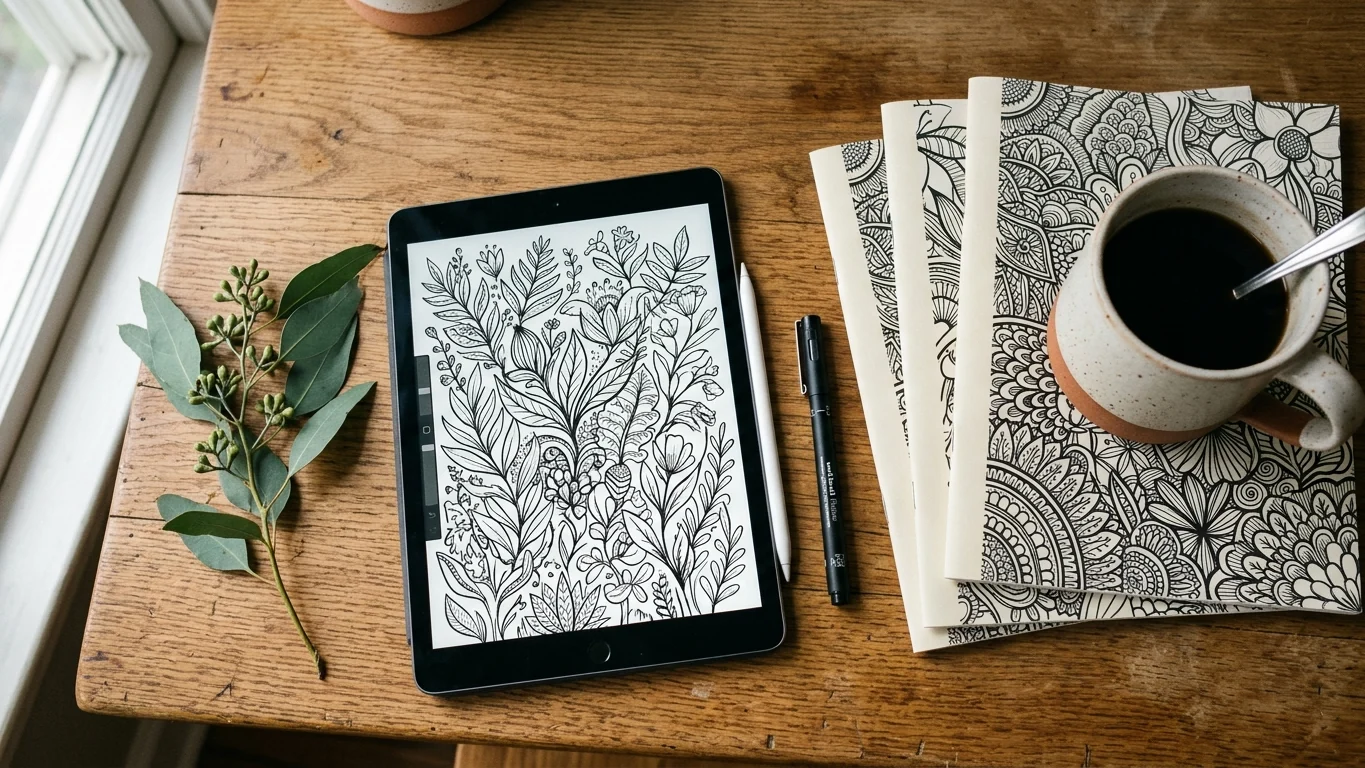
The realistic 2026 workspace: AI tools for production, proof copies for QA, markers for the human gut-check at the end.
The Adult Coloring Book Market In One Screen
- US category revenue (Amazon paperback): $300M+ annually, growing 3-5% YoY
- Average list price: $7.49-$11.99 (gift/premium 70-page books at $12.99+)
- Top-seller velocity: 800-3,000 copies/month
- Mid-pack velocity: 30-150 copies/month for niche-specific entries
- Buyer profile: 76% female, 30-65 age band, broad geography
- Peak demand: November-December (gifting), January (mindfulness), May (Mother's Day, Nurse's Week)
- Total SKU count on Amazon US: ~85,000 adult coloring book paperbacks
- Average gross profit per sale at $9.99: $3.94 (60% royalty, 70-page book)
Step 1: Niche selection (the only decision that matters)
Adult coloring book success is 70% niche selection and 30% execution. Generic books die because they cannot win a specific search query. The bestseller list in 2026 is a graveyard of three-year-old generic mandala books with 10,000 reviews each, plus a fast-turning layer of niche-specific newcomers earning $1k-5k/month.
What an actual sellable niche looks like
A workable 2026 niche has three properties. First, a specific search query a real buyer types into Amazon (not a category). Second, between 50 and 500 existing SKUs (under 50 means demand may not exist; over 500 means saturation). Third, at least one top-10 result with under 50 reviews (proves a new entry can rank).
Examples of niches that pass all three tests in 2026:
- Cottagecore coloring books (cottages, gardens, mushrooms, foraging) - currently trending, low SKU count
- French bulldog coloring books (any breed-specific dog book if it has a loyal subculture)
- Architecture coloring books (specific cities, cathedrals, brutalist buildings)
- Plant identification coloring books (herbs, succulents, mushroom species)
- Senior large-print mandalas (covered in our large-print guide)
- Cultural heritage (Mexican folk art, Polynesian tattoo motifs, Korean folk patterns)
- Hobby-specific (vintage cameras, antique cars, sailing yachts, vinyl records)
- Holiday-specific micro-niches (Halloween cats, Christmas cottages, Easter rabbits)
For the full niche-research methodology, see our deep-dive best coloring book niches and the KDP niche research system. Skip this step and your book is invisible regardless of design quality.
Niches to skip in 2026
- Generic mandalas: 18,000+ SKUs, all top results have 1,000+ reviews. Hybrid only (animal mandalas, architectural mandalas).
- Generic florals: same problem, even worse. Pick a specific flower category (succulents, tropical, wildflowers).
- Generic animals: dog and cat coloring books are oversaturated. Breed-specific or wildlife-specific only.
- Inspirational quotes: too easy to produce, too saturated, race to the bottom on price.
- "Stress relief" without a hook: stress relief is the category benefit; pick an actual theme.
Research niches with real Amazon data, not gut feeling
The KDPEasy keyword and niche research tool surfaces search volume, review counts, and BSR distribution for any coloring book sub-niche. Validate demand before you build.
Validate a niche freeStep 2: Tool selection (the actual cost-benefit map)
The 2026 tool landscape
The tooling decision determines your time-to-launch and your unit economics. Here is the honest 2026 comparison after working with each at production volume:
Adult coloring book tool comparison (2026)
| Tool | Best for | Time per page | Cost | Output quality |
|---|---|---|---|---|
| KDPEasy | End-to-end KDP workflow | 2-5 min | Credit-based | KDP-spec line art, closed shapes |
| Midjourney v7 | Hero pages, premium quality | 5-15 min | $10-30/mo | Beautiful but needs Photoshop conversion |
| Leonardo AI | Batch generation, free tier | 5-10 min | Free / $12-48/mo | Strong line-art preset |
| Litpal AI | Coloring-specific generator | 3-8 min | $9-19/mo | Tuned for coloring style |
| ColorBliss | Absolute beginners | 3-8 min | $8-15/mo | Simple interface, basic output |
| DALL-E 3 (ChatGPT) | Quick concepts | 3-10 min | $20/mo (ChatGPT Plus) | Inconsistent symmetry |
| Procreate (manual) | Premium flagship books | 60-180 min | $12.99 once | Best perceived quality |
| Adobe Illustrator | Vector cleanup, pro work | 60-180 min | $22.99/mo | Industry standard for vector |
Recommended 2026 workflow: KDPEasy or Leonardo for base generation, Illustrator or Inkscape for vector cleanup, Procreate reserved for one premium flagship per year.
KDPEasy vs Midjourney + manual: the honest comparison
Midjourney produces the most beautiful base AI images of any model. The catch is the workflow: generate in Midjourney, screenshot or download, import into Photoshop, run the line-art conversion (Filter > Stylize > Find Edges or a manual threshold pass), clean up artifacts, vector-trace in Illustrator, close gaps with the pen tool, drop into the book template. Realistic time-per-page including cleanup: 15-25 minutes.
KDPEasy outputs line art at 600 DPI in the correct trim, with closed shapes and a KDP-ready PDF wrapper. Time-per-page: 2-5 minutes including the prompt. The tradeoff is artistic uniqueness - Midjourney's output has a higher ceiling for one-off hero images. For a 70-page book, KDPEasy ships in 4-8 hours; Midjourney + manual takes 20-30 hours. For a series of four books, that gap is the difference between 6 weeks and 6 months of production.
Step 3: Interior generation
The complexity progression that prevents bad reviews
The single most common 1-star review on adult coloring books is "too intricate, too hard to start". Buyers want to be eased in, not dropped into the deep end. Mix complexity deliberately:
- 30% beginner pages (large regions, 1.5"+ wide; 20-40 regions per page; simple composition) - front of book
- 50% intermediate pages (medium regions, 0.5-1.5"; 40-80 regions per page) - core middle
- 20% advanced pages (small regions down to 0.25"; 80-150 regions per page; high detail) - back of book
Line quality standards
- Pure black (#000000), not dark grey. Cheap AI output sometimes uses #303030; this prints muddy.
- Consistent line weight, typically 2-4 pixels at 600 DPI. Mixed-weight lines look amateur.
- All shapes fully closed. Open shapes are the #1 review killer.
- Vector or 600 DPI raster. 300 DPI is the KDP minimum; 600 DPI is what bestsellers use.
- No shading, no gradients, no greyscale. Pure black-on-white only.
Page mix template (70-design book)
Production-ready 70-design page plan
- Pages 1-6: intro material (title, copyright, dedication, color-test page, table of contents)
- Pages 7-26: 10 beginner designs (each on odd page, blank back on even)
- Pages 27-106: 40 intermediate designs (same single-sided format)
- Pages 107-146: 20 advanced designs
- Pages 147-150: back matter (about author, book series teaser, blank notes pages)
- Total printed pages: 150 (70 designs + 70 blank backs + 10 intro/back matter)
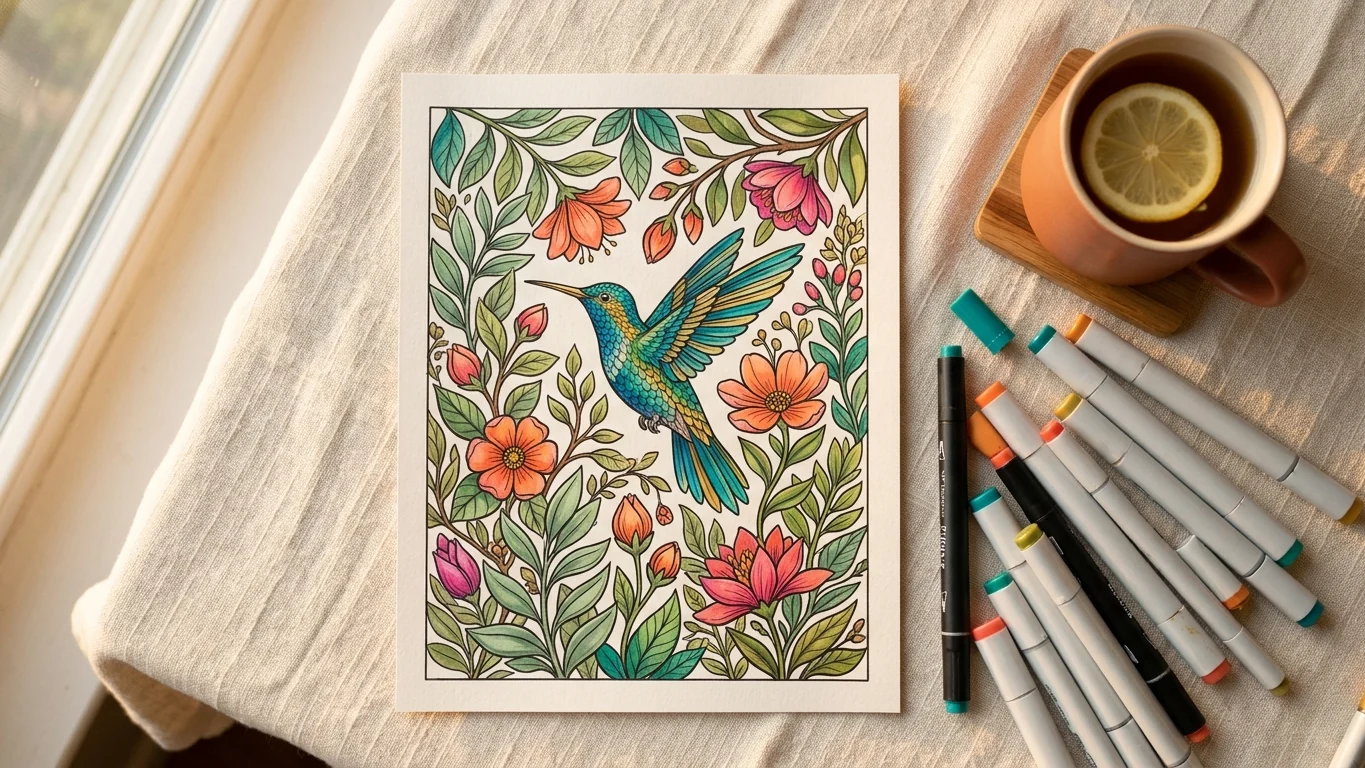
A finished page is your real marketing asset. Photograph the colored version and use it for Pinterest, Instagram, and Amazon A+ content.
Step 4: KDP formatting specs
Trim size decision
Two trims dominate adult coloring books in 2026:
- 8.5x11 (portrait): the standard. 70% of bestsellers use this. Maximum design area, familiar buyer expectation. Use for portrait-oriented designs (full-figure illustrations, tall buildings, complex botanicals).
- 8.5x8.5 (square): rising in 2026. Best for mandalas, centered designs, and books that want to stand out from rectangular thumbnails. About 25% lower print cost per page than 8.5x11.
Avoid 6x9 and 8x10 trims for adult coloring. 6x9 is too small for adult colorists; 8x10 saves pennies on print but reads as compromised. Calculate exact dimensions and bleed in our free KDP cover size calculator.
Interior specs (the non-negotiables)
- Format: PDF, no exceptions (not PNG, JPG, DOCX)
- Color mode: grayscale, not RGB. Always B&W interior - never color (color interiors cost 5x more to print with zero buyer benefit)
- Resolution: 600 DPI preferred (300 DPI minimum)
- Bleed: No bleed for standard coloring books; designs sit safely within 0.25" margins
- Inner margin: 0.5" minimum to avoid the gutter eating part of the design
- Page count: must be even (KDP rejects odd counts; pad with a blank if needed)
- Single-sided: every design on an odd page, blank even page behind it
- Paper: white only. Cream paper kills marker saturation.
Bleed vs no-bleed
For 95% of adult coloring books: choose no bleed. Designs sit within the trim with 0.25" white margin and there is zero risk of edge-trim issues at print. Only choose bleed (0.125" extension beyond trim) if your designs are intentionally edge-to-edge backgrounds. Coloring buyers prefer the white margin to grip the book without smudging their work.
Step 5: Cover design conventions
Warm vs stark: the 2026 palette debate
Adult coloring book covers split into two palette schools, and the data clearly favors one. Stark covers (pure white background, single hero design) read as "minimalist" but underperform at the Amazon thumbnail size because they have no thumbnail differentiation. Warm covers (cream, terracotta, sage, deep teal backgrounds with a colored hero design) outsell stark covers by roughly 20-30% in the same niche.
The 2026 winning palette structure:
- Background: warm gradient (cream-to-terracotta, cream-to-sage, cream-to-teal)
- Hero element: one large fully-colored sample design from inside the book
- Title typography: elegant serif (Cormorant, Playfair, Cooper Black) or refined geometric sans
- Subtitle: short benefit statement ("70 Designs for Stress Relief and Mindfulness")
- Page count and design count: on the cover ("70 Beautiful Designs", "100 Hand-Drawn Pages")
Illustrated vs photographic covers
Illustrated covers (a colored sample of the line art inside) outperform photographic covers (a photo of the book and markers) by 30-50% across nearly every niche I have tracked. The reason is simple: buyers want to see the art style, not the product packaging. Reserve photographic covers for journal-style adult coloring books where the book itself is the gift object.
Front + spine + back: the back is where you convert
Most adult coloring book back covers waste their real estate. The high-performing template:
- Hero copy (3-4 lines): opens with the buyer benefit, not the book feature
- Sample interior pages: 4-6 thumbnails of actual designs, ungoloed. This converts hesitant buyers.
- Feature bullets: page count, single-sided, paper type, beginner-to-advanced progression
- Author signature line: "From the publisher of [other book in your series]"
- Bottom-right 2x2" barcode space: Amazon adds the ISBN barcode here; leave it blank
For series covers that maintain consistency across 4-8 titles, see our guide on cohesive series cover design.
Skip the design tools entirely
KDPEasy generates KDP-ready interiors and matching cover systems in minutes. Stay focused on niche selection and series strategy.
Start your bookStep 6: KDP upload
Pre-upload checklist
- Interior PDF: 600 DPI, grayscale, single-sided, no bleed, 8.5x11 (or 8.5x8.5)
- Page count is even and matches what your title implies (70 designs = ~150 pages)
- Cover PDF: includes front + spine + back as a single spread, 0.125" bleed, CMYK colorspace
- Spine width matches page count (use our spine width calculator)
- Title and subtitle drafted with primary keyword in the title, secondary in subtitle
- Book description (under 4,000 characters) with HTML formatting for bullets
- 7 backend keywords identified (no duplicates with title)
- Two BISAC categories chosen (Coloring Books for Adults plus one niche-specific)
- List price set ($9.99 for the 60% royalty tier)
The upload sequence
- kdp.amazon.com > Create > Paperback
- Language: English. Title: niche-specific. Subtitle: benefit-driven.
- Author name (pen name with three parts performs best: "Hattie Mae Reeves" beats "Mike Smith")
- Description: 4,000 characters, HTML-formatted with bullets and bolds
- 7 keywords: long-tail phrases real buyers search, no title duplicates
- Two categories: Crafts > Coloring Books for Adults + one niche-specific
- Print options: 8.5x11 (or 8.5x8.5), no bleed, B&W, white paper, matte cover (free upgrade, reads premium)
- Upload interior PDF. Wait 1-5 min for processing. Address any quality warnings.
- Upload cover PDF. Use the previewer. Catch every error here, not after launch.
- Price: $7.99 launch / $9.99 long-term. Enable all marketplaces except India and Japan (low coloring demand, higher fraud rate).
- AI disclosure: tick honestly. There is no penalty for disclosed AI use.
- Submit. Approval takes 24-72 hours.
- Order a proof copy ($5-7). Verify quality before promoting.
For the full upload walkthrough with screenshots, see our how to publish coloring books on KDP guide.
Step 7: Pricing math (the $9.99 threshold is everything)
Profit per sale at each price point
For a 70-page B&W coloring book (print cost: $0.85 base + 70 × $0.012 = $1.69):
- $6.99 list (50% royalty): $3.50 royalty - $1.69 print = $1.81 profit
- $7.99 list (50% royalty): $4.00 royalty - $1.69 print = $2.31 profit
- $8.99 list (50% royalty): $4.50 royalty - $1.69 print = $2.81 profit
- $9.99 list (60% royalty): $5.99 royalty - $1.69 print = $4.30 profit (+53% vs $8.99)
- $11.99 list (60% royalty): $7.19 royalty - $1.69 print = $5.50 profit
- $14.99 list (60% royalty, premium): $8.99 royalty - $1.69 print = $7.30 profit
The brutal lesson: a $1 list-price increase from $8.99 to $9.99 increases per-sale profit by 53%. There is no other single change in the entire workflow with that much leverage.
For the full pricing strategy including launch pricing and seasonal adjustments, see our dedicated KDP coloring book pricing deep-dive.
Three-stage pricing ladder for new launches
- Weeks 1-4 (launch): $7.99 to build reviews and BSR (50% royalty, $2.31 profit)
- Weeks 5+ (after 10 reviews): raise to $9.99 to hit the 60% royalty tier ($4.30 profit)
- Q4 holiday surcharge: $11.99 from November 15 through December 24 ($5.50 profit)
Step 8: Series strategy (the only real growth lever)
Single coloring books cap out around $200-500/month. Publishers who hit $3k-10k/month run 4-8 book series under one pen name. The reason is mechanical: Amazon's "Customers also bought" carousel surfaces the next book to anyone who bought the first one. Each book sells the next at zero marketing cost.
The cluster-launch pattern
- Book 1 (September): the broadest title in the series ("Cottagecore Coloring Book for Adults")
- Book 2 (October, 30 days later): a sub-theme ("Cottagecore Mushrooms: A Foraging Coloring Book")
- Book 3 (November): a holiday tie-in ("Cottagecore Christmas: Cozy Winter Designs")
- Book 4 (January): a new-year angle ("Cottagecore Garden: Spring Awakening Coloring Book")
- Books 5-8 (every 30-45 days through year): deepen the niche or branch into related sub-themes
Identical cover system across all books: same font, same color palette, same author byline placement. Vary only the hero illustration and the title. Buyers recognize a series visually in 200ms - this is what triggers "Customers also bought" purchases.
Step 9: Launch sequence
Pre-launch (week before going live)
- Order proof copy 7 days before launch. Inspect for print quality, marker bleed, and binding gutter issues.
- Build 15-20 Pinterest pins (1000x1500 px) using a colored sample page. Schedule for launch day +1.
- Draft 3-5 Instagram carousel posts showing the book in use.
- Identify 5-10 micro-influencers in your niche (under 10k followers - they will respond)
- Prepare an Amazon A+ content layout (free for KDP authors)
Launch week
- Go live at $7.99 launch price
- Post Pinterest pins on launch day +1 (give Amazon 24 hours to index)
- Email 5-10 micro-influencers offering a free PDF in exchange for an honest Instagram or YouTube mention
- Run Amazon Sponsored Products at $0.30-$0.50 CPC for the first two weeks (budget cap $5/day)
- Publish Amazon A+ content within 7 days of launch
Post-launch (weeks 2-8)
- Monitor reviews. Address legitimate quality complaints fast (re-upload corrected interior if needed)
- Raise price to $9.99 once you have 10+ reviews at 4.0+ stars
- Scale Amazon Ads if ACOS is under 30% by week 4
- Start production on Book 2 in the series
- Watch BSR: under 100,000 in Coloring Books for Adults is the threshold for healthy ongoing sales
Build the series, not the singleton
KDPEasy supports four-book and eight-book series under one pen name with shared cover systems. Generate four titles in the time it used to take to ship one.
Plan your seriesHonest tradeoffs and risks
AI disclosure is real and non-negotiable
As of 2026, KDP requires you to disclose AI use during upload. There is no penalty for honest disclosure. There is a real penalty for hidden use if caught (potential account suspension). Tick the checkbox truthfully every single time.
AI output quality variance
AI generators produce duds. Maybe 1 in 3 generations is publication-ready without significant cleanup. Budget for this in your workflow - generate 100 pages to keep 70 good ones. The publishers who do not budget for variance ship inconsistent books and get bad reviews.
The saturation pressure is real
85,000+ adult coloring books on Amazon US is a lot. Most of them earn nothing. The publishers who win are obsessive about niche specificity and series cadence. The publishers who lose try to publish "adult coloring books" without a specific buyer in mind. Do not be the second kind.
Copyright is enforced unevenly but harshly when triggered
Tracing copyrighted images is a fast route to DMCA strikes and account suspension. Always generate original art (AI or hand-drawn) or use commercial-license stock from Creative Fabrica or similar. Two DMCA strikes within 90 days triggers a full account review.
End-to-end launch checklist
- Validate niche: specific search query, 50-500 existing SKUs, at least one top-10 result under 50 reviews
- Plan series cluster of 4-8 books under one pen name with cohesive cover system
- Select tools: AI generator (KDPEasy / Leonardo), cleanup software (Illustrator / Inkscape)
- Generate 70-100 designs at the right complexity progression (30/50/20 easy/intermediate/advanced)
- Vector-trace and close all shapes; verify no hairline gaps before publishing
- Layout 8.5x11 or 8.5x8.5 single-sided, no bleed, 0.5" inner margin, 600 DPI, grayscale PDF
- Design cover with warm gradient background, hero colored sample, niche-specific title
- Create back cover with sample-pages thumbnails (the conversion driver)
- Upload to KDP: 7 keywords, 2 categories, AI disclosed, $7.99 launch price
- Order proof copy and verify print quality before promoting
- Build 15-20 Pinterest pins and 3-5 Instagram posts for launch week
- Run Amazon Sponsored Products at $0.30-$0.50 CPC for 2 weeks ($5/day cap)
- Publish Amazon A+ content within 7 days of launch
- Raise price to $9.99 after 10+ reviews
- Start production on Book 2 within 30 days
The shortest path from idea to printed proof
KDPEasy handles interior generation, cover composition, and KDP-spec PDF export in one workflow. Pick the niche; ship the series.
Start your first bookA FEW MORE ANSWERS
Frequently asked questions
Zero upfront. KDP charges nothing to list a book; print costs are deducted from royalties at sale time. A 70-page B&W coloring book costs $1.69 to print and earns $4.30 net at a $9.99 list price. Your real costs are tools (AI generator subscription $0-$20/mo, optional Illustrator $22.99/mo) and one proof copy at $5-7 to verify quality before promoting.

ABOUT THE AUTHOR
Danielle Okonkwo
Marketing & Growth Lead at KDPEasy. Danielle is a published author with 12+ titles on Amazon KDP and a former book blogger. She draws on hands-on publishing experience and years of testing what works in the KDP marketplace.
Meet Danielle