
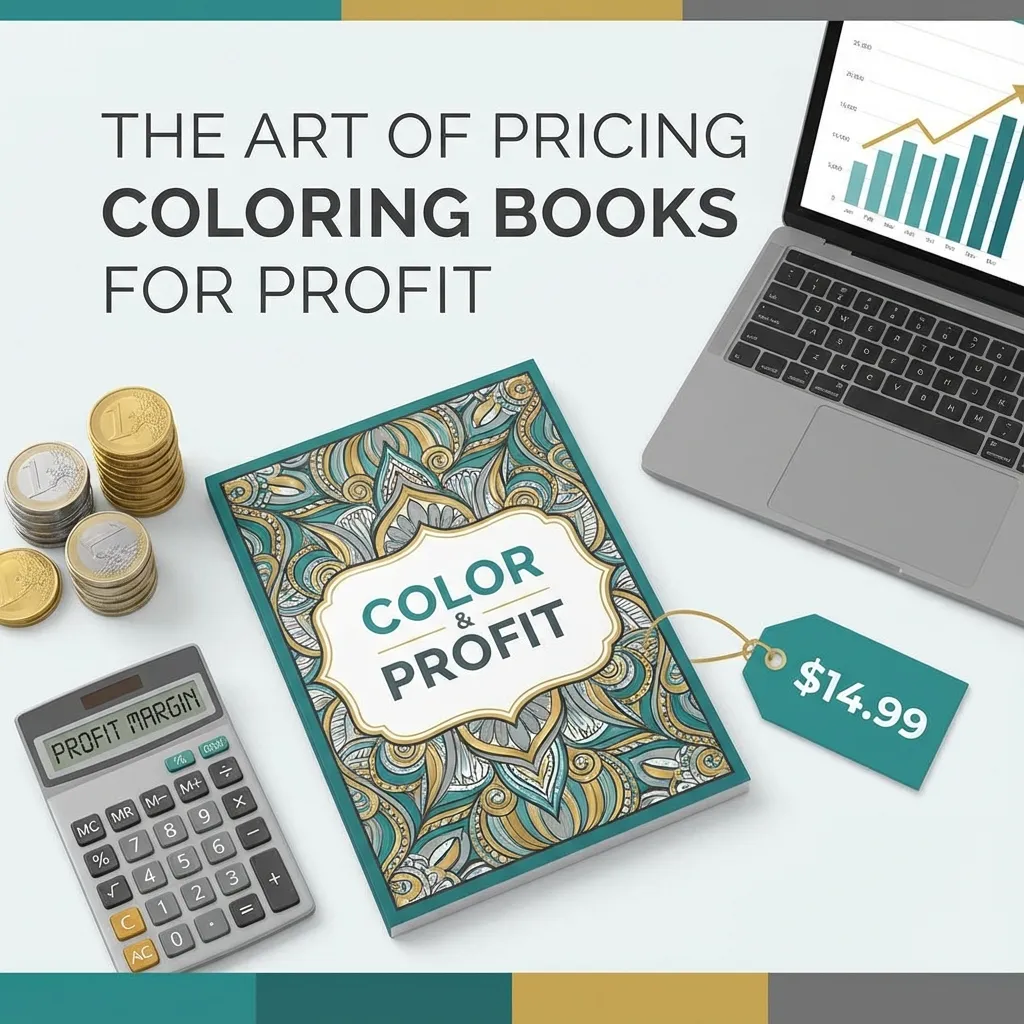
The difference between a $6.99 and $9.99 coloring book? $2,500 in annual profit for every 1,000 copies sold. Yet most KDP creators price blindly, leaving thousands on the table or pricing themselves out of sales. Here's the exact pricing framework that maximizes both sales velocity and profit margins.
📊 KDP Coloring Book Pricing Reality Check
- Average coloring book price: $7.99-$9.99 (sweet spot for impulse purchases)
- Print cost (70 pages, 8.5x11"): $3.65 (black & white interior)
- Amazon's cut: 50% of list price under $9.99 (50% royalty) or 40% at $9.99+ (60% royalty)
- Your net profit at $8.99: $0.85 per book ($4.50 royalty at 50% - $3.65 print cost)
- Your net profit at $9.99: $2.34 per book ($5.99 royalty at 60% - $3.65 print cost)
- Break-even price: $7.30 minimum (covers print cost only at 50% royalty)
- Price elasticity: 10% price increase = 5-8% sales decrease (coloring books are relatively inelastic)
⚠️ KDP Royalty Rate Structure (Updated for 2026)
Since June 2025, Amazon KDP's paperback royalty structure uses a two-tier system that remains in effect in 2026. Books priced under $9.99 receive a 50% royalty, while books priced $9.99 and above receive 60%. This makes the $9.99 price point a critical threshold—pricing at $9.99 instead of $8.99 can dramatically increase your per-book profit due to both the higher price AND the better royalty rate.
All calculations in this guide reflect the current 2026 royalty rates (unchanged since June 2025).
The 3-Step KDP Pricing Formula
Step 1: Calculate Your Print Cost
Amazon charges based on page count + ink type. Use KDP's royalty calculator or this formula:
- Base cost: $0.85 (fixed per book)
- Per page (B&W): $0.012 × page count
- Per page (Color interior): $0.06 × page count
Example calculations:
- 50-page B&W coloring book: $0.85 + (50 × $0.012) = $1.45 print cost
- 70-page B&W coloring book: $0.85 + (70 × $0.012) = $1.69 print cost
- 100-page B&W coloring book: $0.85 + (100 × $0.012) = $2.05 print cost
- 70-page COLOR interior: $0.85 + (70 × $0.06) = $5.05 print cost (avoid unless premium positioning)
💡 Pro Tip: Print Cost Optimization
Always use black & white interiors for coloring books. Color printing costs 5× more and offers zero value—customers are coloring the pages themselves.
Exception: Premium "grayscale shading" coloring books can justify $12.99+ pricing, but niche market.
Step 2: Determine Your Target Profit Per Book
Most successful KDP publishers target $2.00-$4.00 net profit per coloring book. This balances competitive pricing with meaningful income.
- $2.00 profit/book: Aggressive pricing for volume sales (100+ sales/month target)
- $3.00 profit/book: Balanced approach for most niches (50-100 sales/month)
- $4.00+ profit/book: Premium positioning for specialty niches (10-50 sales/month)
Step 3: Calculate List Price Using the Markup Formula
Formula: (Print Cost + Target Profit) ÷ Royalty Rate = List Price
The royalty rate depends on your list price: use 0.50 for books under $9.99 (Amazon keeps 50%), or 0.60 for books priced $9.99 and above (Amazon keeps 40%). Your royalty percentage must cover both print cost AND your profit.
Example (70-page book, $3.00 target profit):
- Print cost: $1.69
- Target profit: $3.00
- At 50% royalty (under $9.99): ($1.69 + $3.00) ÷ 0.50 = $9.38
- Round to $9.99 (hits the 60% royalty threshold!)
Key insight: At $9.99 with the 60% royalty rate, your actual profit is $9.99 × 0.60 - $1.69 = $4.30 per book—well above the $3.00 target. The $9.99 threshold makes this the most profitable price point for most coloring books.
Compare to pricing at $8.99 (50% royalty): $8.99 × 0.50 - $1.69 = $2.81 per book. That's $1.49 less per sale despite only a $1.00 lower list price.
Calculate your exact KDP royalty in seconds
Enter your page count and list price into the KDPEasy royalty calculator to see exact profit per sale before you publish. Supports all trim sizes and both royalty tiers.
Open Royalty CalculatorCreate Your Coloring Book in Minutes
KDPEasy generates print-ready coloring books with automatic formatting for KDP. Focus on pricing strategy, not design headaches.
Start CreatingPricing by Page Count: Profit Calculator (2026)
Here is a detailed breakdown showing the optimal price point and calculated profit for common coloring book page counts. All calculations use B&W interior print costs and the current 2026 royalty tiers (50% under $9.99, 60% at $9.99+).
📊 Pricing by Page Count — Profit at Each Price Point
| Pages | Print Cost | Price | Royalty Rate | Your Royalty | Profit |
|---|---|---|---|---|---|
| 30 pages | $1.21 | $5.99 | 50% | $3.00 | $1.79 |
| 30 pages | $1.21 | $6.99 | 50% | $3.50 | $2.29 |
| 50 pages | $1.45 | $7.99 | 50% | $4.00 | $2.55 |
| 50 pages | $1.45 | $9.99 ✓ | 60% | $5.99 | $4.54 |
| 70 pages | $1.69 | $8.99 | 50% | $4.50 | $2.81 |
| 70 pages | $1.69 | $9.99 ✓ | 60% | $5.99 | $4.30 |
| 100 pages | $2.05 | $9.99 ✓ | 60% | $5.99 | $3.94 |
| 100 pages | $2.05 | $11.99 ✓ | 60% | $7.19 | $5.14 |
Key takeaway: Notice the massive profit jump when crossing the $9.99 threshold. A 50-page book at $7.99 earns $2.55, but at $9.99 it earns $4.54—a 78% increase in profit for just a $2.00 higher price. This is the single most important pricing decision you will make.
⚠️ The Critical $9.99 Royalty Threshold
The $9.99 price point is the most important number in KDP coloring book pricing. Here is why:
- Below $9.99: Amazon keeps 50% of your list price (you get 50% royalty)
- At $9.99 and above: Amazon keeps only 40% (you get 60% royalty)
- The gap is dramatic: A book at $9.98 earns $4.99 royalty. A book at $9.99 earns $5.99 royalty. One penny more in price = $1.00 more in royalty.
- Strategy: If your formula puts you anywhere between $8.00-$9.98, strongly consider pricing at $9.99 instead. The royalty rate jump almost always makes it more profitable, even if you lose a small percentage of price-sensitive buyers.
Exception: Kids coloring books in highly competitive niches may need to stay at $5.99-$7.99 to compete, accepting the 50% royalty rate in exchange for higher sales volume.
Pricing by Coloring Book Category
Standard Adult Coloring Books (Mandalas, Florals, Animals)
- 50 pages: $6.99-$7.99 (competitive with established brands)
- 70 pages: $7.99-$8.99 (sweet spot for most sellers)
- 100+ pages: $9.99-$11.99 (premium value positioning)
Swear Word / Profanity Coloring Books
- 50 pages: $8.99-$9.99 (novelty premium)
- 70 pages: $9.99-$11.99 (gift market positioning)
- 100+ pages: $12.99-$14.99 (buyers expect higher pricing for humor content)
Niche-Specific Coloring Books (Dog Breeds, Zodiac, Medical)
- 50 pages: $7.99-$8.99 (niche targeting allows 10-15% premium over generic books)
- 70 pages: $8.99-$10.99 (passionate audiences pay more for specificity)
- 100+ pages: $11.99-$13.99 (collectors buy complete niche sets)
Kids Coloring Books (Ages 4-8)
- 30-40 pages: $5.99-$6.99 (parents expect lower pricing, buy volume)
- 50 pages: $6.99-$7.99 (standard pricing for activity books)
- 70+ pages: $7.99-$8.99 (rarely justified unless educational content)
Psychological Pricing Tactics
1. The .99 Endpoint Rule
Always end prices in .99, not .00. $7.99 outsells $8.00 by 15-20%. Buyers perceive $7.99 as "$7 range" vs. $8.00 as "$8 range" despite 1¢ difference.
2. Avoid "Tweener" Pricing
Don't price at $8.49 or $9.49. Stick to clean psychological breaks:
- $5.99, $6.99, $7.99, $8.99, $9.99, $11.99, $12.99
- Skip: $7.49, $8.49, $10.49 (no psychological benefit, confuses value perception)
3. Premium Positioning: The $11.99+ Strategy
Breaking the $10 barrier requires justification. Use these tactics:
- 100+ pages: "Over 100 unique designs" in title/description
- Premium paper: "Thick, perforated pages" (use cream interior option)
- Bonus content: "Includes color test pages and bonus patterns"
- Professional quality: Emphasize artist credentials or hours of work in description
4. Gift Market Pricing
Books marketed as gifts can command 15-25% higher prices. Buyers spend more on others than themselves. Use gift-focused keywords + $9.99-$12.99 range.
Competitive Pricing Analysis
How to Research Competitor Pricing
- Search your niche: "French bulldog coloring book" on Amazon
- Filter by bestsellers: Sort by "Best Selling" to see what prices are winning
- Check top 10 results: Note page count and price for each
- Calculate $/page ratio: Divide price by page count (e.g., $8.99 ÷ 70 = $0.128/page)
- Match or undercut by 10%: If market average is $8.99, price at $7.99-$8.49 for competitive edge
Deep-Dive: Competitor Price Analysis Method
Before setting your price, spend 30 minutes doing proper competitor research. Here is the exact process top KDP sellers use in 2026:
- Search your exact niche keyword: For example, "mandala coloring book for adults" on Amazon
- Open the top 20 results in new tabs (ignore sponsored results)
- Record for each book: Price, page count, review count, BSR (Best Seller Rank), and whether it uses the "Bold and Easy" style
- Calculate the price-per-page ratio: Divide list price by page count (e.g., $9.99 / 70 pages = $0.143 per page)
- Identify the "winning range": The price range shared by 60%+ of the top 10 bestsellers—this is where demand is proven
- Check review sentiment on pricing: Filter 1-3 star reviews and search for "price" or "expensive" or "value." If buyers complain about value at $9.99, consider offering more pages at the same price
- Look at "Customers also bought": These are your direct competitors—match or beat their value proposition
2026 pricing reality: Most coloring book niches have settled into a $7.99-$9.99 range. The $9.99 price point is now the most common among successful sellers because of the royalty threshold. If the majority of your competitors are at $9.99, you can either match them (compete on quality/reviews) or price at $7.99 as a launch strategy to gain traction.
⚠️ Warning: Race to the Bottom
Don't compete solely on price. A $5.99 coloring book signals low quality, even if designs are great.
Better strategy: Match market pricing, then differentiate on niche specificity, design quality, or page count. Compete on value, not just price.
Find profitable coloring book niches with real Amazon data
The KDPEasy keyword research tool shows search volume, competition, and estimated sales for any coloring book niche — so you can price with confidence, not guesswork.
Research NichesWhen to Raise or Lower Prices
Raise Prices If:
- Strong reviews (15+ with 4.5+ stars): Social proof justifies premium
- Bestseller rank under 50,000: High demand = pricing power
- Unique niche: Only 1-2 competitors? Test $1-2 higher pricing
- Holiday season (Q4): Gift buyers less price-sensitive, raise 10-15%
Lower Prices If:
- No sales in 30 days: Price likely too high for current visibility
- BSR above 500,000: Need sales velocity to improve ranking before raising price
- New launch (0-5 reviews): Temporarily lower price to gain traction + reviews
- Competing with major publishers: Dover, Crayola, etc. have brand advantage—undercut by 10-20%
The Launch Pricing Strategy
Month 1-2: Price at $6.99-$7.99 (below market average) to drive initial sales + reviews
After 10+ reviews: Raise to $8.99-$9.99 (market rate) to maximize profit
After bestseller status: Test $10.99-$11.99 if BSR stays under 100,000
Focus on Creating, Not Pricing Math
KDPEasy calculates optimal pricing based on your page count and niche. Plus, generates print-ready PDFs in minutes.
Start NowAdvanced Pricing Strategies
1. Series Pricing Pyramid
If you create a series of coloring books in the same niche:
- Book 1: $7.99 (loss leader to hook customers)
- Books 2-3: $8.99 (standard profit margin)
- Books 4+: $9.99-$10.99 (loyal fans less price-sensitive)
2. Page Count Pricing Tiers
Offer multiple versions at different price points:
- "Starter" (50 pages): $7.99
- "Complete" (70 pages): $9.99
- "Ultimate" (100 pages): $12.99
Buyers choose based on value preference, and you capture entire market spectrum.
3. Seasonal Pricing Adjustments
- October-December: Raise prices 10-15% (gift buying season)
- January-March: Standard pricing (self-care/stress relief demand)
- April-September: Consider lowering 10% to maintain sales velocity in slow months
Common Pricing Mistakes
1. Pricing Based on "Effort" Not Market Value
"I spent 40 hours on this, so it should be $19.99!" → Customers don't care about your time. They care about value relative to alternatives. Price based on competitor analysis, not sunk cost.
2. Ignoring Print Cost in Pricing
Pricing a 100-page book at $7.99 might yield $0.50 profit or even a loss after print costs. Always calculate net profit, not just "sounds good" pricing.
3. Never Testing Price Changes
Run 2-week pricing experiments: $7.99 vs. $8.99 vs. $9.99. Track sales volume + total revenue. Optimal price ≠ lowest price. Sometimes $9.99 generates more profit despite fewer units sold.
4. Pricing Identical to Top Competitor
If the #1 bestseller is $9.99 with 2,000 reviews, matching their price won't help you compete. Either undercut by 15-20% or differentiate with more pages/better niche targeting.
Quick Pricing Decision Matrix
🎯 Choose Your Pricing Strategy
- New seller, no reviews: Start at $6.99-$7.99 (build momentum)
- Established niche, 10+ reviews: $8.99-$9.99 (maximize profit)
- Premium/gift positioning: $10.99-$12.99 (100+ pages or unique niche)
- Kids coloring books: $5.99-$7.99 (parent price sensitivity)
- Swear word/novelty: $9.99-$12.99 (humor premium)
- Highly competitive niche: Undercut leader by 10-15%
- Low competition niche: Match or exceed market average
Your Pricing Action Plan
- Calculate print cost using KDP royalty calculator
- Research 10 competitors in your exact niche, note their pricing
- Determine target profit per book ($2-$4 for most)
- Use formula: (Print Cost + Target Profit) ÷ 0.50 for under $9.99, or ÷ 0.60 for $9.99+
- Round to .99 endpoint ($7.99, $8.99, $9.99, etc.)
- Compare to market average: Within 10-15%? Good. Much higher/lower? Adjust.
- Launch and track: Monitor sales for 2 weeks
- Test price increase after 10+ reviews to optimize profit
Create Print-Ready Coloring Books in Minutes
KDPEasy handles formatting, sizing, and bleed for KDP. Focus on niche selection and pricing strategy, not technical headaches.
Start CreatingA FEW MORE ANSWERS
Frequently asked questions
$9.99 is the optimal price point since it qualifies for the higher 60% royalty rate (vs 50% under $9.99).

ABOUT THE AUTHOR
Danielle Okonkwo
Marketing & Growth Lead at KDPEasy. Danielle is a published author with 12+ titles on Amazon KDP and a former book blogger. She draws on hands-on publishing experience and years of testing what works in the KDP marketplace.
Meet Danielle