
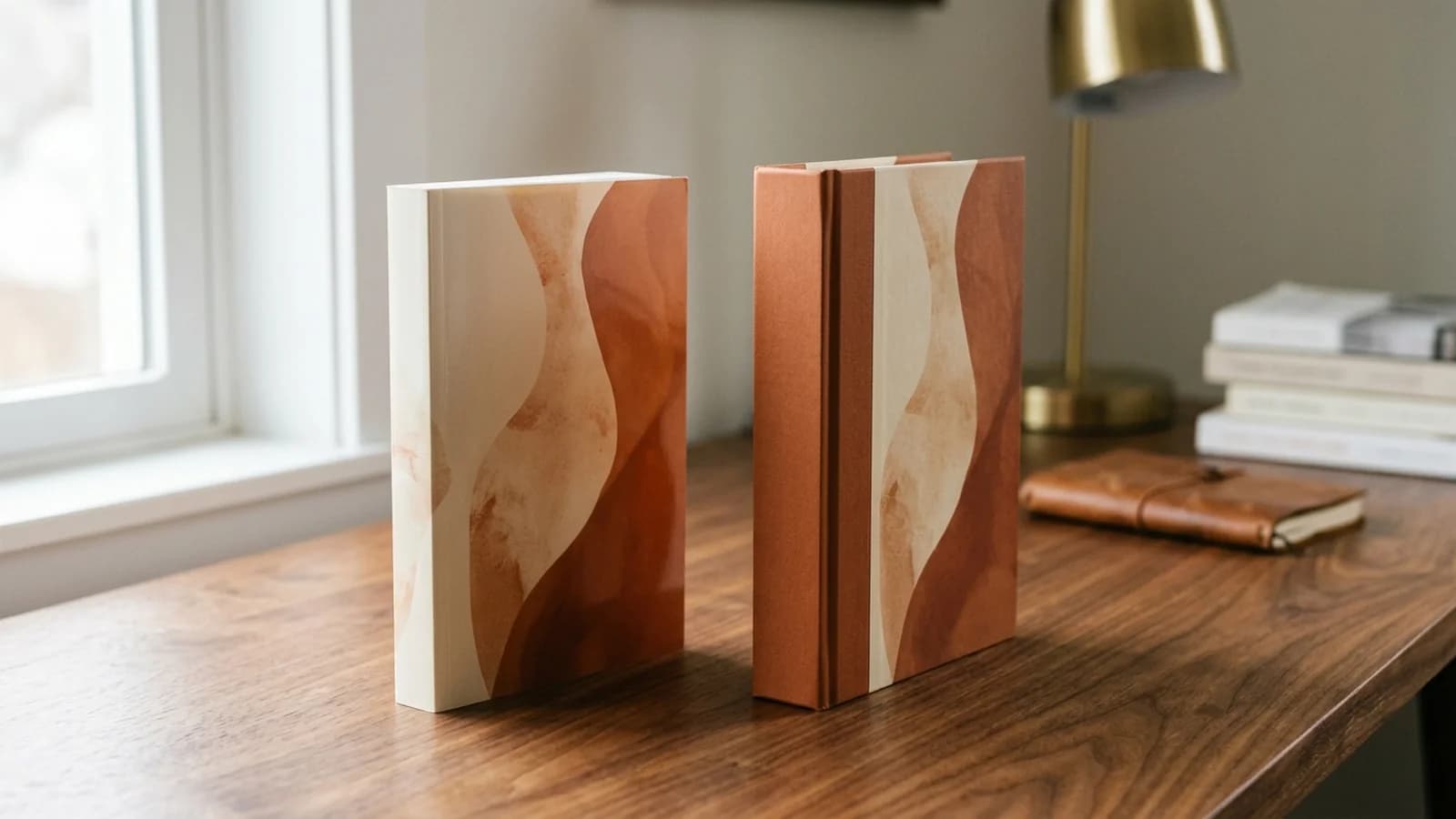
Paperback is cheaper to print, reaches more stores, and sells faster. Hardcover carries a higher list price, signals authority, and survives the gift market. The right answer depends on your page count, genre, audience, and how much margin you are willing to leave on the table for a premium edition. This guide uses the current 2026 KDP print-cost formulas, walks through three real worked examples at 200, 300, and 400 pages, runs a complete 5-book case study with revenue math both ways, and ends with a decision framework you can actually apply to your next title.
Decision rule of thumb (most cases)
Fiction at first launch: paperback plus Kindle. Add hardcover at month 3-6 once you have 20+ reviews.
Non-fiction, memoir, business: launch all three (paperback, hardcover, Kindle) together. Hardcover signals authority and matches gift-market expectations.
Children's picture books: hardcover first, paperback optional. Durability is the selling feature.
Books under 100 pages or in $0.99-$4.99 Kindle niches: skip hardcover entirely.
The 2026 KDP print cost formulas
Every KDP print book follows the same math: a fixed cost per book, plus a per-page cost that scales with length. These figures reflect KDP's US-marketplace 2026 schedule. Equivalent formulas exist for UK, EU, Japan, Australia, and Canada at local currency rates.
Paperback, black ink
- Fixed cost: $1.00 per book
- Per-page cost: $0.012
- Formula: $1.00 + ($0.012 x page count)
- Minimum pages: 24
Paperback, standard colour
- Fixed cost: $1.00 per book
- Per-page cost: $0.065
- Formula: $1.00 + ($0.065 x page count)
- Note: The older premium colour tier ($0.02 per page) was retired when KDP rolled standard colour out globally in mid-2023. There is no cheaper colour option in 2026.
Hardcover, black ink
- Fixed cost: $6.80 per book
- Per-page cost: $0.012
- Formula: $6.80 + ($0.012 x page count)
- Minimum pages: 75
- Maximum pages: 550
Hardcover, standard colour
- Fixed cost: $6.80 per book
- Per-page cost: $0.065
- Formula: $6.80 + ($0.065 x page count)
Three worked examples at 200, 300, and 400 pages
Real math makes the trade-off obvious. Three page counts at 6 x 9 black ink, US marketplace, using the 60 percent royalty tier (list price under $9.99 for paperback is ineligible for 60 percent on some marketplaces - always verify your specific pricing in the KDP dashboard).
200-page book at 6 x 9 black ink
- Paperback print cost: $1.00 + (200 x $0.012) = $3.40
- Hardcover print cost: $6.80 + (200 x $0.012) = $9.20
- Gap: $5.80 per unit
- At $14.99 paperback list: royalty = (0.60 x $14.99) - $3.40 = $5.59 per sale
- At $24.99 hardcover list: royalty = (0.60 x $24.99) - $9.20 = $5.79 per sale
At 200 pages your hardcover needs to list at $24.99 just to match the paperback royalty at $14.99. Most readers will accept a $10 price gap for a hardcover; some will not. If you list the hardcover at $19.99, royalty drops to $2.79 - about half what the paperback earns per copy.
300-page book at 6 x 9 black ink
- Paperback print cost: $1.00 + (300 x $0.012) = $4.60
- Hardcover print cost: $6.80 + (300 x $0.012) = $10.40
- At $16.99 paperback list: royalty = (0.60 x $16.99) - $4.60 = $5.59
- At $26.99 hardcover list: royalty = (0.60 x $26.99) - $10.40 = $5.79
The pattern holds. The fixed $6.80 hardcover premium never goes away, so you always need a minimum $10 list-price delta to match paperback earnings at longer page counts.
400-page book at 6 x 9 black ink
- Paperback print cost: $1.00 + (400 x $0.012) = $5.80
- Hardcover print cost: $6.80 + (400 x $0.012) = $11.60
- At $18.99 paperback list: royalty = (0.60 x $18.99) - $5.80 = $5.59
- At $28.99 hardcover list: royalty = (0.60 x $28.99) - $11.60 = $5.79
At 400 pages the hardcover is at the top of the psychological pricing barrier for fiction ($29.99). Readers accept $29.99 hardcovers from traditional publishers; they hesitate at it for unknown indie authors.
Hardcover royalty rule of thumb
Price your hardcover at exactly $10 above your paperback to earn roughly the same royalty per unit. Price it $11 to $12 above and every hardcover sale becomes pure upside above the paperback baseline.
5-book case study: revenue math both ways
Run the same five books through paperback-only and paperback-plus-hardcover and the gap is real but smaller than people assume. Assume each book sells 100 paperback copies per month at steady state. Hardcover sell-through in fiction averages around 12 to 15 percent of paperback volume on the same title; in non-fiction it averages 25 to 30 percent.
The five books
- Romance novel, 280 pages, paperback $14.99
- Thriller, 350 pages, paperback $14.99
- Business non-fiction, 240 pages, paperback $16.99
- Memoir, 220 pages, paperback $14.99
- Self-help, 200 pages, paperback $14.99
Scenario A: paperback only, all five books, 100 copies/month each
| Title | Print cost | Royalty/copy | Monthly |
|---|---|---|---|
| Romance 280p | $4.36 | $4.63 | $463 |
| Thriller 350p | $5.20 | $3.79 | $379 |
| Business 240p | $3.88 | $6.31 | $631 |
| Memoir 220p | $3.64 | $5.35 | $535 |
| Self-help 200p | $3.40 | $5.59 | $559 |
| Total monthly | $2,567 |
Paperback only across all five books: $2,567 per month, or roughly $30,800 per year. Steady-state on a published catalogue of five.
Scenario B: paperback plus hardcover at $10 list-price premium
Hardcover priced at exactly $10 above each paperback. Fiction hardcover sell-through at 13 percent of paperback volume. Non-fiction (business, memoir, self-help) hardcover sell-through at 27 percent.
| Title | HC list | HC royalty | HC copies/mo | HC monthly |
|---|---|---|---|---|
| Romance 280p | $24.99 | $4.83 | 13 | $63 |
| Thriller 350p | $24.99 | $3.99 | 13 | $52 |
| Business 240p | $26.99 | $6.51 | 27 | $176 |
| Memoir 220p | $24.99 | $5.55 | 27 | $150 |
| Self-help 200p | $24.99 | $5.79 | 27 | $156 |
| HC subtotal | $597 |
Paperback subtotal (unchanged): $2,567. Hardcover subtotal: $597. Total monthly: $3,164. Total annual: roughly $37,968.
The hardcover edition adds $7,164 per year across five titles - a 23 percent revenue lift for what is essentially a re-export plus a new cover file. The lift concentrates on the three non-fiction titles (business, memoir, self-help) which account for $482 of the $597 monthly hardcover royalty.
Case study takeaways
- Hardcover added 23 percent annual revenue across a 5-book catalogue.
- 80 percent of hardcover revenue came from non-fiction titles.
- Fiction hardcover added only $115 per month combined - real but small.
- Conclusion: always add hardcover for non-fiction. For fiction, wait for review velocity before reformatting.
Distribution: the biggest hidden difference
Print cost is the visible cost. Distribution is the invisible one.
Paperback: Expanded Distribution enabled
KDP paperbacks can opt into Expanded Distribution, which pushes the book through Ingram's catalogue to Barnes & Noble, independent bookstores, university libraries, and public library purchasing systems. Royalty drops from 60 percent to 40 percent on Expanded Distribution sales, and the royalty is calculated on list price minus print cost - so margins tighten. Example at $14.99 list, 200 pages, paperback: (0.40 x $14.99) - $3.40 = $2.60 per sale instead of $5.59. The volume usually makes it worth it for non-fiction.
Hardcover: Amazon only
KDP hardcover is available in the US, UK, DE, FR, IT, ES, JP, and AU Amazon marketplaces. It is not available in Canada (you can sell to Canadian customers through Amazon.com with higher shipping costs, but there is no Amazon.ca hardcover fulfillment). It does not route through Expanded Distribution. If a library or bookstore wants your hardcover, they can only buy from Amazon at retail, which they rarely do.
For authors who care about library and indie bookstore reach, the standard move is: publish paperback on KDP with Expanded Distribution, then publish hardcover on IngramSpark (which does route to libraries and bookstores). This requires a separate ISBN and a $49 IngramSpark setup fee (often free during their periodic promos).
KDP hardcover trim sizes
KDP hardcover supports five trim sizes as of 2026:
- 5.5 x 8.5 - compact fiction, novellas, gift books, poetry
- 6 x 9 - the default for most fiction and non-fiction
- 6.14 x 9.21 - traditional publishing house trim (used by Penguin and HarperCollins for hardcover fiction)
- 7 x 10 - workbooks, journals, cookbook-style non-fiction
- 8.25 x 11 - photography books, art portfolios, children's picture books
If your paperback is on a trim size outside this list (for example 5 x 8 or 8.5 x 11), you will need to reformat your interior before offering hardcover. That is not a small job - fonts, margins, image placement, and headers all need to be re-flowed. Plan hardcover trim before you typeset the paperback. For the broader trim-size decision (paperback included), the KDP trim sizes explained guide walks through every option.
The hardcover spine width formula
Spine width drives the total cover canvas. Get it wrong by more than 0.01 inch and the cover snaps back as a hard rejection. Hardcover spine math is slightly different from paperback because the case adds a fixed 4.8 mm (0.189 inch).
The formula
KDP hardcover spine width formula
Spine width = (page count x per-page paper thickness) + 4.8 mm case allowance
- White paper (60 lb): 0.002252 inch per page
- Cream paper (55 lb): 0.0025 inch per page
- Premium colour paper: 0.002347 inch per page
- Case allowance: 4.8 mm (0.189 inch), added once to every hardcover spine
Worked examples
- 75 pages, white paper: (75 x 0.002252) + 0.189 = 0.358 inch
- 100 pages, white paper: (100 x 0.002252) + 0.189 = 0.4142 inch
- 150 pages, white paper: (150 x 0.002252) + 0.189 = 0.5268 inch
- 200 pages, white paper: (200 x 0.002252) + 0.189 = 0.6394 inch
- 300 pages, white paper: (300 x 0.002252) + 0.189 = 0.8646 inch
- 400 pages, white paper: (400 x 0.002252) + 0.189 = 1.0898 inch
- 200 pages, cream paper: (200 x 0.0025) + 0.189 = 0.69 inch
- 200 pages, premium colour paper: (200 x 0.002347) + 0.189 = 0.6584 inch
Always round to four decimal places. Then cross-check the number against the KDP template generator before exporting the cover - if there is any drift, KDP's number wins. The KDP cover size calculator outputs the exact paperback and hardcover spine width side by side for the same page count, which is the fastest way to verify both formats at once. The spine width calculator guide walks through why each paper type uses a different per-page constant.
Case laminate adds no extra spine width
Case laminate is the same finish KDP uses on every hardcover. It does not add to the spine calculation because the laminate film is microscopically thin (sub-0.001 inch). The 4.8 mm (0.189 inch) case allowance already accounts for everything you need to add over the bare paperback spine width.
Get your hardcover spine and bleed right the first time
Our KDP Cover Size Calculator outputs exact dimensions for paperback and hardcover at your specific trim size and page count, using current 2026 KDP spine formulas.
Open the calculatorKDP hardcover is case laminate only
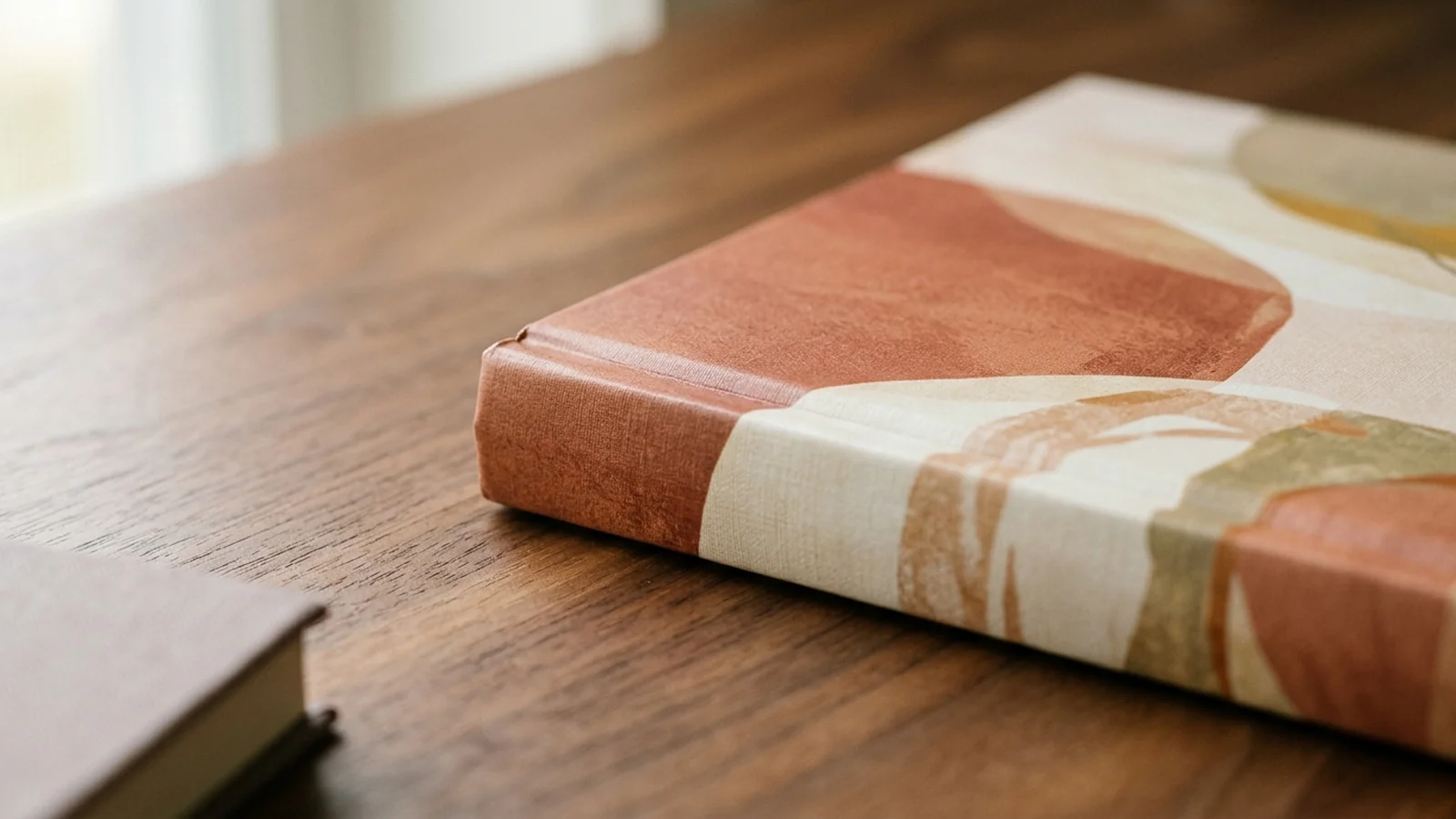
This is the biggest quality difference between KDP and IngramSpark. KDP hardcover is printed as case laminate: the cover image is printed directly onto the board and sealed with a laminate film. There is no dust jacket. There is no cloth binding. The book has a matte or glossy finish depending on your preference setting.
Practical implications:
- Your cover file is the final cover. No separate flap design, no inside-cover illustration.
- No blurb on the inside flap. Everything your reader sees is printed on the front, spine, and back cover - same real estate as a paperback, just thicker.
- The corners will show wear faster than cloth hardcovers under heavy library use. For gift and home shelves the finish holds up fine.
- Cover art needs higher contrast than paperback art - the matte laminate softens colours slightly.
Reader preference by genre
Fiction: paperback wins on price
Romance, thriller, mystery, and sci-fi readers are price-sensitive and buy in volume. A $14.99 paperback outsells a $24.99 hardcover 8-to-1 or more in the same genre. Offer hardcover as a premium option for superfans, but build your launch marketing around the paperback.
Non-fiction and business: hardcover signals authority
Business books, self-help, memoir, and prescriptive non-fiction sell better as hardcover at the launch window. The hardcover is what goes on a CEO's desk, a podcast host's shelf, and a LinkedIn photo. Traditional publishers have trained the market to expect non-fiction in hardcover first; readers perceive paperback-first non-fiction as lower tier.
Children's picture books: hardcover wins on durability
Parents buy picture books for durability. A $19.99 hardcover picture book from KDP at 8.25 x 11 lists better on gift registries and holds up to toddlers. Paperback picture books exist but they feel disposable next to the hardcover equivalent.
Poetry and collector editions
Poetry is one of the few genres where hardcover outperforms paperback on the indie scene. A 5.5 x 8.5 hardcover at $22.99 signals permanence. Readers buying poetry as a gift overwhelmingly choose hardcover.
Gift market (Q4)
Hardcover sales spike 2-3x between mid-November and December 24 every year, across every genre. If you launch a hardcover, time the launch so you have inventory of reviews and rank by October, not November.
Series strategy: paperback first, then hardcover
Series authors face a different format decision than standalone authors. The strongest pattern: paperback across every volume in the series, then a hardcover collector edition for volume 1 (or a complete series omnibus) once the series has loyal readers.
Why paperback first across the series:
- New series readers price-shop. A $14.99 paperback is a low-friction entry; a $24.99 hardcover is a commitment.
- KDP Select Free Days and Kindle Countdown Deals require Kindle and paperback. Hardcover does not participate.
- Expanded Distribution carries the paperback into libraries and indie bookstores where new readers discover series.
- Production speed: paperback approves in 72 hours, hardcover in up to 5 business days. Releasing a series on a tight calendar requires paperback.
Why hardcover for loyal readers later:
- Existing fans repurchase volume 1 in hardcover to display the series on a shelf.
- Hardcover stacks revenue without cannibalising the paperback - different buyer behaviour.
- A hardcover "collector edition" or "deluxe edition" with bonus content (foreword, illustrations, author notes) is the standard upsell.
- Omnibus volumes (books 1-3 bound together as a single hardcover) convert backlist readers into completionist buyers.
When NOT to publish a hardcover
Not every book should be hardcover. Skip it when:
- Your book is under 100 pages. The spine is too thin to look substantial, proportions feel stubby, and the fixed $6.80 cost eats margin. A 75-page hardcover at $19.99 earns $4.20 royalty; the paperback at $9.99 earns $4.10. The hardcover is not worth the effort.
- You are in a genre with $0.99 to $2.99 Kindle competition. Low-priced Kindle fiction niches (steamy romance, sweet romance shorts, cozy mystery cozies) do not support hardcover pricing because readers expect $3 to $10 price points across all formats.
- This is your first book and you have no audience. Hardcover sells to readers who already trust you. First-time indie fiction authors see 2 to 5 percent hardcover sell-through. Focus on paperback and Kindle first; add hardcover after your second or third title.
- Your trim size is not available. If you typeset your paperback at 5 x 8 or 8.5 x 11, adding hardcover requires full reformatting. The cost of a designer's time usually exceeds the additional royalty.
- You are launching with a heavy promo strategy. Amazon Ads, KDP Select Free Days, and BookBub only apply to Kindle and paperback. Hardcover does not participate in most promo ecosystems.
Cover file differences between formats
Your paperback cover file will not work for your hardcover. Key differences:
- Wrap area: hardcover covers include a 15 mm (0.591 inch) wrap that folds around the board edges and onto the inside of the case. Invisible on the finished book but must be included in the file.
- Total trim: each hardcover board is the stated size plus 5 mm (0.197 inch) wide and 6 mm (0.236 inch) tall, and the 15 mm (0.591 inch) wrap on every side replaces the 0.125 inch bleed. For a 6 x 9 hardcover at 300 pages on white paper, the total cover file width is ((6 + 0.197) x 2) + 0.8646 + (0.591 x 2) = roughly 14.44 inches wide.
- Inside flaps: not applicable on KDP. Since hardcover is case laminate only, there are no dust jacket flaps to design.
- Spine calculations differ: hardcover spines are 0.189 inch (4.8 mm) thicker than paperback at the same page count because of the case. Use KDP's official template generator or a calculator that distinguishes hardcover from paperback.
For the full upload walkthrough across all three formats, see the cover upload guide. For the side-by-side technical specs, the hardcover vs paperback cover specification guide goes deeper on bleed, wrap, and barcode placement.
ISBN strategy
Every format requires its own ISBN. KDP gives you one free ISBN per format. If you use the free KDP ISBN:
- Imprint shows as "Independently published" on the copyright page
- You cannot move this ISBN to IngramSpark or another printer later
- You can still list your hardcover with a different ISBN on IngramSpark if you want dual distribution
If you buy your own ISBNs from Bowker ($125 each, or $295 for a 10-pack), you control the imprint, can move the book across distributors, and can build a publishing brand. For a single title the free KDP ISBN is fine. If you plan to publish 3+ books, buy the 10-pack and use your own imprint.
Review times and launch planning
KDP review times differ by format. Plan your launch calendar around the slowest one.
- Kindle: typically 24 to 48 hours
- Paperback: 24 to 72 hours for first review, faster for reuploads
- Hardcover: up to 5 business days for first review, 2 to 3 business days for reuploads
If you want all three formats live on launch day, submit the hardcover first (allow 7 days buffer), then paperback (3 days), then Kindle last. Do not trust the "within 72 hours" window KDP quotes you - always allow buffer for rejection cycles.
Decision framework
Work through these questions in order:
- Is your book under 100 pages? If yes, skip hardcover. Publish paperback and Kindle only.
- Is your book in a $0.99 to $4.99 Kindle fiction niche? If yes, skip hardcover. Your readers will not pay $19+.
- Is this your first indie book with no mailing list? If yes, launch paperback plus Kindle. Add hardcover in month 3 to 6 once you have reviews and rank.
- Is your genre business, self-help, memoir, reference, or children's picture book? If yes, publish hardcover as the primary launch format.
- Is your genre adult fiction with a real audience? If yes, publish both - hardcover at $10 to $12 above paperback.
- Do you need library and bookstore reach? If yes, paperback with Expanded Distribution on KDP, hardcover on IngramSpark (not KDP).
Honest trade-offs
A few things the hardcover-evangelist crowd will not tell you:
- KDP hardcover print quality is good, not great. Binding glue occasionally shows at the case edges on inspection copies. It is fine for retail; it is not the quality of a Macmillan hardcover.
- Returns hurt worse on hardcover. Higher print cost means a returned hardcover costs you more in author-facing accounting than a returned paperback.
- Amazon does not promote hardcover in most search rankings. The default Amazon book search ranks the cheapest format first. Your hardcover often sits below the Kindle and paperback listings unless a reader explicitly filters for it.
- Hardcover-only launches are slower. You give up Kindle Countdown Deals, KDP Select free days, and paperback Expanded Distribution. First-month sales velocity is typically 30 to 50 percent lower on a hardcover-only launch.
International marketplaces and currency math
The print-cost formulas above are US-marketplace figures. If you sell internationally - and most authors do, because KDP opts you into all marketplaces by default - the math recalculates in local currency at each store.
- UK (Amazon.co.uk): paperback fixed cost GBP 0.85, per-page GBP 0.010 for black ink. Hardcover fixed cost GBP 5.50, per-page GBP 0.010. Royalty calculated at 60 percent of list price minus print cost.
- EU (DE, FR, IT, ES): EUR 0.90 fixed paperback, EUR 0.012 per page. EUR 6.40 fixed hardcover, EUR 0.012 per page. VAT complicates effective royalty because VAT is subtracted from list price before royalty is calculated.
- Japan: hardcover was added to Amazon.co.jp in 2024. Print costs run roughly 15 percent higher than US rates due to paper sourcing.
- Australia: paperback only at local print, hardcover fulfilled from US. Customers pay higher shipping on hardcover from AU.
You do not set these prices individually unless you untick the currency-conversion toggle. Most authors leave KDP's auto-conversion on and accept the cross-market royalty variance. If international sales matter, manually price each marketplace against local print cost.
Hardcover plus paperback cover workflow
If you decide to publish both formats, plan the cover workflow once at the start, not twice. The shortcut pros use:
- Design the front cover art first at 300 DPI, sized for your largest format (usually the hardcover board plus wrap).
- Generate the paperback cover file using the paperback spine width at your page count and paper type.
- Generate the hardcover cover file using the hardcover spine width (0.189 inch wider), boards 5 mm wider and 6 mm taller than the trim, and the 15 mm (0.591 inch) wrap on all four sides.
- Use the same front-cover art, back-cover copy, and spine text for both files - just re-layout for the different total canvas dimensions.
- Download both templates from KDP's cover template generator to verify exact pixel dimensions before exporting.
Designers sometimes charge twice for this. It should not cost more than 25 percent extra over a single-format design - the creative work is identical; only the canvas dimensions change.
Generate paperback and hardcover covers in one workflow
KDPEasy outputs print-ready KDP cover PDFs at both paperback and hardcover dimensions from the same front art. Match spine width, bleed, and wrap to your exact page count.
Start freeThe bottom line
For 80 percent of KDP authors, the right move is paperback plus Kindle at launch, hardcover added once the title has 20+ reviews and a stable rank. For non-fiction, memoir, and children's picture books, launch all three formats together. Price the hardcover $10 to $12 above the paperback to preserve royalty parity. Skip hardcover entirely on short books, price-sensitive fiction niches, and debut titles with no audience.
The format question is not ideological. It is arithmetic. Run the numbers, match the format to the genre, and do not let a nice-looking hardcover distract you from what sells the book - the paperback. For the broader profit picture across formats and royalty tiers, see how to make money with Amazon KDP.
A FEW MORE ANSWERS
Frequently asked questions
Paperback uses a flexible glossy or matte cover printed directly onto card stock and glued to the spine. Hardcover uses rigid boards wrapped in a case-laminate cover, with a 15 mm (0.591 inch) wrap on every side that folds onto the inside of the case. KDP only offers case laminate hardcover - no dust jackets, no cloth bindings. Paperback minimum is 24 pages and supports both colour and black ink; hardcover minimum is 75 pages, maximum 550 pages. Paperback can opt into Expanded Distribution through Ingram (libraries, Barnes & Noble, indie bookstores); hardcover ships through Amazon only.

ABOUT THE AUTHOR
Danielle Okonkwo
Marketing & Growth Lead at KDPEasy. Danielle is a published author with 12+ titles on Amazon KDP and a former book blogger. She draws on hands-on publishing experience and years of testing what works in the KDP marketplace.
Meet Danielle