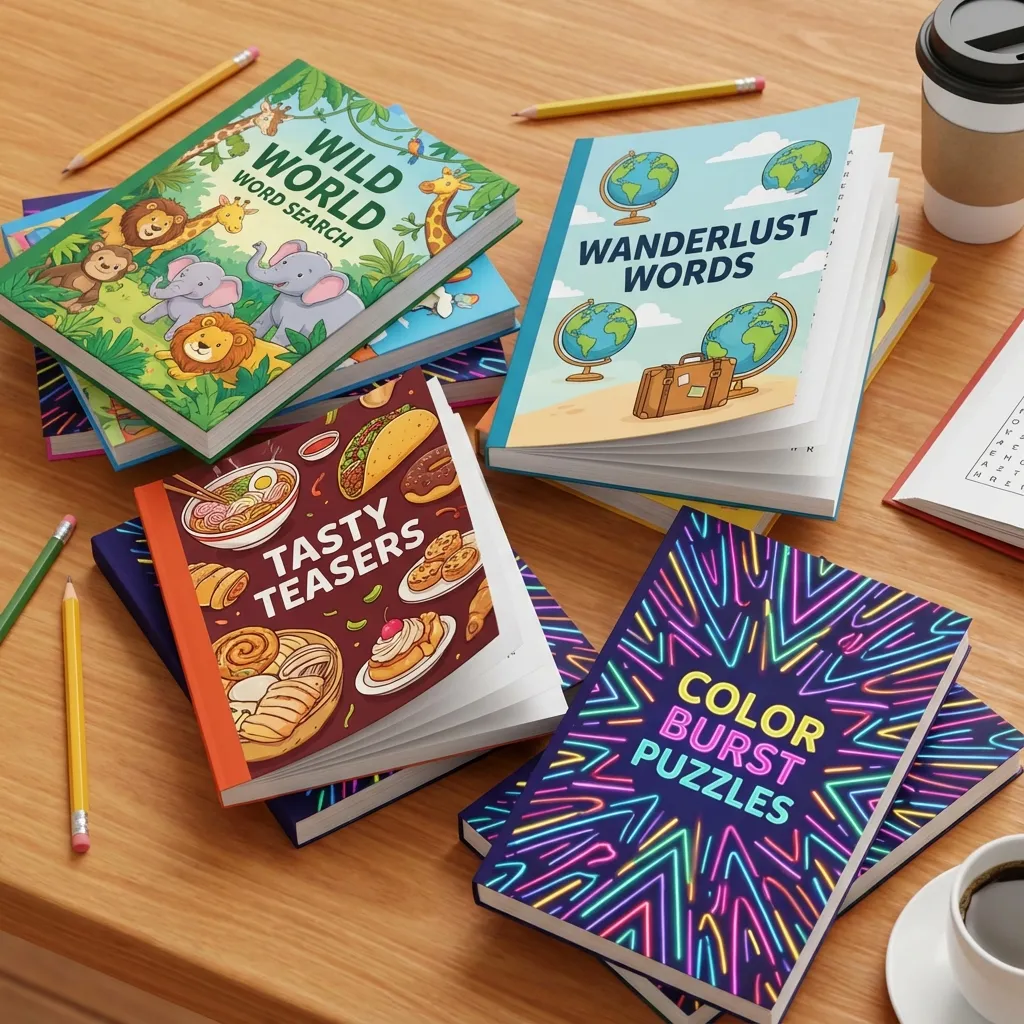


Seasonal activity books are the highest-velocity niche on KDP and the most punishing to publish badly. A book launched on the right date in October can clear $2,000 of royalty before Christmas. The same book launched two weeks late, with a slightly off color story, will clear $200. This guide is the working playbook for not being the second publisher.

The honest market read in 2026
- Concentration: 70-80 percent of an individual seasonal book\'s annual revenue lands in a 6-week window. Plan for the peak, not the off-season.
- Christmas window: Oct 15 to Dec 18 captures roughly 80 percent of an annual Christmas-book\'s sales.
- Halloween window: Sep 10 to Oct 28, roughly 75 percent of annual sales.
- Easter window: Feb 15 to a moving date in late March or early April, roughly 70 percent.
- Repeat-buyer dynamic: The same parents and gift-givers shop each holiday year after year. Building a multi-year catalog matters more than chasing this year\'s viral angle.
- Launch timing: 8-12 weeks before peak is the entire game. Late launches lose 60-80 percent of available revenue.
The honest seasonal economics
Most beginner publishers misunderstand the math. They look at peak sales numbers and assume a book that sells 800 copies in eight weeks is a good annual investment. Sometimes it is, sometimes it is not. The accurate frame is multi-year.
A single Christmas book in a healthy niche earns roughly $1,200-$3,000 in its first peak. In year two, the same book earns 70-90 percent of that. In year three, 50-70 percent. By year four to five it has decayed to maybe 30-40 percent of original peak. Total lifetime revenue from one well-launched Christmas book: $3,500-$8,000 over five years, with most of the work done in the first eight weeks.
That math is good. It is also fragile. A late launch, a weak cover, or a saturated sub-niche can collapse year-one revenue to $300-$600, and the multi-year curve is multiplicative on that base. There is no recovery year for a book that bombed in its peak window. The launch is the entire business.
The four seasons and eight holidays that matter
Not all holidays are equal. The table below ranks the 2026 calendar by revenue potential, competition level, and the realistic launch-by date if you want to capture the peak. Treat any holiday below the line as a series-builder, not a lead launch.
| Holiday / Season | Peak Window | Launch By | Competition | Revenue Potential |
|---|---|---|---|---|
| Christmas | Oct 15 - Dec 18 | Sept 15 | Very high | $1,200-$3,000 peak |
| Halloween | Sept 10 - Oct 28 | Aug 1 | High | $800-$2,000 peak |
| Easter (varies) | Feb 15 - early April | Jan 15 | Medium-high | $500-$1,500 peak |
| Summer break | May 15 - Aug 15 | April 15 | Medium | $600-$1,500 spread |
| Back-to-school | July 15 - Sept 10 | June 15 | Medium | $400-$1,000 peak |
| Thanksgiving | Oct 25 - Nov 26 | Sept 1 | Low-medium | $300-$900 peak |
| Valentine\'s Day | Jan 15 - Feb 14 | Dec 15 | Medium | $300-$800 peak |
| St. Patrick\'s Day | Feb 25 - Mar 17 | Feb 1 | Low | $150-$500 peak |
| Mother\'s Day | Apr 25 - May 12 | Mar 25 | Low | $200-$600 peak |
| Father\'s Day | May 25 - Jun 16 | Apr 25 | Low | $150-$500 peak |
| 4th of July | Jun 15 - Jul 4 | May 15 | Low | $100-$400 peak |
Launch timing: the only thing that actually matters
Every seasonal book fails or succeeds at the launch date. Late launches have no recovery path. The reason is mechanical: KDP review takes 72 hours, Amazon indexing takes another 7-14 days, AMS ad campaigns need 14-21 days to optimize, and review velocity ramps from zero only after launch. A book published on November 20 has none of these systems running when peak Christmas demand hits two weeks later.
The minimum lead time is 8 weeks. The optimal lead time is 12 weeks. The map below is for 2026.
| Holiday | 12-week launch (2026) | Production start |
|---|---|---|
| Halloween (Oct 31) | August 8, 2026 | Late June 2026 |
| Thanksgiving (Nov 26) | September 3, 2026 | Mid-July 2026 |
| Christmas (Dec 25) | October 2, 2026 | Mid-August 2026 |
| Valentine\'s Day (Feb 14, 2027) | November 22, 2026 | Early October 2026 |
| St. Patrick\'s Day (Mar 17, 2027) | December 23, 2026 | Early November 2026 |
| Easter (April 4, 2027) | January 10, 2027 | Mid-November 2026 |
| Mother\'s Day (May 9, 2027) | February 14, 2027 | Late December 2026 |
| Father\'s Day (June 20, 2027) | March 28, 2027 | Early February 2027 |
Build a personal production calendar in May or June of each year that maps backwards from these dates. Treat the launch date as a hard commitment, not a target. A book that misses its launch window should be shelved until the following year, not pushed to a late release.
Create your seasonal cover, fast
Pre-built color stories for every holiday. Christmas, Halloween, Easter, Thanksgiving and more, with the right palette baked in.
Start freeCover conventions by holiday
Each holiday has a non-negotiable color story. Get it wrong and the cover reads as off-holiday, and conversion drops to a fraction of a correctly-coded cover. The grid below is the working palette for each holiday in 2026.

Christmas
- Palette: Deep red, dark forest green, cream, gold or warm tan accent. Avoid pure black backgrounds, they read as sad.
- Hero motifs: Christmas tree, Santa, reindeer, snowman, wrapped gifts, ornament cluster. Pick one, not a collage.
- Tone: Warm, cozy, gift-suggesting. Not commercial mall, not religious-only.
- Typography: Bold serif or chunky friendly sans. Avoid script as primary, it loses readability at thumbnail size.
Halloween
- Palette: Orange (dominant), deep purple, black accent, occasional lime green. Avoid pastel oranges, they read as autumn not Halloween.
- Hero motifs: Friendly jack-o-lantern, ghost, witch hat, candy bucket, haunted house. For kids ages 4-10 stay clearly cute, not actually scary.
- Tone: Playful spooky. Smiling pumpkins, not menacing ones.
- Typography: Chunky, slightly playful. Drippy or "spooky" fonts work here in moderation but should never replace a readable title.
Easter
- Palette: Dusty pastels: pink, mint, soft yellow, lavender, cream. High saturation kills this category.
- Hero motifs: Bunny, decorated eggs, chick, basket, spring flowers. Bunny is the single highest-converting choice.
- Tone: Soft, springlike, gentle.
- Typography: Soft serif or friendly sans. Pastel can carry script better than other holidays.
Thanksgiving
- Palette: Warm earth: burnt orange, ochre, cream, deep brown, occasional cranberry. Looks like late autumn.
- Hero motifs: Turkey, pumpkin, cornucopia, autumn leaves, pie. Friendly turkey converts best.
- Tone: Cozy, family, harvest. Not aggressively patriotic.
- Typography: Serif or warm slab serif. Avoid anything clinical.
Valentine\'s Day
- Palette: Cherry red, dusty pink, cream, occasional gold accent. Avoid hot pink, it reads cheap.
- Hero motifs: Heart cluster, friendly cupid, bouquet, love-letter envelope, smiling bear holding a heart.
- Tone: For kids specifically: friendship, not romance. Aim it at "Valentine\'s for school" buyers.
- Typography: Friendly sans or soft serif.
Mother\'s Day, Father\'s Day, summer break
- Mother\'s Day palette: Soft floral pastels with cream background, occasional sage. The hero is usually a bouquet or "I love mom" framing.
- Father\'s Day palette: Deep navy, warm tan, cream, burgundy accent. The hero is often a tie graphic, fishing rod, or "Best Dad" framing. Keep it warm, not jokey.
- Summer break palette: Bright cyan, sunny yellow, white, coral. Beach, ice cream, sandals. Energetic but not cluttered.
For the technical mechanics of how to package each of these into a print-ready KDP cover, see our KDP cover requirements checklist and perfect KDP cover guide. The aesthetic side is your judgment; the technical side does not have to be.
Repeat-buyer dynamics: the year-after-year compound
The single most underappreciated dynamic in this category is repeat buyers. Parents who bought a Halloween activity book in 2025 are statistically more likely than the average shopper to buy one in 2026, 2027, and 2028. Two reasons: kids age out of last year\'s book, and parents pattern-match to seasonal purchases as a yearly tradition.
This compounds in two practical ways:
- Same buyer, new book each year. Publishing a fresh Halloween book annually inside the same series captures the buyer who is now shopping a year later. They recognize your brand and convert at a higher rate.
- Same buyer, multiple children. A parent with three kids ages 3, 6, and 9 needs three different age bands. A single-holiday series that spans age bands captures all three purchases.
- Same buyer, multiple holidays. A parent who bought your Halloween book is more likely to recognize and buy your Christmas book ten weeks later. Cross-link in the back matter.
The implication is uncomfortable for impatient publishers: this category rewards multi-year compounding. A first-year publisher in a holiday vertical is at a structural disadvantage to a third-year publisher in the same vertical, regardless of cover quality.
Series strategy: the holiday-to-series playbook
Build a series around a holiday rather than across holidays. The reason: the same buyer that picks up your Halloween Activity Book in October is the strongest possible candidate to pick up your Halloween Coloring Book a week later. A buyer who picked up your Christmas book in November is much weaker as a buyer for your Halloween book the following October. Within-holiday series compound. Across-holiday series cannibalize.
The pattern that compounds best:

- Volume 1: mixed-activity book. "Halloween Activity Book for Kids Ages 7-10: Coloring, Mazes, Puzzles." Broadest keyword, broadest appeal.
- Volume 2: single-activity sub-niche. "Halloween Coloring Book for Kids Ages 7-10." Captures buyers who prefer one activity type.
- Volume 3: second single-activity sub-niche. "Halloween Maze Book for Kids Ages 7-10" or "Halloween Word Search Book for Kids Ages 7-10."
- Volume 4: age-shift. "Halloween Activity Book for Kids Ages 4-6." Same series visual identity, different age band.
- Volume 5+: themed within holiday. "Cute Halloween Activity Book for Kids Ages 4-6," "Spooky Halloween Maze Book for Kids Ages 11+."
Cross-link every volume in the back matter. Use identical cover layouts and swap only the hero illustration and the activity-type badge. Same color story across the series, same typography, same age signal.
For series cover discipline specifically, our cohesive series cover design guide walks through the exact template logic.
Activity mix by holiday
Each holiday has activity types that work better than others. The grids below are working mixes for a 100-page seasonal book aimed at ages 7-10.
Christmas (100 pages)
- 30 pages themed coloring (Santa, reindeer, tree, gifts, snowman, ornaments, nativity)
- 25 pages puzzles (Christmas-vocabulary word searches, simple crosswords with picture clues)
- 20 pages mazes ("Help Santa to the chimney," reindeer routes)
- 15 pages dot-to-dot (reveal ornaments, stockings, bell)
- 10 pages other (spot-the-difference, "design your own gingerbread house," count the ornaments)
Halloween (80 pages)
- 30 pages themed coloring (pumpkin, friendly witch, ghost, haunted house, costumes, candy bucket)
- 20 pages mazes (haunted house navigation, witch finding cauldron)
- 15 pages puzzles (Halloween-vocabulary word searches)
- 8 pages dot-to-dot (reveal pumpkin, ghost, bat)
- 7 pages other (shadow matching, count the candies, "design your own monster")
Easter (60 pages)
- 25 pages themed coloring (bunny, eggs, basket, chick, spring flowers, lamb)
- 12 pages mazes ("Help the bunny to the basket," egg hunt routes)
- 12 pages puzzles (Easter-vocabulary word searches, simple crosswords)
- 6 pages dot-to-dot (reveal egg, bunny, chick)
- 5 pages other ("decorate your own egg" pages, spot-the-difference)
For deeper specs by activity type, see our word search book guide, maze book guide, and kids word search books guide.
Pricing strategy
| Book length | Pages | Realistic price | Approx royalty |
|---|---|---|---|
| Light seasonal (toddler) | 40-60 | $5.99-$6.99 | $2.10-$2.45 |
| Standard seasonal (ages 7-10) | 60-100 | $6.99-$8.99 | $2.45-$3.15 |
| Premium seasonal (ages 7-10) | 100-120 | $8.99-$9.99 | $3.15-$3.50 |
| Family / Jumbo | 120-150 | $9.99-$11.99 | $3.50-$4.20 |
Seasonal books are slightly more price-sensitive than evergreen themed books because the perceived life of the product is shorter. A parent will pay $9.99 for a year-round dinosaur book without flinching, and the same parent will hesitate at $9.99 for a Halloween book they assume their child will use for two weeks. Lean toward the lower end of the realistic range for first launches. Use our royalty calculator to model the exact margin.
Profit projections: the multi-year picture
Single Christmas activity book, 100 pages, $8.99
- Royalty per sale: roughly $3.15
- Year 1 peak window (Oct 15 - Dec 18): 400-800 sales = $1,260-$2,520
- Year 1 off-season: 50-100 sales = $160-$315
- Year 1 total: $1,400-$2,800
- Year 2 total: 70-90 percent of year 1 = $1,000-$2,500
- Years 3-5: gradual decay to $400-$1,200 annually
- Five-year lifetime: $3,500-$8,000 from one book
Four-book Halloween series in same niche
- Halloween Activity, Halloween Coloring, Halloween Maze, Halloween (ages 4-6)
- Year 1 peak window combined: 1,200-2,500 sales = $3,800-$8,000
- Year 2 onwards: similar peak, gradual decay starting year 3
- Five-year lifetime per series: $15,000-$32,000
The math is annual. Treat each holiday as a multi-year build. Two or three seasonal series across different holidays, each with three to five books, will produce $20,000-$60,000 of annual revenue once they all reach year three. That is the actual business.
Title formulas that work in 2026
- Holiday + Activity Book + Age + Activity types + Page count: "Halloween Activity Book for Kids Ages 7-10: Coloring, Mazes, Word Searches and Puzzles | 80 Fun Pages"
- Holiday + Single-activity + Book + Age: "Christmas Coloring Book for Kids Ages 4-6"
- The Big + Holiday + Activity Book + Age: "The Big Easter Activity Book: Coloring, Mazes and Puzzles for Kids Ages 7-10"
- Holiday + Fun + Activity types + Book + Age: "Halloween Fun: Mazes, Coloring and Word Search Activity Book for Kids Ages 7-10"
Include the holiday by name (not "Holiday" or "Seasonal"), the age band, and at least two activity types. Add page count as a value cue if the book is over 80 pages.
Plan your full seasonal calendar
Build a four-book series per holiday with consistent cover language. Free trial, print-ready output.
Try KDPEasy freeCommon mistakes that kill seasonal books
What goes wrong, and why
- Late launch. Single biggest failure mode. A November-launched Christmas book misses 70 percent of available revenue.
- Wrong color story. Halloween cover in pastels reads as autumn. Christmas cover in pure red and black reads as somber. Each holiday has a non-negotiable palette.
- Mixed-holiday compilation. "Holiday Activity Book" with Halloween, Thanksgiving and Christmas mixed sells worse than three single-holiday books.
- Generic seasonal title. "Holiday Activity Book" loses to "Halloween Activity Book." Name the holiday.
- No age targeting. "For kids" loses to "Ages 7-10" by 30-50 percent on conversion.
- Building cross-holiday instead of within-holiday. A Christmas buyer is not your strongest Easter buyer. A Halloween-coloring buyer is your strongest Halloween-maze buyer.
- No back-matter cross-sell. The last two pages of every seasonal book should sell the next volume in the same holiday vertical.
8-week production plan for a seasonal launch
Map this calendar backwards from your launch date.
- Week 8 (production start): niche audit. Pull the top 30 books in the holiday vertical for your target age band. Confirm a workable sub-niche.
- Week 7: content planning. Map 80-100 pages using the activity mix table for the holiday. Source themed vocabulary for word searches.
- Weeks 6-5: content production. Generate or commission 30-40 themed coloring pages. Use a generator for word searches and mazes.
- Week 4: layout. Assemble the interior. Tune line weights for the age band. Add front matter and back-matter cross-sell.
- Week 3: cover. Hero motif in the correct holiday palette, age signal, value cue. Test at thumbnail size. Use our cover size calculator for exact dimensions.
- Week 2: KDP upload and proof. Title formula, description, seven backend keywords. Order a paper proof.
- Week 1: publish. Approve the proof. Publish. Set a $5/day AMS campaign on five holiday-vocabulary phrase-match keywords.
- Launch + 0 to 6 weeks (the peak): Monitor ranking, ad performance, and reviews. Increase ad budget on the keywords that convert.
The contrarian recommendation
Do not lead with Christmas or Halloween. Every new publisher does and every new publisher loses in those verticals. Lead with Thanksgiving, summer break, St. Patrick\'s Day, Mother\'s Day, or Father\'s Day. Lower competition, easier to rank, and a chance to build review velocity and craft before you enter the Christmas knife fight.
Treat the first year as the development year. Build a three-book Thanksgiving series in 2026. Build a three-book Easter series in early 2027. Build a four-book Christmas series in late 2027 with the cover skills and review velocity you developed in the easier holidays. By year three you have nine to twelve books across three holiday verticals, each entering its compound year. That is the business.
Seasonal publishing rewards the patient. The single book launched in panic mode three weeks before Christmas is the typical pattern, and the typical pattern loses. Plan the calendar. Launch early. Build series within holidays. The math compounds.
A FEW MORE ANSWERS
Frequently asked questions
A seasonal activity book is built around a holiday or season (Christmas, Halloween, Easter, Thanksgiving, Valentine's, Mother's Day, Father's Day, summer break, fall, winter, spring) rather than an evergreen theme. The economics are different: 70-80 percent of annual sales happen in roughly six weeks per holiday, the cover language changes by holiday, and repeat purchases come from the same buyers every year rather than from new buyers. A single Christmas activity book sells more in six weeks than most evergreen books sell in six months, then almost nothing for the rest of the year.

ABOUT THE AUTHOR
Danielle Okonkwo
Marketing & Growth Lead at KDPEasy. Danielle is a published author with 12+ titles on Amazon KDP and a former book blogger. She draws on hands-on publishing experience and years of testing what works in the KDP marketplace.
Meet Danielle