
Journals are the most resilient long-tail category on KDP. A properly themed journal can earn royalties for a decade with zero maintenance, ships year-round, and never goes out of style. The reason most new publishers fail is they treat journals like templates: same lined pages, same generic cover, same word-salad title across 50 books. KDP's duplicate-template filter caught that strategy in 2022 and the algorithm now de-prioritizes lazy listings. This guide is the 2026 specification stack for publishing journals and planners that rank, sell, and survive: the low-content rules, the interior layouts, the page-count economics, the pricing tiers, the niche selection, and the launch sequence that compounds revenue.
Publishing workflow overview (2026)
The eight-step flow from concept to live listing:
- Pick the niche and format - journal, planner, notebook, or logbook
- Choose the interior layout - lined, dot grid, blank, undated planner, or guided
- Build the interior PDF at the right trim size, page count, and prompt density
- Design the cover with niche-appropriate imagery
- Upload to KDP as a paperback or hardcover, fill metadata and categories
- Price strategically - $5.99 to $14.99 by niche and trim
- Order a proof before promoting (paper feel matters for journals)
- Launch a series instead of a single title for compounding revenue
Total time: 2 to 4 hours for a templated journal, 8 to 12 hours for a fully prompted guided journal.
Step 1: Understand the low-content rules in 2026
KDP's low and no content book program is what makes journals viable. The rules are looser than for traditional books but stricter than they were five years ago. Get them wrong and the listing gets caught by the duplicate-template filter weeks after publishing - which is worse than an outright rejection because the book stays technically live but never ranks.
The current requirements
- Minimum 24 pages. Anything below this is rejected at upload.
- Even page count. Odd page counts fail the auto-check because the printer cannot bind a half-sheet.
- Valid cover meeting the same specs as any other paperback - 300 DPI, correct bleed, embedded fonts.
- No duplicate interior. KDP runs a similarity check across titles in your account and across the broader catalogue. Identical interiors across multiple covers trigger rejection.
- Differentiating element required. Each title needs at least one of: unique theme, unique prompt set, distinct layout variation, or themed margin design.
- AI disclosure if AI generated the written content (prompts, affirmations). Cover artwork does not need disclosure.
Classification: low content vs activity book
Pure notebooks (lined, blank, dot grid with zero prompts) are low content. Journals with prompts, planners with structured layouts, and logbooks with tracking templates are classified as activity books or self-help. The classification matters because activity-book and self-help classifications unlock better browse categories than the low-content category does. If you want to rank in Self-Help > Journal Writing or Health & Fitness > Exercise & Fitness, the interior needs enough structure to qualify out of pure low-content.
Step 2: Pick the format - journal, planner, notebook, or logbook
Four product types share the low-content umbrella but each has its own buyer search behaviour. Mixing them in the title is the most common reason new books fail to rank.
Journal
A journal has prompts, themed pages, or guided reflection space. Examples: gratitude journals, prayer journals, fitness journals, travel journals, dream journals. Journal buyers want structure, not blank pages. Page count typically runs 100 to 120. Price: $5.99 to $11.99 depending on niche.
Planner
A planner organizes time. Daily, weekly, monthly, or yearly views with structured space for tasks, appointments, and goals. Examples: weekly meal planner, daily productivity planner, academic planner, undated weekly planner. Page count runs 120 to 200 because each week or day occupies multiple pages. Trim is usually 8.5 x 11. Price: $9.99 to $14.99.
Notebook
A notebook is open-ended. Lined, blank, or dot grid with no prompts and minimal structure. Examples: composition notebooks, sketchbooks, bullet journals. Notebooks compete on cover design and theme because the interior is generic. The duplicate-template filter hits hardest here. Page count: 100 to 150. Price: $4.99 to $7.99.
Logbook
A logbook tracks specific data with structured templates. Examples: vehicle maintenance log, password log, blood pressure log, fishing log, mileage log, gardening log, breastfeeding log. Logbooks have the highest pricing tolerance because they solve a specific record-keeping problem. Page count: 100 to 150. Price: $9.99 to $14.99.
Which format makes the most money in 2026?
Logbooks lead in royalty per sale due to higher pricing and lower competition. Themed journals (fitness, gratitude, prayer) lead in total volume due to broad appeal. Generic notebooks earn the least per unit because they compete with millions of identical listings on cover design alone. The right answer for most new publishers is a themed journal in a specific niche, paired with a fast-follow logbook in the same niche.
Step 3: Pick the interior layout
Five standard layouts cover roughly 90 percent of all successful KDP journals. Each targets a specific buyer behaviour.
1. Lined
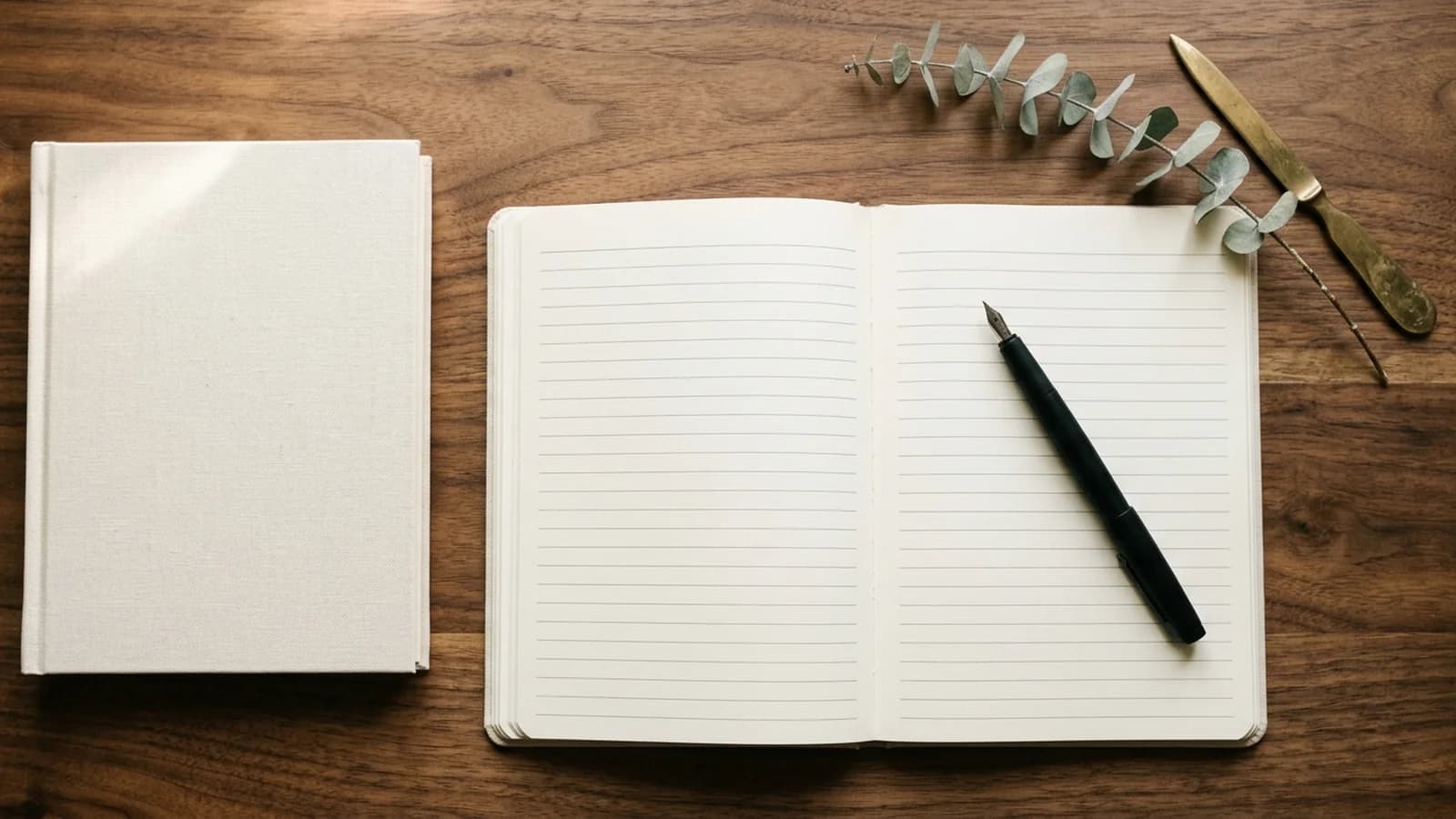
Traditional horizontal ruled lines for free-form writing. The default for diaries, line-a-day journals, and writing prompts. Line spacing: 0.275 inch for adults, 0.4 inch for seniors or large-print editions. Margins: 0.5 inch outer, 0.75 inch inner (gutter).
2. Dot grid
Tiny dots in a 5mm grid for bullet journaling. The bujo audience is small but extremely brand-loyal and willing to pay premium prices. Dot spacing: 0.2 inch (5mm) centre to centre. Dot weight: 0.5pt grey 30%, light enough that pen strokes dominate but visible enough to guide the layout.
3. Blank
Completely blank pages for sketching, doodling, or freeform notes. Strong for sketchbooks, art journals, and visual thinkers. Margins of 0.5 inch all around. Avoid headers and page numbers on blank-page journals - they distract from the open canvas feel.
4. Undated planner
Daily or weekly time-based layouts with no preprinted dates. The user fills in the date. Sells year-round because there is no shelf life. Standard structure: 12 monthly overview spreads (Month 1 through Month 12), each followed by 4 to 5 weekly spreads. Most successful undated planners run 150 to 180 pages.
5. Themed or guided (with prompts)
Page-by-page prompts that guide the buyer through reflection. Common in gratitude, prayer, self-help, and goal journals. Each page has 1 to 3 prompts plus writing space, or a single big prompt with the full page reserved for the response. Premium pricing because the prompts are the actual product.
Step 4: Choose the trim size
Three trim sizes cover roughly 95 percent of the journal and planner market. Match the trim to the use case, not personal preference.
6 x 9 inches - the standard journal trim
Fits in a handbag, looks professional in product photography, matches buyer expectations for personal journals. Use this trim for gratitude journals, prayer journals, dream journals, writing journals, line-a-day journals, and any journal a buyer carries with them. Print cost runs roughly $3.40 at 200 pages, which leaves comfortable margin at the $7.99 to $9.99 price point.
8.5 x 11 inches - the planner and fitness journal trim
Larger writing space for daily planners, fitness logs, business journals, and any journal that needs charts or tables. The trade-off is the book does not fit in most handbags, so it lives on a desk or nightstand. Print cost runs roughly $4.60 at 200 pages, which supports the $9.99 to $14.99 price tier.
5 x 8 inches - the pocket trim
Smaller niche size for pocket journals, travel logs, and ultra-portable formats. Margins get tight so layouts must be simple. Tolerates lower pricing ($4.99 to $7.99) but the smaller size also keeps print costs down. Avoid for prompt-heavy guided journals - the writing space disappears.
Need exact cover dimensions for your page count? Plug the numbers into the KDP cover size calculator and it outputs total width, height, and spine width in seconds.
Step 5: Page-count economics - 50, 100, or 150 pages?
Page count is the lever most new publishers get wrong. Too few pages and the spine has no text and the book feels disposable. Too many pages and the print cost eats the royalty. Three thresholds drive the decision.
| Pages | Print cost (6x9, B&W) | Spine text? | Best use |
|---|---|---|---|
| 50 | $1.60 | No | Promo or tiny niche logbooks |
| 80 | $1.96 | Yes (minimum) | Light themed journals |
| 100 | $2.20 | Yes | Gratitude, prayer, dream |
| 120 | $2.44 | Yes | Standard guided journal |
| 150 | $2.80 | Yes | Fitness journal, weekly planner |
| 200 | $3.40 | Yes | Full undated planner |
Below 80 pages the spine is too narrow to fit text and the book disappears on a shelf. 100 to 120 pages is the sweet spot for most themed journals. 150 to 200 pages is the planner tier. Above 220 pages KDP prints with a thicker spine that adds noticeable cost and slows international shipping.
Build print-ready journal interiors without the PDF headaches
KDPEasy generates KDP-formatted journal and planner interiors at the right trim size, page count, and layout. Pick a niche and ship.
Start freeStep 6: Prompts and reflection space
Prompts are the single biggest differentiator between a 3-star and a 5-star journal. Get the prompt density right and reviews stay positive.
- Gratitude journal: 1 to 3 prompts per page ("Today I am grateful for...", "What made me smile today?", "A win I want to remember")
- Guided journal: A different prompt on every page (100+ unique prompts per book)
- Fitness journal: No prompts but structured tracking sections per day - exercise log, hydration, sleep, macros
- Prayer journal: A scripture verse plus 2 prompts per page (gratitude, requests, reflection)
- Dream journal: Date field, dream summary section, interpretation prompt, emotion tracker, small dot grid for sketching
- Line-a-day journal: One line per day, 5 entries per page (one for each year of a 5-year journal)
- Parenting memory journal: Milestone slots, monthly reflection prompts, photo placeholders
Too few prompts feels lazy ("This is just lined paper with a cover"). Too many prompts feels restrictive ("Where do I write my own thoughts?"). Match prompt density to the niche convention - prayer journals can carry more prompts because users want guidance, while general writing journals need breathing room.
Step 7: Cover design conventions for journals
Journal covers follow stricter conventions than novel covers because the buyer is judging the use case in two seconds on a thumbnail. Three rules.
Rule 1: clean and calming, not busy
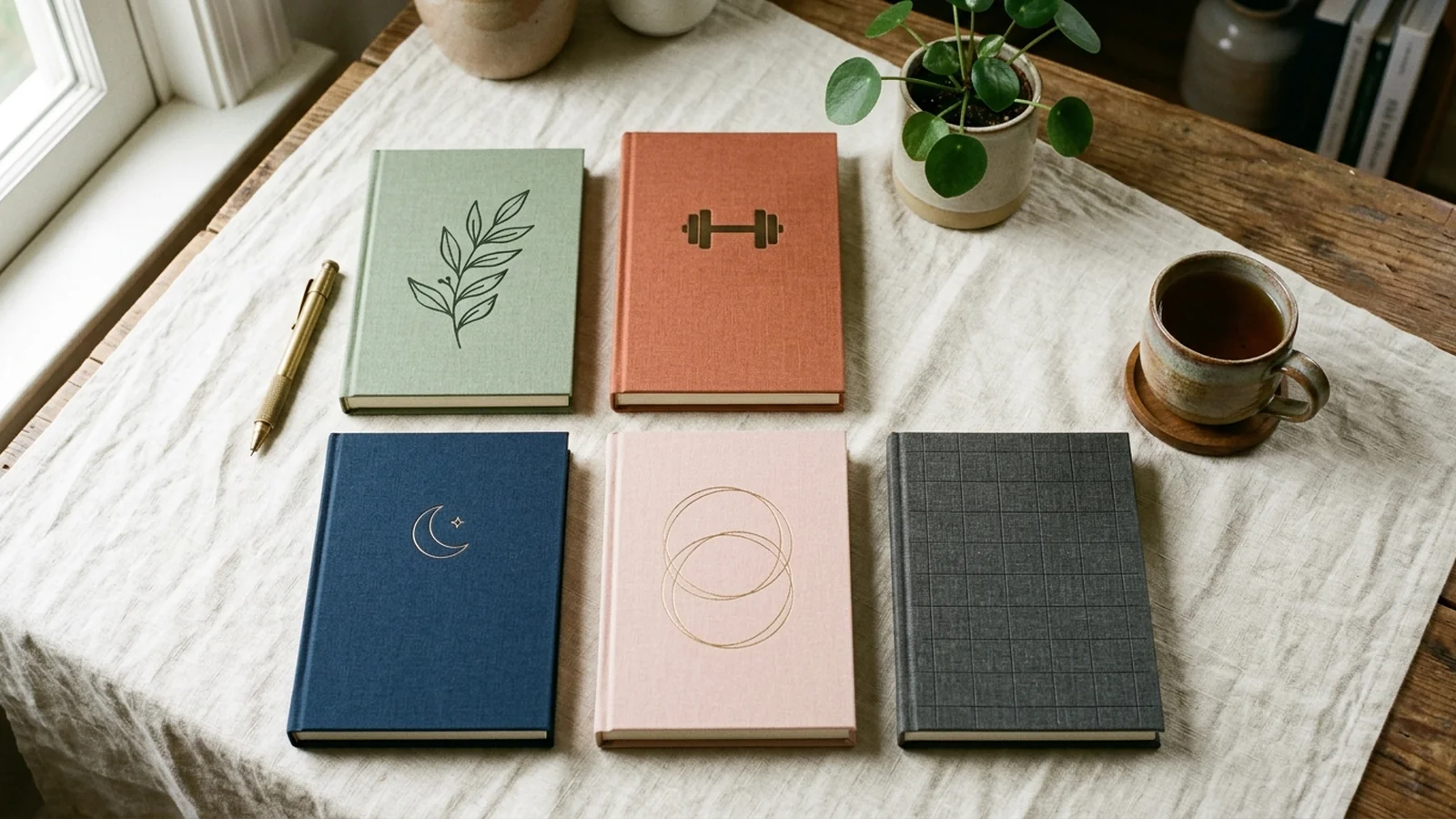
Journals are products people interact with daily. The cover should feel calm. Avoid stock photo collages, busy patterns, and screaming text. The strongest performing journal covers use 60 to 80 percent negative space, one clear focal element, and one title in a confident typeface.
Rule 2: single visual element that telegraphs the niche
Generic abstract patterns compete with millions of identical journals. The cover must telegraph the use case in a single glance. Examples that work in 2026:
- Fitness journal: a single dumbbell silhouette, water bottle, or athletic shoe
- Gratitude journal: a sprig of eucalyptus, a small bird, or a single hand-drawn star
- Prayer journal: praying hands silhouette, a cross, or a single dove
- Dream journal: a crescent moon, a constellation, or a stylized cloud
- Pregnancy journal: a leaf shape, a heartbeat line, or a stylized circle
- Travel journal: a compass, a paper plane, or a vintage map detail
Rule 3: niche-appropriate colour palette
Each niche has expected palettes. Buyers scan thumbnails on those palettes. Fight the palette and the click-through rate drops.
- Gratitude, mindfulness: sage green, warm cream, dusty rose
- Fitness, productivity: charcoal, deep red, electric blue
- Prayer, spiritual: navy, gold, soft beige
- Dream, sleep: deep navy, lavender, soft white
- Parenting, pregnancy: blush pink, soft blue, warm cream
- Travel, adventure: terracotta, deep teal, sandy beige
Step 8: The 7 fastest-selling KDP journal niches in 2026
These seven niches consistently outperform every other journal segment on KDP in 2026. Pick one for your first book.
1. Fitness and wellness journals
The category leader. The query "fitness journal design elements that increase sales" alone draws several hundred monthly searches in 2026, and the broader cluster (workout trackers, weight loss journals, calorie trackers, macro logs, meal planners) consistently leads volume. High-converting fitness journals include:
- Daily exercise log with sets, reps, and weight columns
- Weekly weight or body-measurement tracker
- Weekly progress-photo placeholder pages
- Hydration tracker (8 glasses per day)
- Sleep duration and quality tracker
- Macro and calorie sections per day
- Weekly meal-prep grid with prep notes
- Before and after pages every 4 weeks
- Goal review pages every 4 weeks
Premium fitness journal covers feature dumbbells, water bottles, gym shoes, or athletic photography. Skip abstract patterns - buyers want to see the use case represented on the cover. Pricing: $9.99 to $14.99 at 8.5 x 11 inches with 120 to 160 pages.
2. Gratitude journals
Sustained demand from the wellness market. Classic format: morning gratitude section, evening reflection section, weekly wins page. Page count: 100 to 120. Trim: 6 x 9. Price: $6.99 to $9.99. The 5-minute gratitude format is the dominant template in 2026.
3. Prayer journals
Christian market is loyal and well-defined. Each page typically pairs a scripture verse with prayer prompts and answered-prayer tracking. Targeted denominational versions (Catholic, Baptist, Lutheran, Pentecostal) outsell generic prayer journals roughly 2:1. Trim: 6 x 9. Price: $8.99 to $11.99.
4. Dream journals
Smaller niche but very low competition. Structure each page with date, dream description, interpretation prompts, mood tracker, and a small dot grid for sketching dream imagery. Price tolerates $8.99 to $11.99 because the niche is specialized. Trim: 6 x 9.
5. Line-a-day journals (5-year format)
One line of writing per day, five years per page. The classic format takes a date stamp (Jan 1, Jan 2, etc.) and stacks five years of one-liners under each date. Customer satisfaction is extremely high because the journal becomes more valuable over time. Trim: 6 x 9. Pages: 200. Price: $9.99 to $12.99.
6. Parenting and memory journals
Memory keepers, milestone trackers, baby's first year journals, pregnancy journals, school-year memory books. High gift purchase rate because new parents receive multiple. Higher price tolerance ($9.99 to $14.99) and strong series potential ("First Year", "Toddler Years", "School Years"). Trim: 8.5 x 11.
7. Work and business journals
Goal trackers, sales logs, project journals, meeting notes, founder journals, productivity planners. The B2B angle gives this category strong holiday gift demand (especially November and December for end-of-year planning). Trim: 6 x 9 or 8.5 x 11. Price: $9.99 to $14.99. Add-on niches: recovery journals, mindfulness journals, travel journals all share the same buyer profile and structural conventions.
Design your journal cover in minutes
Our AI book cover generator builds journal-ready covers in seconds. Pick a niche, choose a style, and export print-ready KDP files.
Generate coverStep 9: Pricing strategy
Journal pricing is more flexible than coloring books or puzzle books because the niche matters more than the page count. Use this table as the starting point and adjust against print cost.
| Type | Trim | Pages | Price range |
|---|---|---|---|
| Generic lined journal | 6 x 9 | 100 | $5.99 to $7.99 |
| Gratitude journal | 6 x 9 | 100 to 120 | $6.99 to $9.99 |
| Prayer or themed journal | 6 x 9 | 120 | $8.99 to $11.99 |
| Fitness journal | 8.5 x 11 | 120 to 160 | $9.99 to $14.99 |
| Undated planner | 8.5 x 11 | 150 to 200 | $9.99 to $14.99 |
| Specialty logbook | 6 x 9 or 8.5 x 11 | 100 to 150 | $9.99 to $14.99 |
Run your specific page count through the KDP royalty calculator before settling on a price. Royalty per Amazon-direct sale at 60 percent of list minus print cost: a $9.99 gratitude journal at 100 pages on white paper earns roughly $3.79 per copy. A $14.99 fitness journal at 150 pages earns roughly $6.19. Both sustain consistent volume in the right niche.
Step 10: Series strategy
Standalone journals work but series compound. Two series formats dominate KDP in 2026.
Format 1: 4-book seasonal set
Spring, Summer, Fall, Winter journals with identical interior layouts but different seasonal covers. Buyers stack all four because the cover variation makes them feel like distinct products. Pricing stays consistent across all four volumes. Launch all four at once.
Format 2: Themed sequential series
Stage-based volumes within a single theme:
- Parenting: "Pregnancy", "Newborn", "First Year", "Toddler", "School Years"
- Fitness: "Beginner 12-Week Plan", "Strength Building 12-Week Plan", "Endurance 12-Week Plan"
- Prayer: "Morning Prayer Journal", "Evening Prayer Journal", "Family Prayer Journal"
- Business: "Year 1 Founder Journal", "Year 2 Scale Journal", "Year 3 Operator Journal"
- Travel: "Europe Travel Journal", "Road Trip Journal", "Family Vacation Journal"
Launch with at least 3 volumes simultaneously. Single-volume launches under-perform because the Amazon algorithm has no series signal to amplify. For broader niche-research methodology that applies equally to journals, the KDP niche research system walks through the demand and competition signals to look for.
Run the numbers before you price
Our royalty calculator shows exact royalty per sale at every price point given your trim size, page count, and distribution channel.
Calculate royaltyStep 11: Upload metadata that ranks
Title formula
The title structure that consistently outperforms: [Niche] Journal: [Subtitle with Benefit] | [Optional Volume Number]
- "Fitness Journal for Women: 12-Week Workout & Nutrition Tracker | Volume 1"
- "Gratitude Journal for Women: 5-Minute Daily Practice for a Happier Life"
- "Prayer Journal for Christian Women: A 12-Week Scripture & Reflection Guide"
- "5-Year Memory Journal: One Line a Day for Five Years"
- "Undated Weekly Planner: Goal Setting & Productivity Tracker"
Keywords (use all 7 slots)
Real keyword sets that move journals in 2026:
- fitness journal for women workout tracker
- workout planner daily exercise log
- fitness planner notebook for women
- gym journal weight lifting log book
- workout journal for women 12 week
- fitness tracker journal paperback
- exercise log book for women workout
For the deeper keyword methodology (long-tail discovery, reverse ASIN, low-content modifiers), the low-content book keywords guide walks through the full process.
Categories
The strongest browse categories for journals:
- Books > Self-Help > Journal Writing
- Books > Health, Fitness & Dieting > Exercise & Fitness (fitness journals)
- Books > Christian Books & Bibles > Christian Living > Prayer (prayer journals)
- Books > Parenting & Relationships > Family Activities (parenting journals)
- Books > Business & Money > Skills (business journals)
- Books > Crafts, Hobbies & Home > Crafts & Hobbies (creator journal PDF, hobby journals)
Common mistakes that tank journals
Generic covers
Abstract patterns and stock photo flowers compete with millions of identical journals. The cover must telegraph the use case: dumbbells for fitness, praying hands for prayer, ultrasound silhouette for pregnancy. Niche-specific imagery wins.
Too many prompts that constrain users
Three prompts per page is helpful. Seven prompts per page is overwhelming. Match prompt density to the niche convention - prayer journals can carry more prompts because users want guidance, while general writing journals need breathing room.
Publishing identical templates with different covers
KDP's duplicate-template filter catches identical interiors across multiple titles. You need at least one differentiating element per book: a different prompt set, a different cover, a different page count, or a different layout. The "100 covers, 1 interior" strategy stopped working in 2022.
Dating the journal unnecessarily
A "2026 Planner" stops selling in January 2026. An "Undated Weekly Planner" sells year-round. Unless you have a calendar reason (academic year, fiscal year), default to undated.
Skipping the proof copy
Paper feel matters more for journals than any other KDP product type. Buyers write in them. A $7 proof reveals whether the paper handles ink without bleed-through and whether the binding lies flat enough to write on the inner gutter pages.
Pre-submission quality check
- Page count is even and at least 80 pages (for spine text)
- Cover represents the niche (not generic patterns)
- Interior has at least one differentiating element vs other titles in the catalogue
- Prompt density matches the niche convention
- Title includes the exact format word (Journal, Planner, Notebook, Logbook)
- Undated layout unless there is a calendar reason for dates
- All 7 keyword slots filled with long-tail phrases
- AI disclosure box answered correctly during upload
- If part of a series, volume number is clearly marked
Launch timeline
- Day 1: Build interior layout, write prompts if needed (2 to 4 hours)
- Day 1: Design cover, export PDFs at 300 DPI
- Day 1: Upload to KDP, fill metadata, set price - use the click-by-click flow in our cover upload guide
- Day 1: Order proof copy
- Day 7: Proof arrives, check paper handling and cover
- Day 8: Publish
- Day 9 to 10: KDP approves
- Day 15 to 17: Book fully indexed in Amazon search
- Day 30 to 60: Launch second volume of the series
For the broader landscape of fitness and wellness books on KDP, the fitness and health books on Amazon KDP guide covers the larger category including non-journal formats.
Publish your first journal this week
KDPEasy generates print-ready journal interiors and KDP-compliant covers. Pick a niche, choose a layout, and ship a full series instead of a single title.
Get started freeA FEW MORE ANSWERS
Frequently asked questions
KDP defines a low-content book as a paperback or hardcover with mostly blank or templated pages and minimal authored text - notebooks, journals, planners, sketchbooks, log books, and password keepers all fall in this category. The current minimum is 24 pages with an even page count and a valid cover that meets the same specs as any other paperback. Pure low-content (lined notebooks, dot grid pads) faces a duplicate-template filter that rejects identical interiors across multiple titles. Journals with original prompts, planners with structured layouts, and themed logbooks are classified as activity or self-help titles instead, which opens up better browse categories.

ABOUT THE AUTHOR
Danielle Okonkwo
Marketing & Growth Lead at KDPEasy. Danielle is a published author with 12+ titles on Amazon KDP and a former book blogger. She draws on hands-on publishing experience and years of testing what works in the KDP marketplace.
Meet Danielle