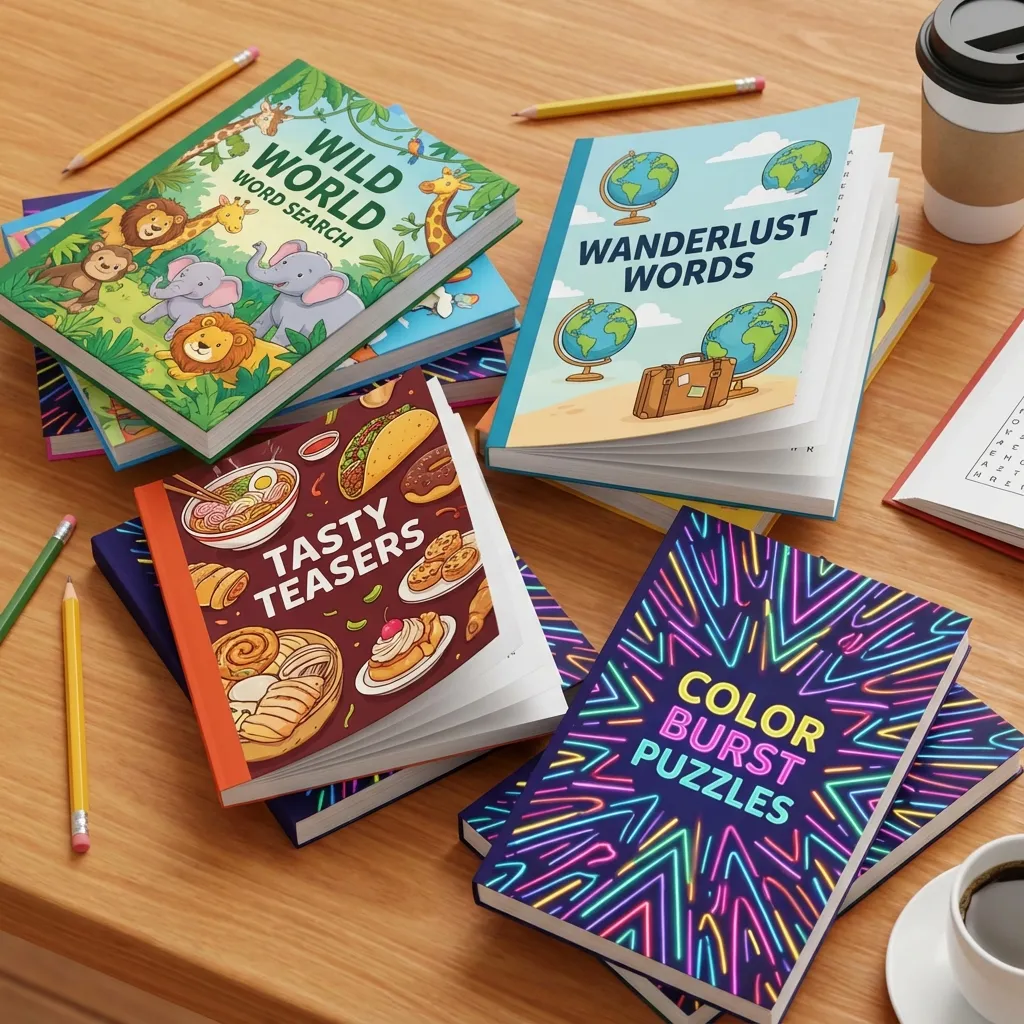

A 200 puzzle word search book that earns $300 a month is a four hour build once you know the workflow. The trap most first time publishers fall into is treating "make a puzzle book" as a creative project. It is a production process. The publishers who scale to $5,000 a month do not write better puzzles. They run the same 10 step pipeline on 30 titles a year. Here is that pipeline, with the exact specs, the math, and the three example walkthroughs that show it in motion.
Step 1: Pick a niche (puzzle type plus theme plus audience)
The single biggest predictor of a puzzle book's success is the specificity of its niche. A book titled "Word Search Volume 1" competes with roughly 200,000 listings on Amazon. A book titled "Word Search for Bird Watchers: 100 Themed Puzzles, Large Print" competes with about 180. Same author effort. Two orders of magnitude difference in rank-ability.
A workable niche needs three layers stacked together.
- Puzzle type: word search, sudoku, crossword, maze, logic, kakuro, or a mixed activity book.
- Theme: a specific interest, hobby, fandom, season, or profession (bird watching, gardening, classic rock, RV camping, Christmas, nurses).
- Audience: an age, an accessibility tier, or a use case (kids 6 to 8, large print seniors, dementia care, travel paperback).
Stack the three and you get a search query that 50 to 500 people type into Amazon every month but that has 50 to 800 competing listings. That is the publishable zone. Examples of niches that hit the zone in 2026:
- Large print word search for seniors with dementia, calming themes
- Dinosaur mazes for kids ages 6 to 8
- Sudoku for nurses on night shift
- Christmas word search large print
- RV camping activity book, mazes plus word search
- Bird watching word search for adults
For a deeper breakdown of which puzzle types pair with which audiences, see the best puzzle book types for Amazon KDP guide. For audience research and demand sizing, the keyword research tool shows monthly search volume and competition for any niche query.
A note on what KDP calls these books
Amazon KDP classifies puzzle books with prompts and a solutions section as activity books, not low content books. That matters because activity books unlock the "Books > Humor & Entertainment > Puzzles & Games" tree, which is where buyers actually shop. Low content books get filed under stationery and rarely reach puzzle buyers. If your book has solvable puzzles plus solutions, tick it as an activity book during upload.
Step 2: Choose your puzzle type
The four mainstream KDP puzzle types each have very different production economics. Resist the temptation to bundle different types into one book on your first launch. Mixed difficulty and mixed type titles sell at roughly one third the rate of single-type titles, because buyers want to know exactly what they are getting.
| Puzzle type | Production time per book | Audience size | Typical royalty per sale | Difficulty for beginners |
|---|---|---|---|---|
| Word search | 3 to 5 hours | Huge (ages 8 to 90) | $2.00 to $4.50 | Easiest |
| Sudoku | 4 to 6 hours | Large, dedicated | $2.50 to $4.00 | Easy |
| Maze | 3 to 6 hours | Strong in kids | $2.40 to $4.00 | Easy |
| Crossword | 30 to 60 hours | Medium, loyal | $3.00 to $5.00 | Hard |
| Mixed activity | 5 to 8 hours | Strong gift market | $3.00 to $5.50 | Medium |
For first-time publishers, word search wins on every dimension that matters: production speed, audience size, generation simplicity, and the breadth of themes you can layer on top. Mazes are a close second for the kids segment specifically, covered in how to create maze puzzle books for KDP.
Step 3: Generate puzzles and solutions
Three options exist for generating puzzles at scale, and they sit on a steep cost-to-time curve.
Free puzzle generators for KDP
Free puzzle generators for KDP exist for every puzzle type. QQWing generates sudoku with verified unique solutions and difficulty grading. Puzzle Maker (Discovery Education) builds word search grids one at a time. MazeGenerator.net produces print quality mazes in SVG. These are valid, royalty-free, and the puzzles they generate are public domain when produced from your own word lists or seeds. The constraint is throughput: one puzzle per click, then manual layout in InDesign or Affinity. A 200 puzzle word search book takes 12 to 20 hours of layout work even with a free generator.
Paid puzzle generator for KDP
Paid all-in-one tools like KDPEasy generate the puzzles and produce a print-ready PDF in one step. Batch a themed word list, pick the difficulty, and the system outputs a 200 puzzle word search book with solutions, page numbers and front matter, ready to upload. The same flow works for sudoku, mazes, crosswords and mixed activity books. A 4 to 6 hour build instead of 20. For publishers who target 1 book per week, the math pays for the subscription in the first release.
Custom puzzle commissions
Hire a puzzle designer on Fiverr or Upwork for $30 to $80 per book of generated grids, $80 to $200 for crossword clue sets. Useful for crossword books where every clue is original copy. Overkill for word search or sudoku where the cost per puzzle is roughly free.
Skip the layout work entirely
KDPEasy generates print-ready KDP puzzle interiors with grids, solutions, and correct page counts in a single export. Word search, sudoku, mazes, crosswords. Free to try.
Create my puzzle book freeStep 4: Do the page count math
Page count is the parameter that drives print cost, spine width, and your final royalty. Get it wrong and the book either looks underpriced or eats your margin. Here is the math for a typical 100 puzzle word search book.
| Section | Pages | Note |
|---|---|---|
| Title page | 1 | Book title, subtitle, volume, author |
| Copyright page | 1 | Always page 2 |
| How to play / instructions | 1 | Mention solutions are at the back |
| Blank / "Let's begin" | 1 | Ensures puzzles start on odd pages |
| Puzzles | 100 | One grid per page |
| Solutions divider | 2 | Divider plus blank |
| Solutions | 50 | Two solutions per page, compact |
| Back matter | 2 | "Other books in this series" |
| Total | 158 pages | Even number, spine width 0.36 inches on white paper |
Two hard rules: the page count must be even (KDP rejects odd page PDFs), and it must be at least 80 pages if you want text on the spine. For exact spine width by paper type, run the numbers through the KDP spine width calculator.
For the full interior layout specs - margins, gutter, font sizing, two-page spreads, solution placement - see the companion guide on puzzle book interior formatting for KDP.
Step 5: Design the cover
The cover is the only marketing asset that gets seen before the listing copy. Two thirds of puzzle book buyers scroll the category grid and tap on the cover image alone. Treat it like a billboard, not a portrait.
Cover requirements (KDP)
- Single PDF spread (front, spine, back as one continuous file)
- 0.125 inch bleed on the three outside edges
- CMYK color, 300 DPI minimum
- Spine width depends on page count and paper. Use the KDP cover size calculator to get the exact dimensions.
- No spine text if under 80 pages
Cover conventions that sell
- Big title: Readable at thumbnail size (about 200 pixels wide on the search results page). Sans-serif, bold, high contrast.
- Volume number: Prominent if part of a series. Buyers who finished Volume 1 want to spot Volume 2 fast.
- Theme imagery: One clear photo or illustration that matches the theme. Avoid stock pencil-and-paper imagery unless it is your differentiator.
- "Large Print" badge: If applicable, place it in a corner ribbon. Senior buyers scan for this specifically.
- Puzzle count: "100 puzzles" or "200 puzzles" on the cover. Counts perceived value.
For a deeper cover playbook see the best KDP cover generator tools and the AI book cover generator which produces print-ready KDP covers in minutes.
Step 6: Export the print-ready PDF
This is the step where most first-time publishers create the upload errors that bounce their book. Run through this checklist before clicking export.
PDF export specs that pass KDP review
- Format: PDF/X-1a:2001 preferred, regular PDF 1.4 to 1.7 acceptable
- Resolution: 300 DPI for grids, 600 DPI for fine crossword cell numbers
- Color mode: Grayscale interior (puzzle books rarely use color), CMYK cover
- Fonts: Embed all fonts. Subset embedding is allowed.
- Bleed: No bleed on the interior unless you have full-page decorative borders
- Page count: Even, minimum 24 pages, maximum 828 pages
- File size: Under 650 MB
- Trim marks: Do not include crop or trim marks. KDP handles trimming.
- Transparency: Flatten before exporting
The error messages that get thrown most often: "Page count must be even" (add a blank back page), "Interior text not embedded" (re-export with embed-all-fonts enabled), "Cover dimensions do not match interior" (page count changed between export and cover generation - regenerate the cover with the new spine width).
Step 7: Upload to KDP
The KDP upload flow takes 30 to 60 minutes the first time and 15 minutes once you have the template. Sign in to kdp.amazon.com, click "Create new title", select Paperback, then fill out the metadata.
Title and subtitle
Title is the most important on-page SEO field. Stack the main keyword first, then the audience, then the format. Real examples that rank in 2026:
- "Large Print Word Search for Seniors: 100 Easy Puzzles with Themed Word Lists, Volume 1"
- "Dinosaur Mazes for Kids Ages 6 to 8: 80 Fun Maze Puzzles with Solutions"
- "Sudoku Puzzle Book for Adults: 200 Easy to Hard Sudoku with Step-by-Step Solutions"
Description (1,500 to 2,000 characters of HTML)
Write three or four paragraphs of sales copy, formatted with bold tags for scannability. Open with a hook for the audience, then list the value (puzzle count, large print, themed lists), then close with use cases (gift, travel, relaxation) and a soft CTA. Don't use em dashes or all-caps "FREE" promises. KDP's editorial filters can flag them.
Keywords (7 slots)
Fill all seven. Use long tail phrases. Never repeat a word that already appears in your title, because KDP de-duplicates automatically. For a large print senior word search book:
- word search books for adults large print
- large print puzzle books for seniors
- brain games for adults word search
- word search puzzles for seniors easy
- relaxing puzzle books for adults
- word search book paperback large print
- word search book volume 1 series
Categories (pick 2, request 8 more later)
Choose the two most specific categories at upload, then email kdp-support to add up to 8 more after publication. Top categories that move puzzle books:
- Books > Humor & Entertainment > Puzzles & Games > Word Search
- Books > Humor & Entertainment > Puzzles & Games > Sudoku
- Books > Humor & Entertainment > Puzzles & Games > Crosswords
- Books > Humor & Entertainment > Puzzles & Games > Mazes
- Books > Self-Help > Memory Improvement (senior books)
- Books > Health, Fitness & Dieting > Aging > Mental Health
- Books > Children's Books > Activities, Crafts & Games > Activity Books (kids)
Step 8: Set the price
Pricing is the second highest signal of quality on a puzzle book listing, right after cover design. Underpricing reads as low quality. Overpricing kills the click-through.
| Book type | Pages | Price | KDP print cost | Royalty (60%) |
|---|---|---|---|---|
| Kids puzzle book ages 4 to 8 | 80 | $6.99 | $2.30 | $1.89 |
| Standard word search adult | 158 | $7.99 | $2.86 | $1.93 |
| Standard sudoku 200 puzzles | 200 | $8.99 | $3.26 | $2.13 |
| Large print senior word search | 120 | $11.99 | $2.50 | $4.69 |
| Themed mixed activity kids | 100 | $9.99 | $2.50 | $3.49 |
The large print senior category is the highest royalty per sale on the entire puzzle market. Senior buyers explicitly search "large print" and the niche tolerates $11.99 to $14.99 without complaint. Use the KDP royalty calculator to model exact royalty for any page count and price combination.
Step 9: Order a proof copy
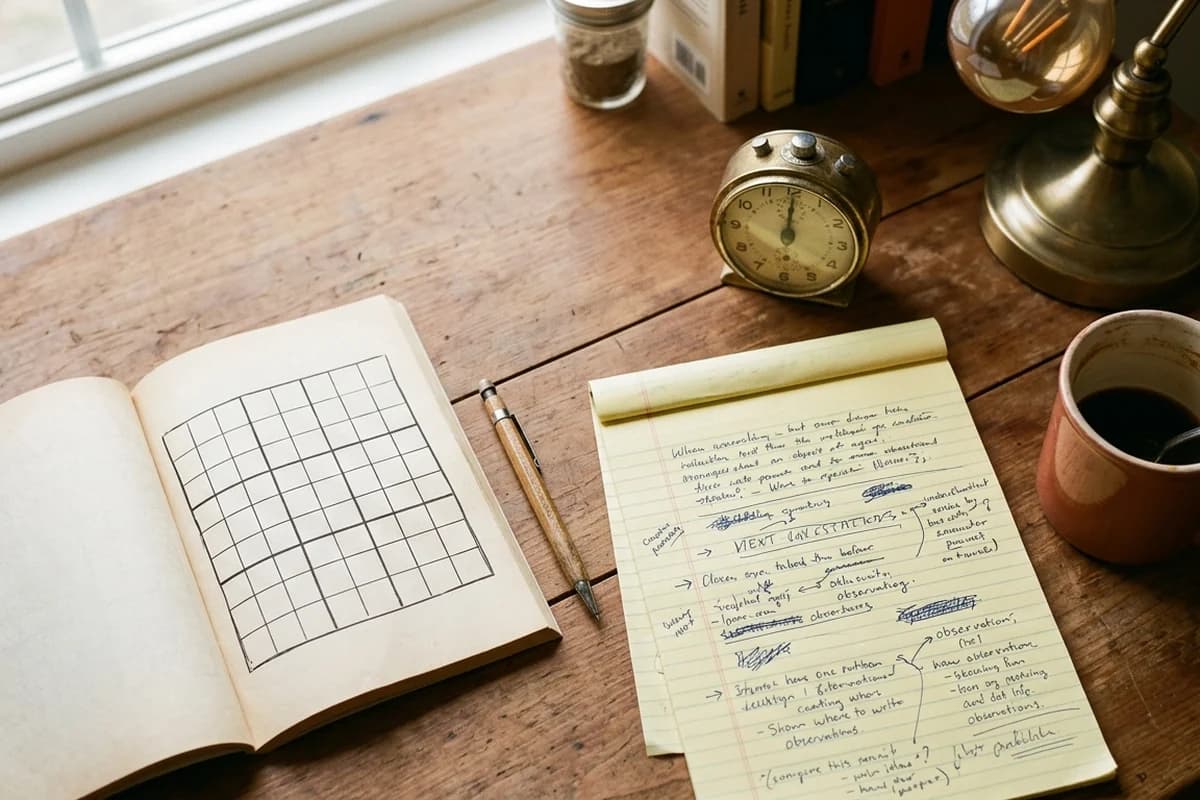
A $7 proof copy is the cheapest insurance in self-publishing. The KDP digital previewer hides four classes of problems that only show up on paper: grid alignment shifts where the spine compresses inner-edge cells by 2 to 4 millimeters, font weight rendering where bold puzzles look medium on cream paper, cover color shifts from CMYK profile mismatches, and ink bleed-through on duplex puzzle pages.
The proof flow: in your KDP bookshelf click "Request Proof Copy", choose paperback, pay print plus shipping (about $7 to $15), wait 5 to 10 days. When it arrives, do these five checks.
- Open to a center page. Can you read the gutter-side letters of the grid without flattening the book?
- Hold a puzzle page up to light. Is the next page bleeding through significantly?
- Check page 1 and the last puzzle for any printing artifacts (toner streaks, faint lines).
- Pick 5 random puzzles. Verify the solution in the back actually solves them.
- Inspect the cover spine. Is the title centered? Any color shift versus the digital preview?
Fail any of these, fix the interior or cover, re-upload, and order a second proof. It is faster than refunds and one-star reviews.
Step 10: Launch in the first 90 days
Publishing the book is the start, not the finish. The first 90 days determine whether the title compounds into long-term passive royalty or sinks into the back catalog. Here is the playbook that works.
Week 1 (launch week)
- Wait for KDP indexing to finish (5 to 10 days after approval). Do not run ads before.
- Launch with 3 volumes in the same series if possible. A single-volume series looks like a hobby title.
- Set up an Amazon Author Central page with bio, photo, and the series listed.
- Email 10 to 20 personal contacts who fit the target audience. Ask for genuine reviews if they like the book.
Weeks 2 to 4
- Open Amazon Ads at $5 to $10 a day. Start with manual targeting on 10 to 15 long-tail keywords. CPCs in puzzle categories run $0.20 to $0.50.
- Run a Goodreads giveaway for 10 to 25 paperback copies (about $80 to $200 in print cost). This drives early reviews from readers in the target audience.
- Post on the relevant subreddits and Facebook groups (r/puzzles, "Word Search Lovers" FB group, etc.). Lead with value, not promotion.
Weeks 5 to 12
- Publish 1 to 2 new volumes a month to stay in "New Releases" and lift the older volumes.
- Tune Amazon Ads: pause keywords below 0.5 percent CTR after 1,000 impressions. Increase bids on the 2 to 3 keywords driving conversions.
- Pitch 5 to 10 micro-influencers in the niche (book blogger, senior community Facebook page admin, kids activity Instagram account) with free paperback copies.
- By month 3, sales should be at 60 to 80 percent of steady state. Month 4 to 5 is typically when the curve flattens.
Run your cover and pricing math in 2 minutes
Free KDP cover size calculator and royalty calculator. Plug in page count, trim and price, get exact spine width and royalty per sale.
Open the cover calculatorThree example walkthroughs
Example 1: Large print senior word search
- Title: "Large Print Word Search for Seniors: 100 Themed Puzzles with Calming Scenic Word Lists, Volume 1"
- Puzzle count: 100 large print (12 x 12 grids, 30 point letters)
- Page count: 124 pages (4 front matter + 100 puzzles + 18 solutions + 2 back)
- Trim: 8.5 x 11 inches, white paper
- Price: $11.99
- Print cost: $2.50
- Royalty per sale: $4.69
- Time to build: 5 hours with KDPEasy
- Realistic 6-month sales: 200 to 400 copies a month at steady state
Example 2: Themed kids maze book
- Title: "Dinosaur Mazes for Kids Ages 6 to 8: 80 Fun Maze Puzzles with Solutions"
- Puzzle count: 80 mazes (progressive easy to medium)
- Page count: 100 pages
- Trim: 8.5 x 11 inches, white paper
- Price: $7.99
- Print cost: $2.35
- Royalty per sale: $2.44
- Time to build: 4 hours
- Realistic 6-month sales: 150 to 300 copies a month, with strong Q4 gift spikes
Example 3: Standard adult sudoku
- Title: "200 Hard Sudoku Puzzles for Adults: Brain-Training Sudoku Book, Volume 1"
- Puzzle count: 200 hard sudoku
- Page count: 256 pages
- Trim: 8.5 x 11 inches, white paper
- Price: $8.99
- Print cost: $3.78
- Royalty per sale: $1.62
- Time to build: 5 hours
- Realistic 6-month sales: 100 to 250 copies a month, high repeat purchase rate across volumes
Notice how the senior large print book has roughly 3x the royalty per sale of the sudoku book despite a lower retail price. That gap is what makes large print the highest-revenue segment in the entire puzzle category, covered in detail in large print word search for seniors.
Common mistakes that tank puzzle books
- Mixing difficulty in one book. "Mixed difficulty" titles sell at one third the rate of single-difficulty titles. Buyers want to know what they are getting.
- Duplicate puzzles. One duplicate puzzle in a 200 puzzle book draws 1-star reviews citing "fake puzzles". Always run your generator's dedupe check and spot check 10 random puzzles.
- Four puzzles per page. A 4 per page sudoku layout makes cells 0.3 inches. Solvers cannot write digits. Stick to 1 per page (premium) or 2 per page (economy).
- Generic titles. "Word Search Volume 1" competes with 200,000 listings. Niche down.
- Skipping the proof copy. $7 catches grid alignment, font weight, and cover color issues that digital previews miss.
- Running ads before indexing. Wastes spend. Wait until your book appears for its exact title search before opening Amazon Ads.
- Solutions interleaved between puzzles. Solvers see the next solution by accident. Always all-back-of-book.
Launch your first puzzle book this month
KDPEasy generates puzzle interiors, designs the cover, and runs the cover math in one workflow. Free to start, no card required.
Create my cover freeA FEW MORE ANSWERS
Frequently asked questions
The best puzzle generator for KDP is one that exports a print-ready 8.5 x 11 inch PDF with embedded fonts, 300 DPI grids, a numbered solutions section, and a correct even page count. KDPEasy does all of this in a single export. Free puzzle generators for KDP like QQWing (sudoku) and Puzzle Maker (word search) produce valid puzzles but require manual layout work in InDesign or Affinity Publisher before they are upload-ready. For sub-$100 budgets and weekly publishing, a paid all-in-one tool pays for itself in the first book.

ABOUT THE AUTHOR
Danielle Okonkwo
Marketing & Growth Lead at KDPEasy. Danielle is a published author with 12+ titles on Amazon KDP and a former book blogger. She draws on hands-on publishing experience and years of testing what works in the KDP marketplace.
Meet Danielle