
Leonardo AI sits in an unusual spot in 2026. It is not the prettiest model on the market, and it is not the cheapest. What it is - and what almost no one explains clearly - is the most production-friendly AI image platform for people who actually need to ship a KDP book this month. Elements for character lock-in, Canvas for surgical edits, Phoenix for prompt adherence, Kino XL for cinematic looks, and a free tier that genuinely covers a first book. This is the working guide I wish I had when I started feeding Leonardo into a real publishing pipeline.

The honest take
Leonardo wins for KDP interiors. Midjourney still wins for one-off hero covers when you want maximum aesthetic ceiling. If you are publishing a coloring book, a picture book, or a themed puzzle book, Leonardo is the right tool. If you are publishing a single thriller cover, open Midjourney instead. The rest of this guide is about getting the most out of Leonardo for the first case.
Why Leonardo wins for KDP interiors (and where it does not)
The KDP interior problem is different from the cover problem. A cover is one image. An interior is 20 to 100 images that all need to look like they came from the same artist, on a budget that survives 3 to 5 iterations per page. That changes which features matter.
Three things make Leonardo the right pick for that workload:
- Elements. Reusable style and character anchors. You upload 2 to 8 reference images, name the Element, and apply it at an adjustable weight to every subsequent prompt. The model treats it as a soft anchor, not a copy-paste, so the same character can sit, run, sleep, and the face survives. This is the single feature that justifies choosing Leonardo for a 40-page picture book.
- Canvas with inpainting. A real editing surface. You mask the extra finger, type the fix, and pay 2 to 5 tokens instead of regenerating the whole image for 12 tokens. Across a book that is a 60% token saving over the lifetime of the project.
- Commercial rights on free. Almost unique among premium AI image platforms. You can ship a complete first book on $0 of subscription if you are willing to work inside the daily token cap.
And the honest counterweights:
- Aesthetic ceiling. Midjourney v6 still produces a more painterly, more "art-directed" output for one-off hero shots. If you are publishing a single book this year and the cover is the whole product, open Midjourney.
- Generation speed. Leonardo is faster than Stable Diffusion locally, but slower than Midjourney at peak times. Build your queue and walk away.
- Prompt syntax. Less forgiving than ChatGPT-style natural language. You will spend a week learning the right adjective stacks.
The Leonardo model lineup as of 2026
Leonardo runs more than a dozen models. Most of them you can ignore. Four cover 95% of KDP work.
| Model | Strength | Use it for | Avoid for |
|---|---|---|---|
| Phoenix | Prompt adherence | Picture book scenes, characters in specific poses | Pure line art |
| Kino XL | Cinematic lighting, depth of field | Mood-driven children's books, memoir interiors, atmospheric chapter openers | Coloring books, flat puzzle art |
| Leonardo Diffusion XL | Clean line art, flat illustration | Coloring book pages, puzzle borders, simple illustrated elements | Photorealism, painterly scenes |
| Anime XL | Manga and anime style, character art | Kid and teen coloring books with character themes, manga-style activity books | Realistic non-fiction, mandala patterns |
| Flux (third-party in Leonardo) | Highest raw fidelity | Photorealistic non-fiction diagrams, premium hero shots | Volume work - costly per token |
The simple rule: Phoenix for scenes with characters, Diffusion XL for anything that needs to be flat or line-only, Kino XL when you want a cinematic feel. Everything else is a special case.
Workflow 1: Coloring book interiors
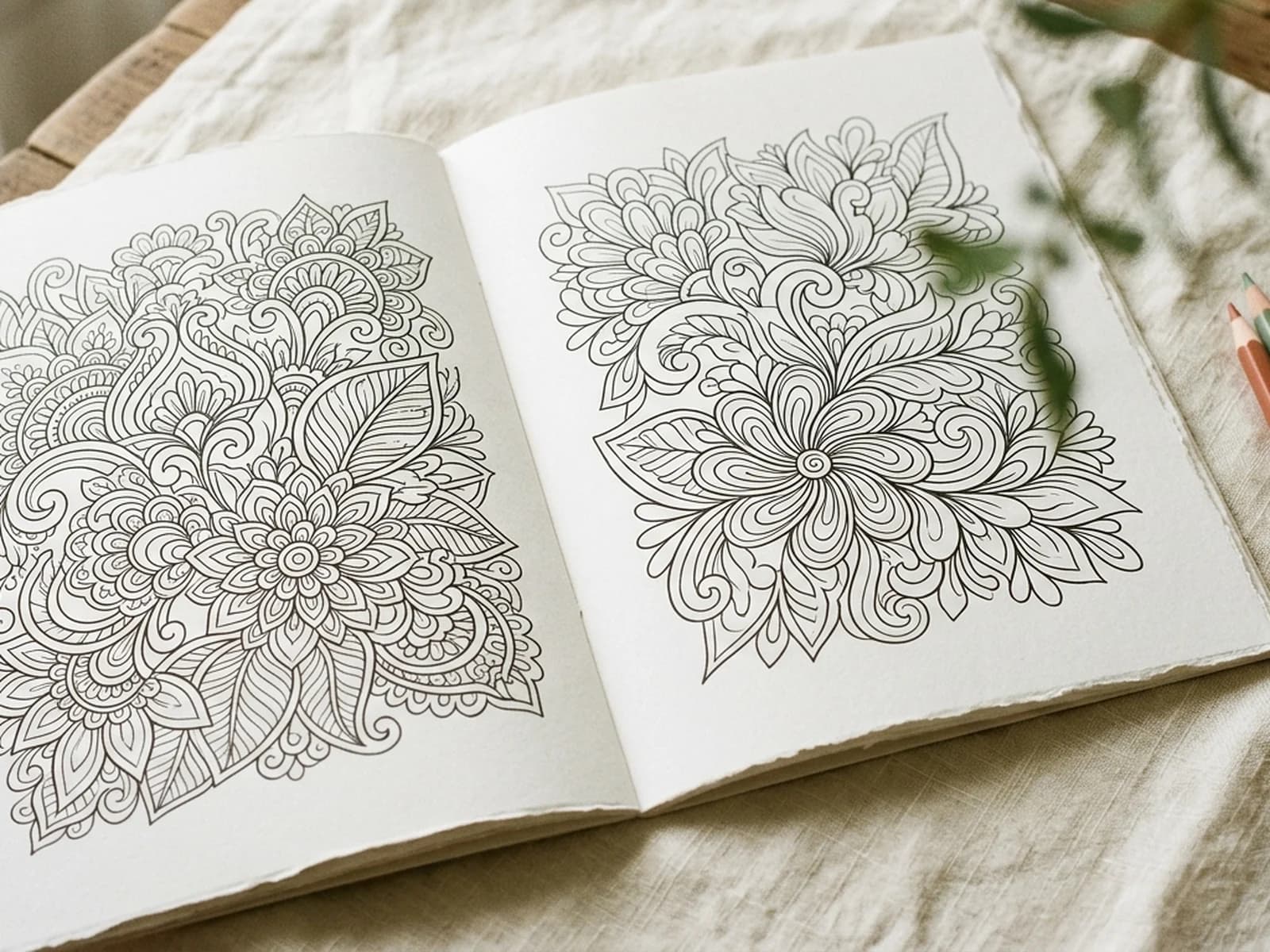
Coloring book pages are the cleanest Leonardo use case and the best place to start. The art is flat. The output is binary. The market has clear age and theme conventions. Here is the production loop I run for a 40-page book.
Step 1. Lock the visual style with one Element
Pick six reference images that share the line weight and motif density you want. They do not have to be your own art - they can be public domain prints, photographs you converted to line art, or even early Leonardo outputs you liked. Upload them as a new Element named after your book ("Botanical Mandala Lines"). Set the recommended Element weight at 0.6 to start.
Step 2. Build a single prompt skeleton
Variation should come from the subject, not the prompt structure. My working skeleton for line art:
black and white line art coloring book page, [SUBJECT], bold even outlines, pure white background, no shading, no grey tones, no fill, symmetrical composition, suitable for adult coloring, print-ready, high detail line weight
Negative prompt:
shading, gradients, grey tones, fill, color, painted, watercolor, 3d render, photograph, soft shadow, blurry, low quality, signature, watermark
Model: Leonardo Diffusion XL. Alchemy on. Size 832x1216. Guidance scale 8 to 10. Element applied at 0.6. Generate 4 images per subject, pick the cleanest, discard the rest.
Step 3. Fix in Canvas, not in regeneration
Stray marks, asymmetric petals, an awkward overlap - all of these get fixed in Canvas for 2 to 5 tokens, not regenerated for 12. Mask the area, type "clean white background" or "extend the leaf to match left side", and let it inpaint.
Step 4. Upscale and export
Run Universal Upscaler at the 2x Creative preset. That gets you to 1664x2432, which is 200 DPI at a real 8.5x11 page. For 300 DPI safety, run a second pass through Topaz Gigapixel or the KDPEasy image upscaler. Export as PNG, drop into your interior layout, and you have a coloring book page that costs roughly $0.04 to produce if you are on Apprentice.
Token budget for a 40 page coloring book
Plan for 540 to 700 tokens of real work. 40 final pages times 12 tokens per high-quality generation is 480, plus a 30% discard rate for false starts and a small allowance for Canvas edits. That fits inside one week on the free tier or two days on Apprentice ($12/month). Compare with $400 to $800 for a human illustrator and the math becomes obvious.
Workflow 2: Picture book illustrations with character consistency
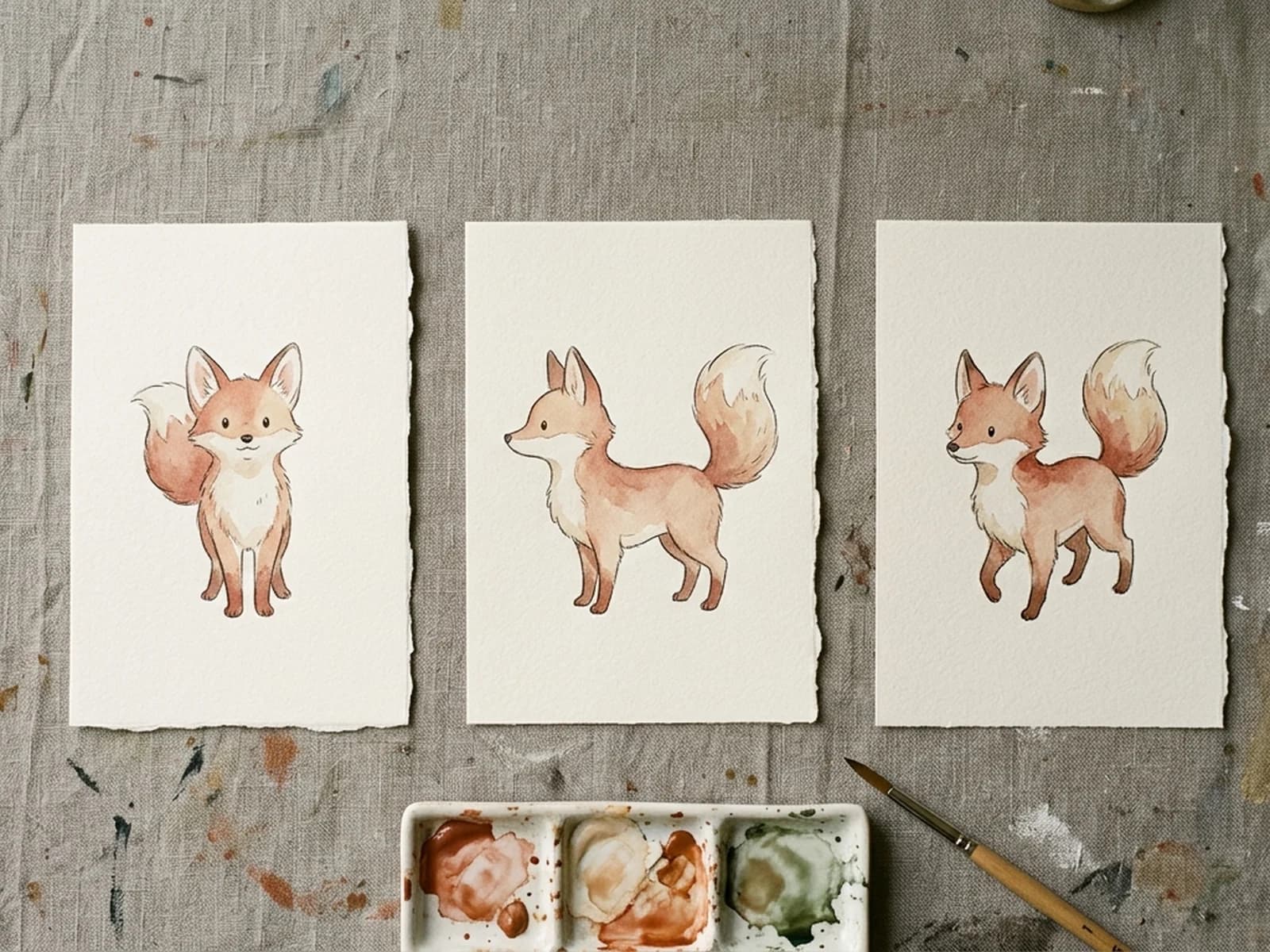
Picture books are where Leonardo earns its keep. The challenge is not generating a beautiful scene - any model can do that. The challenge is generating the same character across 24 pages while the world around them changes. Here is the loop that actually works.
- Generate the character sheet. Switch to Phoenix. Prompt: "character design sheet, three views (front, side, three-quarter), [DETAILED CHARACTER DESCRIPTION], soft watercolor illustration style, neutral white background, picture book art". Iterate until you have one image where all three views look like the same character. This usually takes 8 to 20 generations.
- Crop into three reference images. Use any photo tool to crop the front, side, and three-quarter views into separate files.
- Upload as a Character Element. Create an Element named after your hero ("Mira the Fox"). Upload all three crops. Set default weight to 0.7.
- Write scene prompts that ignore the character. Counter-intuitively, you should describe the scene and the action, not the character. Let the Element handle the visual identity. Example: "wide picture book illustration, a small fox cub stands at the edge of a misty forest at dawn, looking curious, soft warm light filtering through tall pines, painterly watercolor style, gentle palette of teal and gold". The Element provides the fox. The prompt provides the world.
- Tune the Element weight per scene. Close-ups need higher weight (0.8 to 1.0) to keep the face exact. Wide environmental shots can drop to 0.5 so the character integrates with the scene. Test both ends and you will see the pattern.
For the story craft side - how to structure those 24 pages, where the emotional beats land, and which age group word counts to target - read our picture book story writing guide. For the illustration aesthetic decisions, see our picture book illustration guide.
Workflow 3: Puzzle book art
Leonardo cannot generate a real solvable maze or crossword grid - and you would not want it to. What it does excellently is the decorative skin of a puzzle book: themed borders, chapter dividers, mascots, section openers, and the small motifs that turn a plain word search into a giftable book. Here is the pattern.
- Define the visual theme. "1950s diner", "cottagecore garden", "underwater adventure". Pin it tight; loose themes produce inconsistent art.
- Build a style Element from 4 to 6 example illustrations that match your theme. Keep them flat and simple.
- Generate the asset set. Use Diffusion XL with a flat illustration preset. Prompt skeleton: "flat illustration, [SUBJECT], simple vector style, transparent background, even line weight, no gradients, suitable for puzzle book decoration". Generate a border, three chapter dividers, one mascot in two or three poses, and a back-cover element.
- Drop the assets into your puzzle layout. The puzzles themselves come from a dedicated generator - see our word search book guide or maze puzzle book guide. Leonardo handles the chrome around them.
Build a print-ready cover for any Leonardo interior
Once your interior pages are dialed in, you still need a cover that sells. KDPEasy turns a prompt and a trim size into a print-ready KDP cover in minutes.
Create your cover freeLicensing and commercial use, in plain English
This is where most "Leonardo for KDP" articles get vague. Here is the simple version, accurate as of the 2026 terms of service:
- You own commercial rights to your outputs. Including on the free tier. Including for print-on-demand, ebooks, merchandise, and physical products.
- You do not own a copyright on AI-generated images in the US. US Copyright Office guidance through 2026 is that purely AI-generated images cannot be copyrighted by you. Your book as a compilation, including layout, text, and selection, is copyrightable. The individual AI images inside it are not.
- Amazon KDP requires AI disclosure. During the publishing flow, KDP asks if AI was used. Answer honestly. There is no penalty for saying yes. There is a real penalty (account-level) for being caught lying.
- You cannot generate copyrighted characters or trademarked logos. No Mickey Mouse, no Pikachu, no Coca-Cola can. Leonardo's filters catch most of this but not all of it. Your liability if you push around them.
- Real human likenesses are gray. Avoid prompting for named celebrities. Generic "older woman with grey hair" is fine; "Helen Mirren as a wizard" is not.
Subscription tiers and what they actually buy
| Tier | Price | Tokens/month | Worth it for |
|---|---|---|---|
| Free | $0 | 4,500 (150/day) | First book. Testing. Hobbyist publishing 1 to 2 books a month. |
| Apprentice | $12 | 8,500 | 3 to 8 books a month. Private generations. The sweet spot for independent KDP authors. |
| Artisan | $30 | 25,000 | 10+ books a month. Multi-pen-name catalogs. Full-time low-content publishers. |
| Maestro | $60 | 60,000 | Agencies and teams. Most independent authors never need this. |
The honest path: start free, ship one full book, then upgrade to Apprentice the first time you hit the daily cap with momentum. Skip the higher tiers until your KDP revenue justifies them.
Common pain points and the fixes that ship
Pain 1. The character changes between page 4 and page 14
Cause: you stopped using the Element halfway through, or you let the Element weight drift below 0.5 on scene prompts. Fix: lock the Element weight at 0.7 minimum for all scenes, raise to 0.85 for close-ups, and re-generate any drift pages.
Pain 2. Coloring pages come out grey and shaded
Cause: wrong model or weak negative prompt. Fix: switch to Leonardo Diffusion XL, add "shading, gradients, grey tones, fill, watercolor, soft shadow, painted, 3d render" to the negative prompt, and remove words like "soft" or "gentle" from the positive prompt.
Pain 3. Hands and feet are broken
Cause: SDXL family models still struggle with extremities. Fix: do not try to prompt your way out. Mask the broken hand in Canvas, type "hand resting at side" or "paw curled around stick", and inpaint for 3 tokens. This is the single most-used Canvas fix in my workflow.
Pain 4. The same prompt gives radically different aesthetics over time
Cause: model updates, server-side seeds, or you switched between models without realizing. Fix: every working prompt should be saved with the model name and Element used. When you find a recipe that works, lock it in a notes file and stop tweaking.
Pain 5. Output looks "obviously AI" at thumbnail size
Cause: over-prompting with adjective stacks ("intricate detailed beautiful magical wonderful") and no human editing pass. Fix: trim prompts to the essential nouns and one or two adjectives, and run every page through a 30-second human edit pass in Canvas - simplify a busy area, erase a stray detail, fix a composition. The book will read as curated, not batch-generated.
The 80/20 of prompt quality
Most AI-image pages get worse with more adjectives, not better. "Cute happy fox cub in a magical wondrous forest at sunset with detailed beautiful lighting" is worse than "small fox cub in a misty forest at dawn, looking curious". Trim. Then trim again.
How Leonardo fits into the bigger 2026 AI image stack
No serious KDP publisher uses one tool. The stack I see across the most consistent earners looks like this:
- Leonardo for interiors. Coloring pages, picture book scenes, puzzle decoration, character work. This guide.
- Midjourney for hero covers when you want maximum aesthetic ceiling. See our Midjourney book covers guide.
- Stable Diffusion locally when you need volume, full control, and zero per-token cost. See our Stable Diffusion KDP advanced guide.
- An upscaler (KDPEasy or Topaz) at the end of every pipeline to take 1024px outputs to 300 DPI print resolution. See AI upscaling and image editing for KDP.
- A general AI tool comparison framework so you know when to switch between them. See our AI image generation guide for KDP.
And in the same way, no serious cover artist looks at AI output without studying real fine-art motif and composition. Browsing curated print collections - museum archives, fine-art print catalogs - is the fastest way to upgrade your prompt vocabulary. A few minutes of looking at how a real artist handles line weight, motif density, and composition gives you better adjectives to feed Leonardo and avoid the homogeneous AI look that buyers spot from across a thumbnail.
What "good" looks like at the end
A finished KDP coloring book interior generated through Leonardo should hit four marks:
- Visual consistency across all pages - same line weight, same motif density, same composition habits. This is the Element doing its job.
- No obvious AI tells. No melted hands, no impossible perspectives, no shaded line work, no half-rendered elements. Canvas pass cleaned those up.
- Print resolution. 300 DPI at the final trim size. Upscaler did the work.
- A point of view. Not just 40 pretty pages, but 40 pages that read as a curated set with a clear theme. This is the human editor in the loop, not Leonardo.
Get all four and your book will sit comfortably in the top 30% of AI-assisted KDP coloring books in 2026. Skip any of them and it will read as a batch dump. The difference between a $200/year book and a $2,000/year book is almost entirely in the editorial pass on top of the AI output, not in the AI itself.
A FEW MORE ANSWERS
Frequently asked questions
For interiors, yes. Leonardo wins on three things that matter inside a book. First, Elements lets you lock a visual style or a character across 30+ pages without re-prompting from scratch. Midjourney character reference is close, but Elements is more forgiving when the pose and angle change. Second, the platform has real editing tools (Canvas, inpainting, image guidance) so you fix a hand or an extra finger in 30 seconds instead of regenerating 100 images. Third, the free and Apprentice tiers grant commercial use, so a hobbyist publishing a single coloring book a month never has to upgrade. Midjourney still leads for one-off cover hero shots when you want maximum aesthetic ceiling.

ABOUT THE AUTHOR
Danielle Okonkwo
Marketing & Growth Lead at KDPEasy. Danielle is a published author with 12+ titles on Amazon KDP and a former book blogger. She draws on hands-on publishing experience and years of testing what works in the KDP marketplace.
Meet Danielle