
Midjourney is still the best off-the-shelf book cover image generator in 2026. v6.1 produces the most reliable photographic results across the genres that dominate KDP, and v7 pushes harder on stylized fantasy and sci-fi work. That part of the story is uncomplicated. The part nobody on YouTube tells you is that Midjourney does not export a KDP-ready cover by itself. It produces a beautiful sRGB image at the wrong size, in the wrong color space, with no spine, no bleed, and unprintable text. The cover you actually upload to Amazon is built around that image, not delivered by it.
This guide is the working playbook. v6.1 vs v7. Prompt structure that ships covers. Aspect ratios that match KDP trim sizes. The CMYK gap, the spine width gap, and the workarounds. Commercial licensing. Genre-by-genre prompts that work. Real cost math including the rejection cycle. If you finish this article and only use Midjourney without Photoshop or KDPEasy, you have not understood the workflow.
What Midjourney is and is not, honestly
- What it is: The best general-purpose AI image generator for cover art in 2026, with minimal setup, predictable quality, and full commercial rights on paid plans.
- What it is not: A print production tool. It outputs sRGB images in standard aspect ratios. It does not handle CMYK, spine width, bleed, KDP templates, real typography, or page-count-based spine sizing.
- What you still need: A layout tool (Photoshop, Affinity, KDPEasy), a print color workflow, and the willingness to do the final 30% of work that turns an image into a cover.
v6.1 vs v7: which to use in 2026
Midjourney v6.1 stabilized in mid-2024 and remains, in 2026, the most predictable cover-quality model in the lineup. v7 raised the ceiling on fine detail, lighting realism and complex compositions, but it changed how prompts behave in ways that are not always to a book cover\'s advantage. The two are not strictly upgrades of each other for cover work, they are different tools.
| Use case | Recommended version | Reason |
|---|---|---|
| Contemporary romance | v6.1 | More predictable skin tones, softer light, less over-stylized |
| Thriller, mystery, suspense | v6.1 | Cleaner noir compositions, better anatomy |
| Epic fantasy | v7 | Stronger painterly detail, richer environments |
| Sci-fi / space opera | v7 | More confident on hard surfaces, lighting drama |
| Horror / supernatural | v7 | Better deep shadow detail and texture |
| Non-fiction (self-help, business) | v6.1 | More restrained, easier to integrate typography |
| Children\'s picture books | v6.1 (with --niji 6 alternative) | More consistent character work with --cref |
| Cookbook / lifestyle / homestead | v6.1 | More photographic, less over-rendered |
Practical rule: if the cover is meant to look like a photograph, default to v6.1. If the cover is meant to look like a painting or a piece of concept art, default to v7. Test the same prompt on both before locking your choice for a series.
The book cover prompt formula that actually works
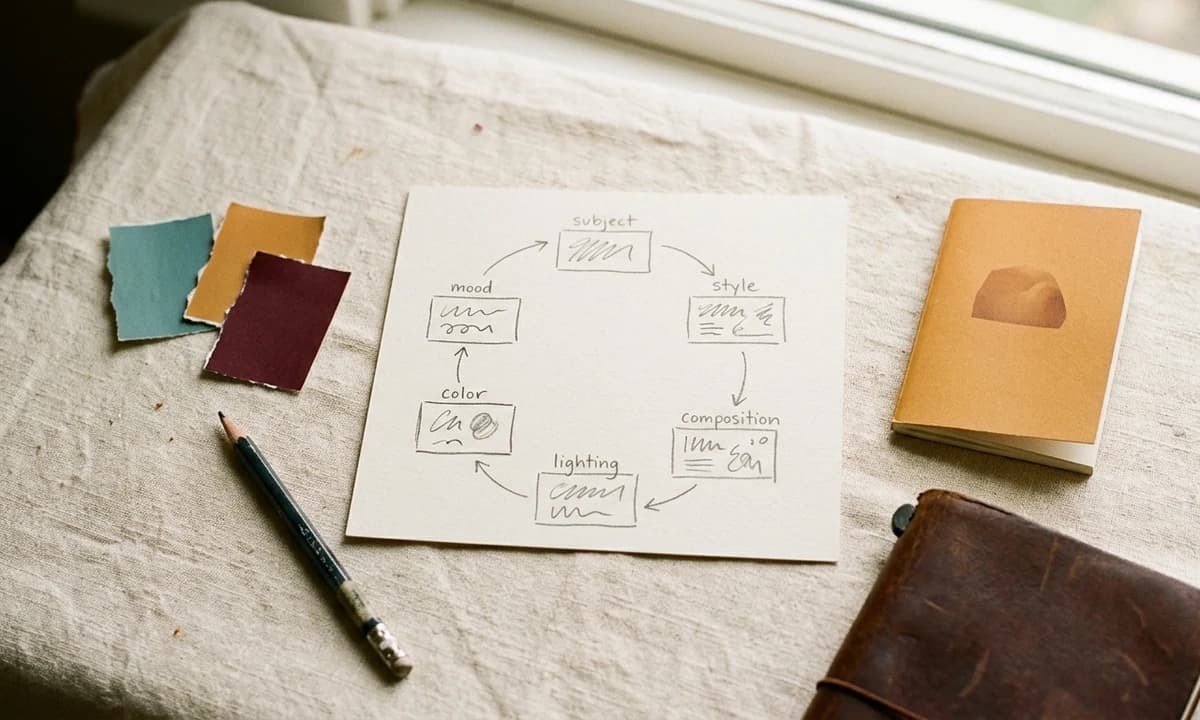
Most "Midjourney prompt formula" content online is over-engineered and under-tested. After hundreds of book covers shipped, this six-part skeleton is the one that delivers ship-quality results across genres on the first or second iteration.
[Subject phrase] + [Style anchor] + [Composition and framing] + [Lighting] + [Color palette] + [Mood] --ar 6:9 --stylize [value] --v 6.1
The six parts in order of impact on the output:
- Subject phrase. The thing in the image. Be specific. Not "woman" but "a woman in her late 30s wearing a dark wool coat, mid-stride". Specificity is the cheapest quality lever you have.
- Style anchor. The visual reference. "Cinematic photograph", "matte painting", "Studio Ghibli illustration", "noir film still", "watercolor botanical illustration". Avoid name-checking living artists; results are inconsistent and ethically grey.
- Composition and framing. Where the subject sits, what angle, what depth. "Eye-level medium shot, subject on the right third, deep depth of field" gives Midjourney a real instruction.
- Lighting. Often the single biggest difference between amateur and professional looking output. "Cold morning window light", "moonlight through fog", "single overhead key light", "golden hour rim light".
- Color palette. Constraints help. "Muted earth tones", "desaturated teal and amber", "high-contrast black and red", "warm cream and dusty rose". Naming three colors out-performs naming one.
- Mood. The emotional tone. "Tense, suspenseful", "wistful, melancholic", "triumphant, bright", "ominous, foreboding". This is the last 5% of the prompt but it shifts the output meaningfully.
After the prompt body, the parameters do specific jobs.
| Parameter | Range | Book cover recommendation |
|---|---|---|
--ar 6:9 | Aspect ratio | 6:9 for 6x9 paperback, 5:8 for ebook, 1:1 for square trim |
--stylize or --s | 0 to 1000 | 150-300 for photographic, 400-700 for painterly |
--chaos or --c | 0 to 100 | 0-15 for consistency, 30-60 for exploration |
--no | Negative prompt | Always: --no text, letters, words, typography, watermark |
--cref | URL of reference image | Character consistency for series |
--cw | 0 to 100 | 0-25 for face-only carry-over across scenes |
--sref | URL of style image | Lock visual style across a series |
--weird | 0 to 3000 | 0 for commercial, 500+ for horror or surreal |
Aspect ratio tricks: matching KDP trim sizes
Midjourney has no idea what KDP is. It thinks in aspect ratios. Your job is to translate your final cover dimensions into the closest aspect ratio Midjourney can produce, generate larger than you need, and crop down. Never the reverse.
| KDP trim size | True aspect | Midjourney --ar | Notes |
|---|---|---|---|
| 6 x 9 paperback front | 2:3 | --ar 6:9 or --ar 2:3 | Either reads the same to MJ |
| 5.5 x 8.5 paperback | 11:17 (close to 2:3) | --ar 2:3 | Crop slightly tighter |
| 5 x 8 paperback | 5:8 | --ar 5:8 | Slimmer, romance-typical |
| 7 x 10 paperback | 7:10 | --ar 7:10 | Cookbooks, large non-fiction |
| 8.5 x 8.5 square | 1:1 | --ar 1:1 | Picture books |
| Kindle ebook only | 1600 x 2560 (5:8) | --ar 5:8 | Amazon recommended dims |
| Full wrap (do not attempt) | Varies by page count | Generate front, expand | See "the full wrap problem" below |
For exact bleed, spine width and full-wrap dimensions, work from the KDP cover size calculator and the trim sizes explainer. Midjourney does not know your page count, but your spine width does, and getting it wrong is the most common KDP cover rejection.
The full wrap problem
Authors keep asking if Midjourney can generate a full paperback wrap: back cover, spine, and front cover in one image, sized correctly for a specific page count. The answer is no, and trying to do it produces a cover that fails on three fronts.
First, Midjourney does not know your page count, so it cannot size the spine. The spine of a 150-page book is roughly 0.34", while the spine of a 350-page book is roughly 0.79". The spine width is computed from the page count and paper type in the spine width calculator guide. Midjourney cannot calculate it.
Second, Midjourney does not respect the KDP bleed or safe zones. The 0.125" bleed around every edge must contain artwork but no critical content, and the safe zone must contain the title, author and barcode. Midjourney will happily put your hero subject\'s face directly on the spine fold.
Third, even when Midjourney accepts an extreme aspect ratio like --ar 15:9, the composition usually collapses. The model is trained on roughly portrait or roughly landscape compositions; it does not natively understand a spread.
The working full-wrap workflow
- Generate the front cover at
--ar 6:9(or whatever your trim). - Use Midjourney\'s Pan Left feature (or the Zoom Out / Generative Expand in Photoshop, or Affinity\'s generative fill) to extend the artwork leftward across the spine and into the back cover area.
- Pull the official KDP cover template for your trim size and page count.
- In Photoshop, Affinity Publisher or KDPEasy, place the front, spine and back artwork onto the template.
- Add the title, author, spine text, back-cover description and barcode in actual typography.
- Export to PDF/X-1a at 300 DPI, in CMYK if you are doing your own color conversion.
See the full guide to building a full-wrap KDP cover for the exact template assembly process.
Resolution and upscaling
Midjourney v6.1 outputs upscales at roughly 1456 x 2184 pixels for --ar 2:3. v7 produces similar sizes. For a 6x9 paperback at 300 DPI that is technically 1800 x 2700 pixels. You are short. You have two real options.
First, use Midjourney\'s built-in "Upscale (Creative)" or "Upscale (Subtle)" buttons, which upscale to 2912 x 4368 for --ar 2:3. Subtle preserves detail, Creative slightly reinterprets. For book covers, Subtle is the safe default.
Second, run the Midjourney upscale through Topaz Gigapixel AI ($99 one-time license, currently the gold standard), or a free alternative like Real-ESRGAN, to reach 4x of the original. This gets you well above 300 DPI even for a 6x9 paperback, and the extra resolution headroom is useful when you crop. Plan on a one-minute upscale pass per cover.
Verify your final dimensions and DPI with the fix blurry KDP covers guide, which walks through the DPI math and how to spot a cover that will print soft before you upload it.
The CMYK conversion gap (and why it matters for paperback)
Midjourney outputs sRGB images. Always. KDP\'s print supply chain runs on CMYK presses, specifically US Web Coated SWOP v2 for paperback interiors and covers. KDP will accept your RGB PDF and convert it internally, but that conversion is automatic and conservative. Saturated reds shift to a duller brick, deep blues lose punch, neon greens and oranges desaturate visibly.
For most authors most of the time, the automatic conversion is acceptable. For premium-priced books, series with brand consistency, or covers where a specific color is doing the emotional work (a single red dress on a thriller, a particular blue on a sci-fi), you should do the conversion yourself.
Manual CMYK conversion workflow
- Open the upscaled Midjourney image in Photoshop or Affinity Photo.
- View → Proof Setup → US Web Coated (SWOP) v2. Toggle Proof Colors on and off to see the shift.
- Identify the worst out-of-gamut areas (View → Gamut Warning in Photoshop).
- Use Hue/Saturation or Selective Color adjustment layers to manually pull the out-of-gamut colors back into a printable range. Reduce saturation, not lightness.
- Edit → Convert to Profile → US Web Coated (SWOP) v2. Choose "Relative Colorimetric" with Black Point Compensation on.
- Save as PSD with layers for future edits, then export the print PDF in CMYK.
Budget 20-40 minutes per cover for this pass on the first 5 covers, less as your eye calibrates.
If you are not yet ready to do manual CMYK conversion, ship the RGB PDF and accept the automatic conversion. It is not a deal-breaker. But the difference between a saturated, vibrant cover and a slightly washed-out paperback is often a manual CMYK pass.
Commercial license: what you actually own
Midjourney\'s Terms of Service are clearer than most AI tools. On any paid plan you receive:
- Ownership of the images you generate, subject to the laws of your jurisdiction. The U.S. Copyright Office has held that purely AI-generated images cannot themselves be copyrighted, but Midjourney still grants you a perpetual, worldwide license to use them.
- Full commercial usage rights, including book covers, merchandise, marketing materials, and resale of products incorporating the images.
- A caveat for companies earning over $1 million annually, which requires the Pro plan or higher. Indie authors are well below this threshold.
- An obligation that your prompts and outputs do not violate intellectual property of others. Do not generate images of named living people, named copyrighted characters, or directly imitate a living artist\'s style.
For KDP\'s purposes, this license is sufficient. KDP requires you to own or have license to use cover imagery, and Midjourney\'s paid-plan license satisfies that requirement. As of late 2025 KDP added an optional self-disclosure flag for AI-generated content, but it does not affect your right to publish.
Practical caution: copyright on the combined cover (your typography, your layout, your composition decisions) is reasonable to claim. Copyright on the underlying AI image alone is not. If protecting the cover artwork is critical (highly recognizable series branding, for example), commission a human illustrator instead.
Genre-by-genre prompts that actually ship covers
These are starting prompts that get you to a usable cover in 4-8 iterations rather than 40. Copy them, swap the subject for your book, then iterate on lighting and palette.
Thriller / suspense
cinematic photograph of a woman in her 30s in a dark wool coat walking away down a rain-slicked city alley at night, viewed from low angle behind her, single sodium streetlight casting long shadow, desaturated palette of charcoal and warm amber, atmosphere of quiet dread and isolation, 35mm film grain --ar 6:9 --s 200 --no text, letters, words, watermark --v 6.1
Domestic / psychological thriller
cinematic photograph of a perfectly ordinary suburban kitchen at dusk, single overhead pendant light, a coffee cup overturned on the marble counter, the back door slightly ajar, no people visible, color palette of muted teal and warm cream, mood of subtle wrongness and dread, shallow depth of field --ar 6:9 --s 250 --no text, letters, words, watermark --v 6.1
Contemporary romance
warm cinematic photograph of a couple silhouetted against a sunset beach, viewed from behind at medium distance, golden hour with strong lens flare and rim light, palette of warm peach and dusty rose, mood of hopeful tenderness, shallow depth of field, soft 35mm film aesthetic --ar 2:3 --s 180 --no text, letters, words, watermark --v 6.1
Historical romance
painterly oil-on-canvas portrait of a young woman in a forest-green velvet 1820s gown, three-quarter pose, viewed at eye level, soft window light from the left, palette of deep emerald, cream and rose gold, mood of quiet longing, Pre-Raphaelite influence --ar 2:3 --s 450 --no text, letters, words, watermark --v 6.1
Epic fantasy
epic matte painting of a lone hooded figure standing at the edge of a vast crystal canyon at twilight, viewed at wide angle from low behind, dual moons rising, volumetric god rays cutting through the haze, palette of deep purple, electric teal and bone white, mood of awe and impending journey, painterly digital concept art --ar 6:9 --s 600 --no text, letters, words, watermark --v 7
Cozy / urban fantasy
warm illustration of a small magical bookshop interior at golden hour, stacked spellbooks on uneven shelves, a black cat curled on a velvet armchair, motes of golden dust in the slanted light, palette of warm amber, deep teal and cream, mood of cozy mystery, Studio Ghibli influence --ar 2:3 --s 400 --no text, letters, words, watermark --v 6.1
Sci-fi / space opera
cinematic concept art of a single starship silhouetted against a vast ringed gas giant, three-quarter angle from below, dramatic backlight from a distant blue star, palette of deep navy, magenta nebula and amber thruster glow, mood of wonder and scale, highly detailed digital painting --ar 6:9 --s 500 --no text, letters, words, watermark --v 7
Horror / supernatural
moody photograph of an abandoned Victorian mansion at midnight, viewed at low angle with the building looming overhead, single dimly lit second-floor window, broken moonlight through storm clouds, palette of deep charcoal with sickly green window glow, atmosphere of profound dread, 35mm film grain --ar 6:9 --s 350 --no text, letters, words, watermark --v 7
Cozy mystery
warm illustration of an English village high street at autumn dusk, half-timbered tea shop in the center with warm window light, falling leaves, palette of warm cream, burnt orange and forest green, mood of cozy welcome with a hint of intrigue, painterly storybook style --ar 2:3 --s 400 --no text, letters, words, watermark --v 6.1
Self-help / personal development
clean photograph of a single hand reaching toward a sunrise above a mountain ridge, viewed at eye level from behind, soft golden hour backlight, minimal composition with negative space for title, palette of warm gold, soft cream and pale blue, mood of optimistic clarity --ar 6:9 --s 150 --no text, letters, words, watermark --v 6.1
Business / non-fiction
minimalist photograph of a single architectural detail, a clean staircase ascending into warm light, viewed at low angle, palette of warm cream, deep charcoal and brass accent, mood of disciplined intent, large clean negative space for title, soft natural light --ar 6:9 --s 100 --no text, letters, words, watermark --v 6.1
Cookbook / lifestyle
warm overhead editorial photograph of a single ceramic bowl of seasonal vegetables on a weathered linen napkin, soft side window light, palette of warm cream, sage and terracotta, gentle film grain, mood of considered abundance, shallow depth of field, no people in frame --ar 7:10 --s 180 --no text, letters, words, watermark --v 6.1
Cross-genre tip
Whatever genre you are in, study the top 20 covers in your Amazon category before writing prompts. Note their palette, framing and lighting. Cross-reference with the perfect KDP cover guide for the cover conventions that are doing the work. For genre-specific psychological detail, the thriller cover psychology, romance cover design and self-help cover design deep-dives describe exactly what each reader is looking for at a glance.
Skip the Photoshop assembly. Go straight to a print-ready cover.
KDPEasy combines AI imagery with KDP-correct templates, real typography, and CMYK-aware exports. Cover ready in minutes, not hours.
Try it freeCharacter consistency for series with --cref
--cref (character reference) is the single best feature for series authors and children\'s book illustrators. It lets you anchor a character\'s face, hair and overall look across multiple generations.
- Generate a clean reference portrait. Frontal, neutral expression, well-lit, plain background. Use --ar 2:3 and --s 150 for a clean photographic reference.
- Upscale and save the URL. Right-click the upscaled image, copy image address. The URL ends with the file extension; that is the one you use.
- Reference in subsequent prompts. Add
--cref [URL]at the end of your new prompt. - Tune with --cw. --cw 0 carries the face only (allows new outfits, scenes). --cw 50 is default. --cw 100 carries everything (face, hair, clothing, pose). For series covers, --cw 0 to --cw 25 is correct.
--cref struggles with: extreme angles, heavily stylized characters from a realistic reference, multiple characters in one scene, lighting that is wildly different from the reference. For a six-book children\'s series with 30+ consistent character illustrations, train a Stable Diffusion LoRA instead. See the Stable Diffusion KDP advanced guide for the LoRA workflow.
Cost math: what Midjourney actually costs per cover
The marketing math online is "$10 a month replaces a $500 designer". The real math is more nuanced.
True cost per cover, all-in
- Midjourney Standard plan: $30 per month. Divided across 10-15 finished covers per month, that is $2-$3 per cover in subscription.
- Layout tool (Photoshop, Affinity, or KDPEasy): Photoshop is $20/month, Affinity Publisher is $70 one-time. Amortized across a year, $1-$2 per cover.
- Topaz Gigapixel (optional upscaler): $99 one-time license, amortized $0.50 per cover.
- Stock typography fonts: $0 if using free Google Fonts, up to $200 one-time for a premium serif. Amortized: $0-$2 per cover.
- Hard cost per cover: $3-$8 in software.
- Soft cost per cover: 60-120 minutes of your time. At $25/hour self-valuation that is $25-$50 in time.
- KDP rejection rework time: Plan one rejection cycle for your first 3 covers, adding 30-60 minutes each.
- True all-in cost: $30-$60 per cover for an experienced indie. Compare to $150-$500 for a commissioned designer.
The cost story is real. Midjourney plus an hour of layout time per cover is one of the highest-leverage spends in indie publishing. The story you should not believe is "free, instant, professional". It is cheap, fast, and very good. Not free, not instant.
The complete workflow, start to finish
- Research the top 20 covers in your Amazon category. Note palette, framing, lighting, hero subject.
- Write 3-5 prompt variations using the six-part formula. Pick one or two parameter combinations.
- Generate the first batch. 4 images per prompt, 12-20 total in your first pass.
- Select 3 candidates. Look at them at thumbnail size (100px wide) on your phone. The candidates that still work at thumbnail are your real shortlist.
- Upscale the shortlist with Subtle Upscale or Creative Upscale.
- Run the winner through Topaz Gigapixel or Real-ESRGAN to 4x. You now have a 4000+ pixel image at 300+ DPI.
- Open in Photoshop or Affinity. Soft-proof against US Web Coated SWOP v2. Color-correct out-of-gamut areas.
- Place onto the KDP cover template for your trim size and page count. Add title, author, spine text in real typography.
- Build the full wrap. Front, spine, back. Bleed correct, safe zones respected, barcode placed.
- Export PDF/X-1a at 300 DPI in CMYK.
- Thumbnail test. Drop the PDF into a 100x150 pixel viewer. If the title and subject do not read at that size, redesign.
- Upload to KDP. Run the cover preview, verify the bleed lines and spine, approve, and publish.
For the upload-and-publish step specifically, see the KDP cover upload guide, which walks through the cover preview screen and the most common rejection reasons.
Where Midjourney fits in the broader 2026 AI cover stack
Midjourney is one tool in a stack, not the whole stack. The broader landscape:
- Midjourney v6.1 / v7: Best out-of-the-box image quality across genres. The default choice for most indie authors.
- Stable Diffusion (Flux, SDXL, ControlNet, LoRA training): Maximum control, custom training, zero ongoing cost. Right tool for high-volume publishers and signature series. See the Stable Diffusion KDP advanced guide.
- Leonardo AI: Strong free tier, useful for high-volume coloring book interiors. Less consistent on cover art than Midjourney.
- Ideogram 2.0+: Best AI text rendering. Useful for typography-driven covers but rarely replaces a real layout tool.
- Adobe Firefly 3: Trained exclusively on licensed content. Safest from a copyright perspective. Quality is improving but still behind Midjourney for cover work.
For the side-by-side comparison and which tool fits which publisher, see the AI image generation for KDP guide and the comparison in the best KDP cover generator tools roundup.
Common mistakes that waste hours
- Trusting AI-generated text. Never. Always add real typography in Photoshop, Affinity, or KDPEasy.
- Generating at low resolution. Always upscale. 1456px is not enough for a 6x9 paperback at 300 DPI.
- Skipping the thumbnail test. A cover that looks great at full size and unreadable at 100px will lose on Amazon\'s search grid.
- Cramming five elements into the composition. One hero subject. Stop adding more.
- Ignoring genre conventions. Romance buyers expect a specific palette and framing. A "unique" thriller cover that does not look like a thriller cover is a cover that does not sell.
- Trying to do a full wrap in one generation. Generate the front, expand to spine and back, assemble in Photoshop.
- Skipping CMYK proofing. For premium covers, the manual color conversion pass is the difference between vibrant and dull on press.
- Using the same prompt 30 times. Change one variable at a time. Iterate on lighting, then palette, then composition.
Final read
Midjourney v6.1 and v7 in 2026 are the highest-leverage tool indie authors have for cover imagery. They will not deliver a print-ready KDP cover on their own and the people who tell you they will are skipping the parts that matter. The realistic workflow is: Midjourney for the image, Topaz or Real-ESRGAN for the upscale, Photoshop or Affinity or KDPEasy for the layout, manual CMYK conversion for premium covers, and the KDP template for the final wrap.
Done well, the entire pipeline is 60-120 minutes per cover at a software cost of $3-$8. That is the real story. It is not "free instant designer". It is "the best leverage in indie publishing in 2026", and that is enough.
Move from Midjourney image to KDP-ready cover in one tool
KDPEasy pairs AI imagery with print-correct KDP templates, real typography, and exports that actually pass Amazon\'s cover review.
Start freeA FEW MORE ANSWERS
Frequently asked questions
For most KDP genres in 2026, v6.1 still produces the most predictable, photographically convincing book cover compositions. v7 is sharper on fine detail and stronger on stylized fantasy and sci-fi, but it changes how prompts behave and the personalization features can drift. Recommendation: default to v6.1 for romance, thriller, non-fiction and contemporary fiction, switch to v7 for epic fantasy, sci-fi, horror and visually maximalist genres. Test both with the same prompt and the same aspect ratio before committing.
ABOUT THE AUTHOR
Danielle Okonkwo
Marketing & Growth Lead at KDPEasy. Danielle is a published author with 12+ titles on Amazon KDP and a former book blogger. She draws on hands-on publishing experience and years of testing what works in the KDP marketplace.
Meet Danielle