

Mandala coloring books are simultaneously the most lucrative and the most ruthless coloring niche on KDP. Roughly 35% of all adult coloring book sales are mandala-themed; the top mandala publishers do $10k-15k per month. The same niche also hosts about 18,000 paperback SKUs, almost all priced inside a $7-12 band, and most of them buried below the fifth page of search results. Launching a generic "Adult Mandala Coloring Book" in 2026 is publishing into a graveyard. The book you can actually win with combines AI-generated efficiency, hybrid theming, and intentional complexity progression. Here is the playbook.
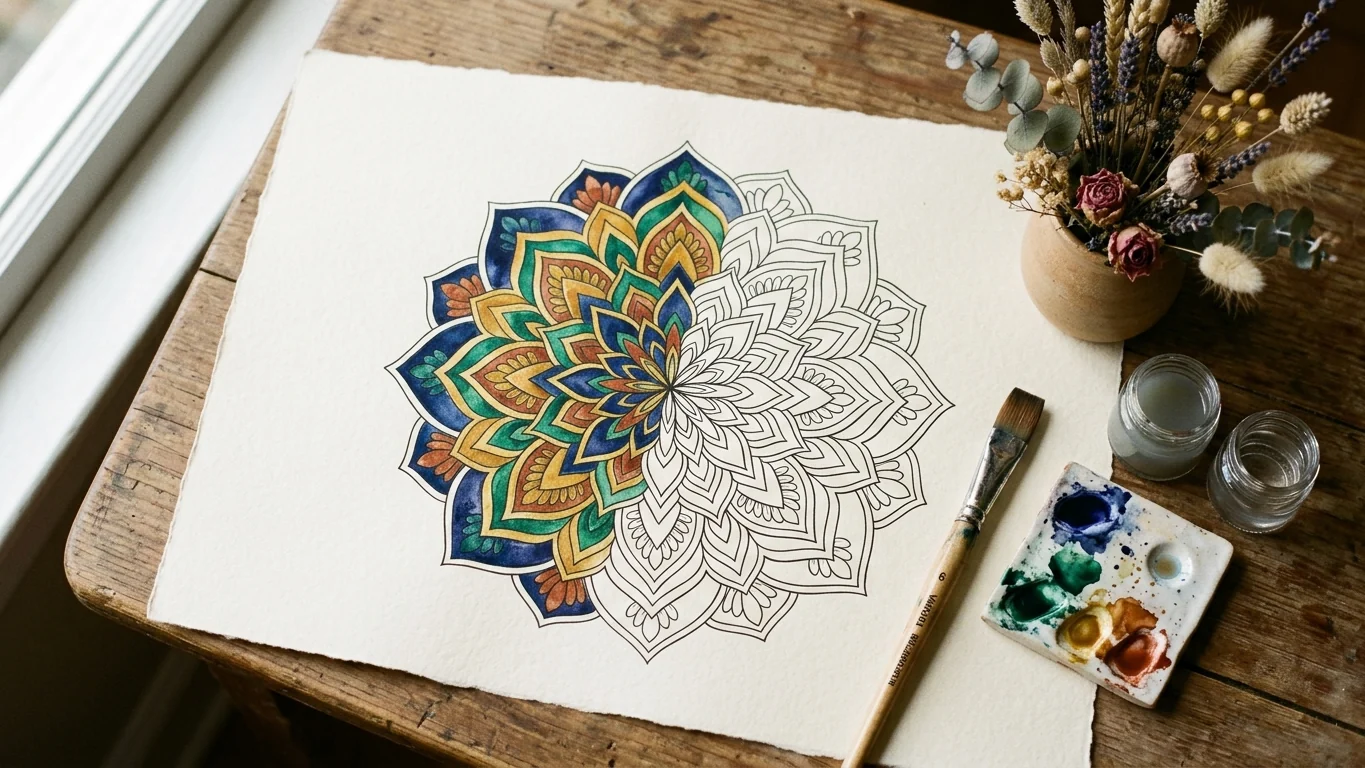
A mandala designed for adult colorists in 2026: deep concentric layers, jewel-tone palette, meditative pace.
The Mandala Niche In One Screen
- Amazon SKU count: ~18,000 paperback mandala coloring books in the US store
- Category share: 35% of all adult coloring book paperback sales
- Average list price: $7.99-$11.99 (premium specialty books up to $16.99)
- Top-shelf velocity: 500-1,500 copies/month for category bestsellers
- Mid-pack velocity: 30-120 copies/month for well-positioned new entries
- Buyer profile: 72% female, 35-60 age band, broad geographic distribution
- Peak demand: January (New Year mindfulness), May (Mother's Day), November-December (gifting)
- Hybrid sub-niches with room: animal mandalas, nature mandalas, architecture mandalas, zodiac mandalas, large-print mandalas
Why mandalas dominate (and why that is the problem)
The structural advantages
Mandalas hit four psychological buttons that almost no other coloring theme manages simultaneously:
- Symmetry preference: humans find radial symmetry inherently pleasing, regardless of culture or training. Mandalas exploit this directly.
- Meditative completion: the circular structure pulls the eye inward; finishing one feels like completing a meditation session.
- No color theory required: any color combination works in an abstract pattern. Beginner colorists never feel like they made a wrong choice.
- Cross-cultural legitimacy: mandalas appear in Tibetan Buddhism, Hindu yantra, Native American medicine wheels, and Celtic knotwork. Buyers feel they are doing something deeper than a coloring page.
The market reality nobody mentions
These advantages are exactly why the niche is impossible to enter generically. Search "mandala coloring book" on Amazon and the top results have 2,000-15,000 reviews. The top-listed books have been on the platform for 7-10 years. They have indexed every keyword, captured every category, and locked in their BSR. A new generic mandala book launched today competes for the same buyer and loses every time.
The only way in is differentiation by sub-niche. Look at the second-page search results and you will see what is actually working in 2026: "Animal Mandalas for Adults", "Mandala Coloring Book for Seniors with Large Print", "Christmas Mandalas", "Zodiac Mandala Coloring Book", "Architectural Mandalas". These are 30-200 SKU sub-niches with bestsellers doing 50-300 copies per month and real room for new entrants.
Mandala generation: the four real options
Option 1: Dedicated mandala generators (best for pure geometry)
Specialized tools enforce mathematical symmetry. You draw one segment; the tool mirrors it radially.
- Mandala Maker (web, free with paid premium): drag-and-drop, choose 4/6/8/12-fold symmetry, instant export. Good for absolute beginners.
- Inkscape (free, desktop): use the rotational pattern tool with copy mode. Steeper learning curve but produces commercial-quality SVG output.
- Adobe Illustrator (subscription, $22.99/mo): the Transform > Rotate with Copy effect is the industry-standard workflow. Combine with Pathfinder for complex overlays.
- Procreate (iPad, $12.99 once): hidden gem - the radial symmetry guide in Procreate 5+ produces hand-feel mandalas with perfect symmetry. Best of both worlds.
Pros: mathematically perfect symmetry, vector output, infinite variation. Cons: the output looks "designed" rather than "drawn"; production rate is 30-90 minutes per mandala depending on complexity.
Option 2: AI image models with mandala prompting (best for hybrid themes)
General AI image models can produce stunning mandalas, especially hybrid concepts (elephant mandalas, floral mandalas, architectural mandalas). The prompt matters enormously. The 2026 prompt formula that consistently works:
- "Symmetrical mandala coloring page, black and white line art, intricate detailed pattern, [theme], white background, no shading, no gradient, vector style, sharp lines, 8-fold radial symmetry, centered composition"
- Add a negative prompt where supported: "no color, no shading, no gradient, no text, no signature, no watermark"
- Aspect ratio: square (1:1) for mandalas. Most AI models default to square for "mandala" prompts.
Real-world model comparison after running 200 mandala prompts in early 2026:
- Midjourney v7: most beautiful output, frequently adds subtle shading that needs post-processing. Best for hero pages.
- Leonardo AI: strongest "line art" preset, cleanest output by default. Best for batch generation.
- KDPEasy: tuned for KDP specs, outputs 600 DPI single-sided pages directly. Best for end-to-end workflow.
- Litpal AI: mandala-specific generator with symmetry constraints. Solid mid-tier choice.
- ColorBliss: easy interface, limited customization but very fast. Best for absolute beginners.
- DALL-E 3 (ChatGPT Plus): hit-or-miss on symmetry. Will sometimes return a 7.5-fold mandala instead of 8-fold, which destroys the design.
Option 3: Hand-drawn (best for premium positioning)
Drawing every mandala by hand in Procreate or Illustrator gives you the highest perceived quality and the highest review scores. Hand-drawn mandala books on Amazon routinely hold 4.7-4.8 stars while AI-heavy books cluster at 4.3-4.5. The tradeoff is brutal: a 60-page hand-drawn book is 120-240 hours of work versus 5-15 hours for AI-assisted. Use hand-drawing for one flagship SKU per year; use AI for the rest of the catalog.
Option 4: Hybrid AI + manual cleanup (the workflow that actually wins)
After watching 30+ mandala publishers ship in 2026, the dominant workflow is hybrid:
- Generate the base mandala with AI (Leonardo or KDPEasy)
- Vector-trace the output in Illustrator or Vectornator (5 minutes)
- Use "Expand Strokes" to convert lines into closed paths
- Manually close any gaps with the pen tool (3-5 minutes per page)
- Drop the cleaned page into the book template
Total time per page: 10-20 minutes. Quality is indistinguishable from hand-drawn at a casual buyer level. This workflow ships a 60-page mandala book in two-to-three working days.
Generate 100 mandalas with built-in symmetry and KDP specs
KDPEasy outputs 600 DPI single-sided mandala pages with closed-shape line art, ready for the book template. No Illustrator required.
Start freeDifferentiation strategy: which hybrid niche to pick
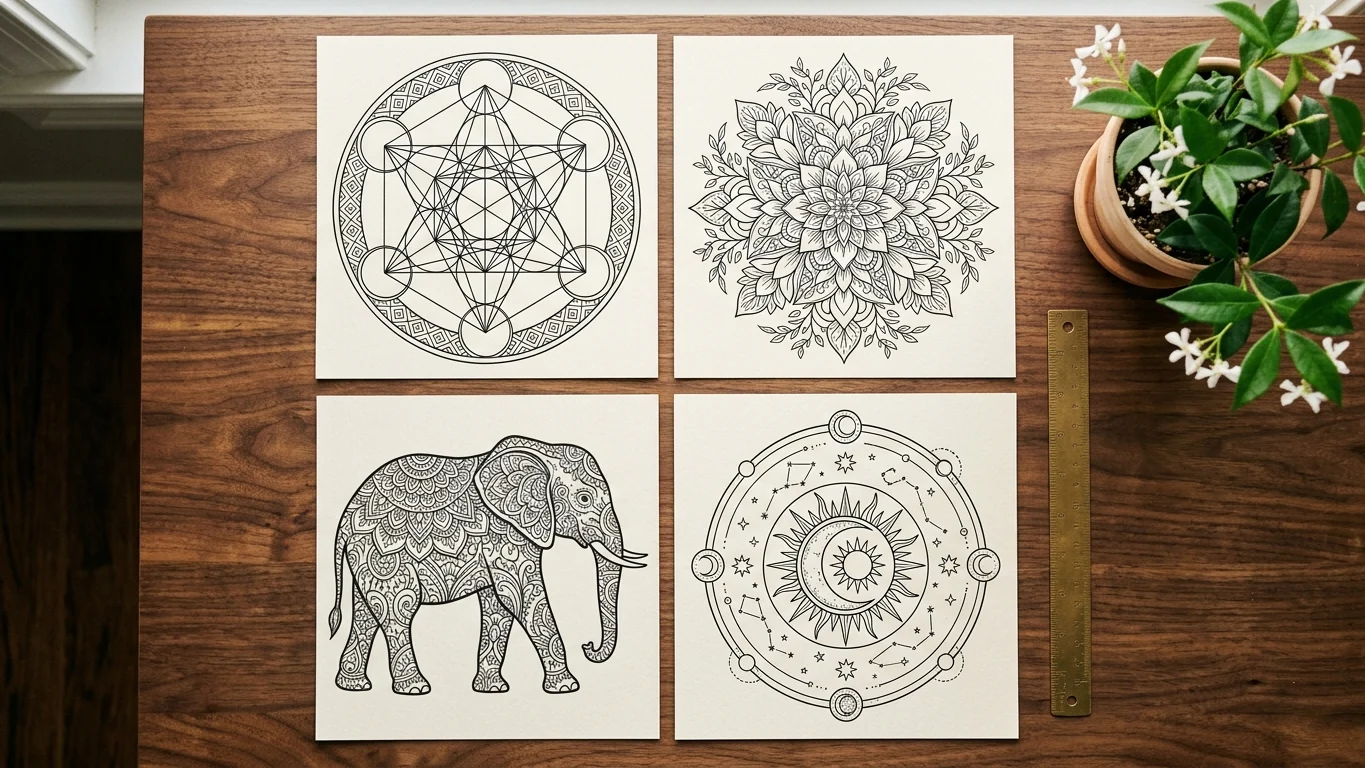
Four mandala sub-niches with room to launch in 2026: sacred geometry, botanical, animal silhouette, celestial.
Mandala + animals (the strongest hybrid)
Animal-shaped mandalas (an elephant silhouette filled with mandala patterns; a wolf head built from radial symmetry) are the most commercially successful hybrid in 2026. Why: it combines the two most popular coloring themes (animals + mandalas) into a single page. Sub-categories with real demand:
- Elephant mandalas: highest search volume of any animal mandala (~12k/month). The spiritual association with elephants in Hindu/Buddhist iconography keeps demand stable.
- Wolf mandalas: teen and young-adult appeal. Pinterest-driven.
- Owl mandalas: evergreen, slightly older buyer demographic.
- Horse mandalas: a smaller niche but extremely loyal buyers (the horse-girl demographic).
- Cat and dog mandalas: oversaturated. Skip.
Mandala + nature
Mandalas built from botanical elements, ocean motifs, mountain silhouettes, or forest scenes. Less saturated than animal mandalas, often higher review scores because the imagery photographs beautifully colored.
- Floral mandalas: oversaturated already - skip unless you have a specific flower theme (succulents, wildflowers, tropical)
- Ocean mandalas: shells, fish, waves, coral. Strong gift-market appeal.
- Forest mandalas: trees, mushrooms, ferns. Cottagecore aesthetic - currently trending.
- Seasonal mandalas: autumn leaves, spring blossoms, winter snowflakes. Strong Q4 holiday driver.
Mandala + architecture (under-served)
Cathedral rose windows, Islamic geometric patterns, Hindu temple ceilings, Moorish tile work - all are essentially architectural mandalas, and the niche has fewer than 200 SKUs on Amazon. This is one of the highest-opportunity hybrid mandala sub-niches in 2026.
Audience-specific hybrids
- Large-print mandalas for seniors: simpler designs, fewer regions per page, 8-12 mandalas per book instead of 100. Growing buyer segment. Pairs with our large-print seniors guide.
- Mandalas for kids: 4-fold or 6-fold symmetry, larger sections, gridded pages with 4 small mandalas per page.
- Mandalas for stress relief during chemotherapy: very narrow but extremely loyal niche, often pre-ordered in bulk by hospital gift shops.
Cultural and geographic hybrids
- Celtic mandalas: knotwork in radial form. Strong Irish-American audience.
- Tibetan thangka-style mandalas: traditional Buddhist iconography. Niche but devoted.
- Aztec and Mayan sun mandalas: bold geometric, Mexican-American buyer appeal.
- Mehndi/henna mandalas: South Asian wedding tradition. Underserved.
Page structure: progression beats randomness
The complexity ladder that prevents 1-star reviews
The biggest 1-star review pattern in this niche is "too intricate, frustrating to start". Buyers want a book that builds them up, not throws them into the deep end. The proven structure:
- Pages 1-20 (20% of book): Beginner mandalas. 3-4 concentric zones, simple geometry, large coloring regions (1.5"+ wide), 4-6 fold symmetry. Confidence builders.
- Pages 21-80 (60% of book): Intermediate mandalas. 5-7 concentric zones, mixed geometric and organic elements, medium regions (0.5-1.5"), 6-8 fold symmetry. Core content.
- Pages 81-100 (20% of book): Advanced mandalas. 8-12+ zones with sub-patterns, fine detail down to 0.25" regions, 8-16 fold symmetry. Achievement unlocked for finishing colorists.
Gridded mandala layouts: when to use them
A gridded page (2x2 or 3x3 small mandalas) is great for one specific purpose: warm-up pages at the front of the book for nervous colorists. They give the buyer a "win" in 10 minutes instead of 90 and reduce abandonment. Use them sparingly:
- Adult books: 4-6 gridded pages out of 60-100, all in the first quarter
- Kids books: 50% gridded, 50% single-page; gridded becomes the main format
- Senior large-print: no gridded pages; large single mandalas only
Page mix template (100-mandala adult book)
- Pages 1-4: gridded warm-up pages (16 small mandalas total)
- Pages 5-20: 16 beginner full-page mandalas, 4-6 fold symmetry
- Pages 21-80: 60 intermediate full-page mandalas, 6-8 fold symmetry
- Pages 81-100: 20 advanced full-page mandalas, 8-12 fold symmetry
- Each design printed single-sided with a blank back to prevent marker bleed-through
- Total printed pages including blanks: 200
Cover conventions: what the bestsellers actually do
The 8.5x8.5 square format advantage
Mandala books are increasingly published in 8.5x8.5 square trim instead of 8.5x11 portrait in 2026. Why: the circular mandala on the cover centers perfectly in a square thumbnail, the trim is cheaper to print, and the book stands out from a sea of rectangular covers in Amazon search results. About 30% of new mandala bestsellers in 2026 use square trim, up from 12% in 2024.
Cover formula for mandala books
- Hero element: one large colored mandala dead-center (the buyer should see "what does this colored look like?")
- Background: warm gradient (cream to terracotta, or cream to deep teal). Avoid pure white or pure black backgrounds - they read as cheap.
- Title typography: elegant serif at the top (Cormorant Garamond, Playfair Display) or all-caps geometric sans (Lulo, Trajan). Avoid script for mandalas - it competes with the geometric line art.
- Subtitle: spell out the buyer benefit. "100 Intricate Mandalas for Stress Relief and Mindfulness" outperforms generic "Adult Coloring Book".
- Back cover: show 3-4 sample interior pages at thumbnail size. This converts hesitant browsers.
For more on cover specs by trim size, see our breakdown of KDP trim sizes and use the free KDP cover size calculator to get exact dimensions for 8.5x8.5 or 8.5x11.
Pricing math: the $9.99 threshold is everything
100-page mandala book economics
- Print cost (8.5x11, B&W, 100 pages): $0.85 + (100 × $0.012) = $2.05
- List at $7.99 (50% royalty): $4.00 royalty - $2.05 print = $1.95 profit
- List at $9.99 (60% royalty): $5.99 royalty - $2.05 print = $3.94 profit
- List at $11.99 (60% royalty): $7.19 royalty - $2.05 print = $5.14 profit
- List at $14.99 premium (60% royalty): $8.99 royalty - $2.05 print = $6.94 profit
The $9.99 jump doubles per-sale profit on the same product. If you only remember one number from this guide, remember $9.99. Run a sanity check with our KDP royalty calculator for your specific page count.
When premium pricing ($12.99+) makes sense
- The book exceeds 100 pages (more designs = more perceived value)
- The hybrid theme has weak competition (architectural mandalas, Celtic mandalas, mehndi mandalas)
- The pen name has established review history (15+ reviews at 4.5+ stars)
- The cover finish is matte (KDP's matte upgrade is free and reads as "premium")
- The book is positioned as a gift (Q4 seasonal copy in the description)
Skip the symmetry-software learning curve
KDPEasy generates perfect mandalas at any complexity, exports KDP-ready PDFs at 600 DPI, and ships a 100-page book in an afternoon.
Build your bookMarketing: how mandala books actually get found
Keyword strategy (7 KDP keyword slots)
Never burn a keyword slot on "mandala coloring book" - the category itself indexes you for it. Use the 7 slots for long-tail keywords that the bestsellers have not saturated. A working 2026 keyword set for "Elephant Mandala Coloring Book for Adults":
- elephant coloring book for adults relaxation
- animal mandala coloring book stress relief
- intricate elephant designs adult coloring
- mindfulness coloring book elephants
- safari coloring book for women
- spiritual elephant gift coloring book
- large print elephant mandala book seniors
Each slot pulls a different long-tail search. Avoid duplicating any word that already appears in your title - KDP indexes those automatically, so the slot would be wasted.
For the full backend keyword methodology and reverse-ASIN research, see our KDP keyword research guide.
Pinterest is the secret channel
Mandala coloring books over-index on Pinterest traffic. Roughly 30-45% of mid-tier mandala book sales originate from Pinterest pins of colored sample pages. Create 15-20 vertical pins (1000x1500 px) per book showing finished colored examples, with the book cover and Amazon link in the pin description. Cost: zero. ROI: routinely positive.
Series strategy: cluster, don't one-off
Single mandala books cap out around $200-500/month. Mandala publishers who hit $5k+/month run series of 6-10 books under one pen name with a consistent cover system. The customer who buys book one bingewatches the others.
A working 6-book mandala series cluster
- Book 1 - Base: "100 Geometric Mandalas for Adults: Beginner to Advanced"
- Book 2 - Animal hybrid: "Wildlife Mandalas: Elephants, Wolves, Owls and More"
- Book 3 - Nature hybrid: "Forest Mandalas: Trees, Mushrooms, and Botanical Patterns"
- Book 4 - Cultural hybrid: "Celtic Mandala Coloring Book: Knotwork and Sacred Geometry"
- Book 5 - Audience-specific: "Large Print Mandalas for Seniors: Easy Designs"
- Book 6 - Seasonal: "Christmas Mandalas: Holiday Designs for Adult Coloring"
Same pen name, identical color system on the cover, 30-45 days between launches. The "Customers also bought" carousel does the marketing.
Honest risks in this niche
Copyright violations are common and dangerous
Mandalas appear in millions of public images, but specific stylized mandalas are copyrighted. Tracing or near-copying a Pinterest find is a fast route to an Amazon DMCA strike. Always either generate your own with AI/software, draw from scratch, or use commercial-license stock from sites like Creative Fabrica. Two DMCA strikes on the same KDP account can trigger account suspension.
AI generator output is not automatically royalty-free
The AI image generator's terms of service matter. Midjourney's commercial license requires a paid tier. DALL-E 3 outputs are free to use commercially. KDPEasy outputs are licensed for KDP publishing directly. Always check the ToS before uploading.
Open shapes are the silent review killer
The most common 2-star review pattern in mandala books is "markers bleed through the gaps in the lines". This happens when AI-generated mandalas have hairline gaps in the line art that the eye does not catch but the marker tip finds. Always vector-trace and manually close all shapes before publishing.
Mandala book launch checklist
- Pick one hybrid sub-niche from the list (animal, nature, architecture, cultural, audience-specific). Resist combining.
- Validate demand with 30 minutes of keyword research and a quick search of competitor BSR.
- Generate 100 mandalas at progressive complexity (20 easy / 60 intermediate / 20 advanced).
- Vector-trace and close all shapes. Budget 5 minutes per page for cleanup.
- Lay out single-sided at 8.5x11 (portrait) or 8.5x8.5 (square). Test the square format for hybrid mandala niches.
- Design cover with centered hero mandala, warm gradient background, clean serif title.
- Use square trim (8.5x8.5) to stand out from rectangular thumbnails in search results.
- Set list price at $9.99 to hit the 60% royalty tier.
- Fill 7 keyword slots with long-tail phrases; never duplicate words already in the title.
- Pick 2 categories: Crafts > Coloring Books for Adults plus one niche-specific second category.
- Disclose AI use truthfully on the publish form.
- Order proof copy. Inspect for marker-bleed-test risk (closed shapes, no hairline gaps).
- Build 15-20 Pinterest pins of colored sample pages before launch.
- Plan books 2-3 in the series within 30-45 days.
Generate a complete mandala series in days, not months
KDPEasy generates symmetric mandalas at any complexity, exports KDP-ready PDFs, and supports both 8.5x8.5 and 8.5x11 trims. Build the series; we handle the production stack.
Start your seriesA FEW MORE ANSWERS
Frequently asked questions
Amazon currently shows roughly 18,000 paperback titles for "mandala coloring book" in the US store. About 35% of all adult coloring book sales are mandala-themed. A generic mandala book launched today competes against thousands of established titles and bestsellers averaging 1,000+ reviews. Pure mandala is a saturated niche; hybrid mandala (mandala + animals, mandala + architecture, zodiac mandala) is where the opportunity now lives.

ABOUT THE AUTHOR
Danielle Okonkwo
Marketing & Growth Lead at KDPEasy. Danielle is a published author with 12+ titles on Amazon KDP and a former book blogger. She draws on hands-on publishing experience and years of testing what works in the KDP marketplace.
Meet Danielle