

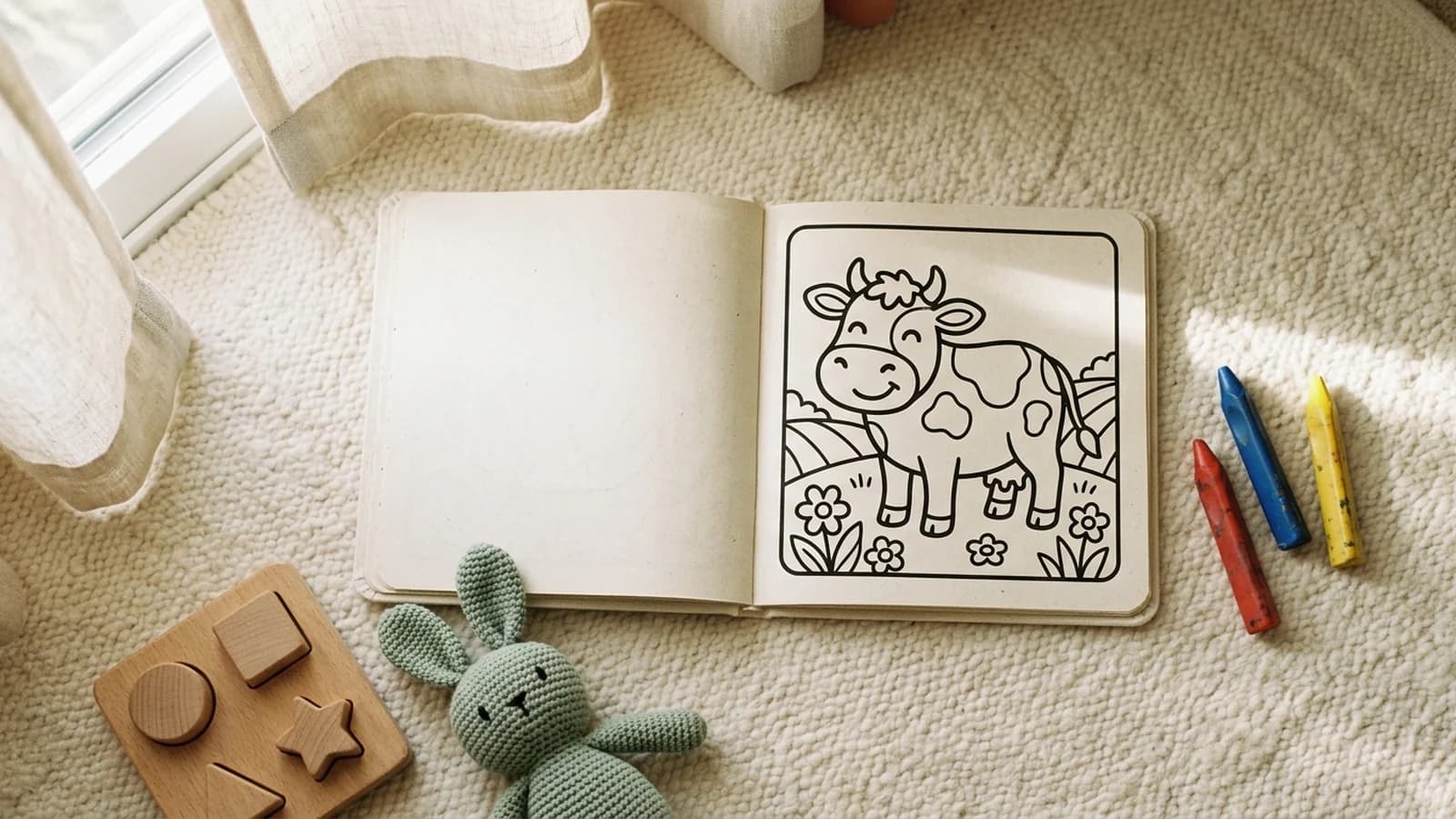
Toddler busy books look like the simplest KDP niche. They are not. The activities are simple, yes, but the design constraints are unforgiving. One mistake in line weight, page complexity, or cover tone and the book reads as either too babyish for the parent or too hard for the child. This guide is the working playbook for getting it right.
The honest market read in 2026
- Active demand: Roughly 20,000-30,000 monthly searches across "toddler busy book," "quiet book toddler," and "Montessori busy book" combined.
- Competition: Medium overall, high in the generic "toddler activity book" search, low in themed sub-niches.
- Price band: $7.99-$12.99 with the sweet spot at $9.99-$11.99 for a 50-70 page book.
- Buyer mix: Roughly 40 percent Montessori-aligned parents, 25 percent travel parents, 25 percent gift buyers, 10 percent daycare and preschool bulk purchases.
- Repeat purchases: Same household buys two to three busy books per year per toddler, plus replacements for destroyed copies.
- Seasonal lift: 20-30 percent of annual sales happen between November 15 and December 20 as gift purchases.
Who is actually buying these books
Most beginner publishers fail this niche because they design for "a toddler." The product is not bought by a toddler. It is bought by an adult who has a specific anxiety they want the book to relieve. Three personas dominate, and the cover, title and description all need to speak to them.
1. The Montessori-aligned parent
Wants screen-free, skill-building activities organized around fine-motor development, color and shape identification, and self-directed exploration. Pattern-matches against books labeled "Montessori" or marketed with words like "skills," "learning," "first," and "discover." Pays premium ($10.99-$12.99) for a clear educational angle. Will not buy anything that looks loud, neon, or commercial.
2. The travel parent
Shopping the week before a flight or long car trip. Searches "toddler travel busy book" or "quiet book airplane." Wants compact (8 x 8 or 8.5 x 11 maximum), B&W-friendly so the toddler can color rather than just look, and self-contained so no extra parts get dropped on a plane. Will pay $9.99-$11.99 with delivery urgency. Reads reviews specifically for "did it keep my child quiet for X hours."
3. The gift buyer
Grandparents, aunts, uncles, family friends. Less price-sensitive ($10-$13 acceptable), more cover-sensitive. Wants something that looks thoughtful and not embarrassing. Pattern-matches against the visual language of Eric Carle, Sandra Boynton, Anna Llenas. Buys around birthdays, baby showers, Christmas, and Easter. Often combines with a small toy as a paired gift.
The three things the cover must signal in 0.8 seconds
- Age targeting. "Ages 2-4," "My First," or an obvious toddler-skill visual.
- Tasteful warmth. Friendly hero animal, soft warm palette. Not loud, not neon.
- Value clarity. "50 Activities" or a list of three to four skill types in a clean badge.
Activity types: what works at this age
The non-negotiable rule is one activity per page. Toddlers cannot scan a busy spread. They cannot follow multi-step instructions. They cannot read at all. Every page must be self-evident from the visual alone. The mix below is what we use for a 60-page book.
| Activity Type | Pages | Skill | B&W or Color |
|---|---|---|---|
| Matching (identical pairs) | 10 | Visual discrimination | Color (small) |
| Tracing (lines, shapes, basic letters) | 10 | Fine motor | B&W |
| Simple coloring (single thick-outline subject) | 10 | Fine motor, expression | B&W |
| Simple mazes (one obvious path) | 6 | Visual planning | B&W |
| Color identification ("color the apple red") | 6 | Color recognition | Color reference, B&W activity |
| Shape sorting and identification | 6 | Shape recognition | Color |
| Counting 1-10 with visible objects | 6 | Number recognition | Color |
| Fine-motor patterns (zigzag, loop, spiral) | 6 | Pre-writing | B&W |
Notice what is missing: word searches, crosswords, dot-to-dot beyond 1-10, and anything that requires reading. These are not failures of imagination. They are failures of developmental fit. A toddler cannot do these activities, and a parent buying a toddler book is going to write a one-star review the moment they see them.
Page conventions: the design rules nobody tells beginners
The visual language of a toddler busy book is unforgiving. Get any of the parameters below wrong and the book will read as either "for older kids" (parents return it) or "for babies" (parents will not buy it).
- Line weight: 4-5pt for coloring outlines, 3pt minimum for tracing dotted lines, 2pt for mazes. Anything thinner disappears under a chunky crayon.
- Single subject per page. One animal, one shape, one task. Crowded spreads cause meltdowns and one-star reviews.
- Generous whitespace. Toddlers need room to be messy. Tight layouts read as anxiety-inducing to the parent.
- Hybrid color strategy. Reserve full color for the identification pages where color is the activity. Use B&W line art for everything else. Halves your print cost and increases royalty by $0.80-$1.50 per book.
- No instructions on the activity page. Put a single-line parent prompt at the bottom margin in 10pt italic if needed. The child cannot read it anyway.
- Margins. 0.5 inch outside and gutter for activity pages. The toddler will run a crayon off the page and you do not want it disappearing into the spine.
- True black (K=100) line art. Rich black registers poorly on KDP\'s print process and produces fuzzy outlines on the very thick lines this age requires.
For deeper formatting context, our puzzle book interior formatting guide covers the wider mechanics of preparing a print-ready KDP interior, all of which applies to busy books.
Cover conventions: warm, animal-led, parent-trustable
Toddler book covers operate in a separate visual world from older-kid activity book covers. The dominant aesthetic comes from picture books, not workbooks. Sandra Boynton, Eric Carle, Anna Llenas. Soft, warm, hand-illustrated, single hero. The covers that fail in this niche almost always fail because they look too much like a generic kids activity book.
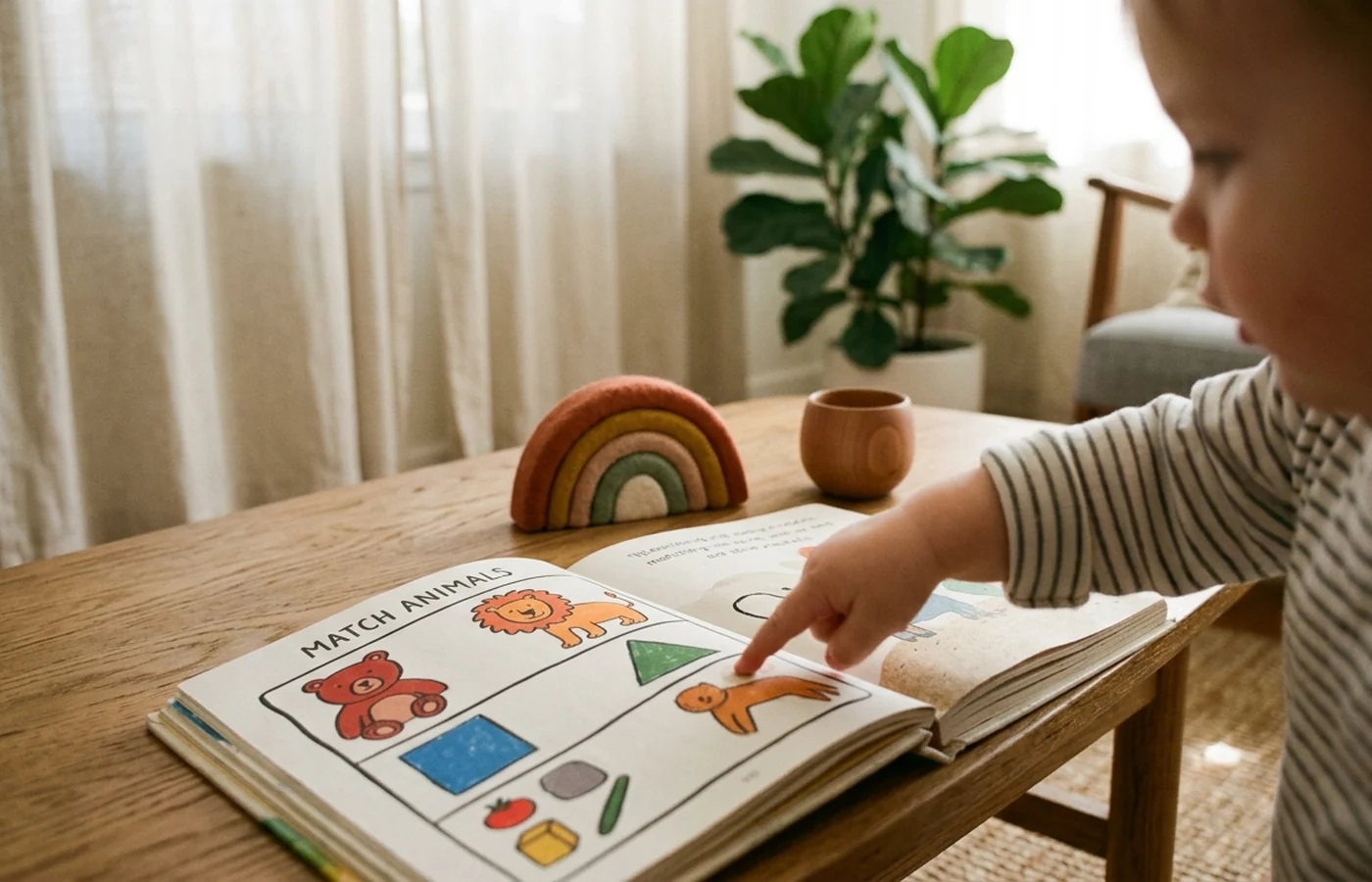
- One friendly animal hero. A bear, a rabbit, a fox, a dog, a duck. Smiling, gentle, made of soft shapes. Never sharp, never aggressive, never neon.
- Warm muted palette. Cream, sage, terracotta, dusty blue, soft mustard. Not primary saturation. Save that for older books.
- Hand-illustrated feel. Even if you use AI for the illustration, choose a style that reads as picture book, not as digital vector. Slightly imperfect lines are a feature.
- Title typography. Chunky friendly sans-serif (think Quicksand, Recoleta, Caveat-style) or a soft serif. Avoid corporate fonts.
- Visible age signal. "Ages 2-4," "My First," or a clear toddler skill cue. A grandparent shopping at midnight needs to know this is the right gift.
- Activity badge. "50 Skill-Building Activities" or "Matching, Tracing, Coloring and More" in a soft contrast block.
For the cover production logic, our perfect KDP cover guide and cover requirements checklist cover the technical side. The aesthetic side is judgment.
Build a parent-trustable toddler book cover
Soft warm palette, single hero animal, the right age signal. KDPEasy makes the technical side disappear so you can focus on judgment.
Start freeThe print-quality reality nobody admits
Here is the truth that almost no KDP guide will tell you: a toddler busy book has a six-month life expectancy. Pages will be torn out. Corners will be chewed. Crayons will rip through paper. Markers will bleed across spreads. This is not a defect. It is what the product is for.
Three implications follow, and they should shape every design choice you make.
1. Design for replacement, not for keepsake
A keepsake book is precious, careful, and used once. A toddler busy book is a consumable. The right frame is: a parent buys this book, the child destroys it inside six months, and the parent buys the next one. Frame the buying decision around this honestly in your description ("Designed to be loved and used. Perfect for ages 2-4 who learn by doing"). Do not pretend the book will survive untouched.
2. Price as a consumable
At $9.99, a busy book that lasts six months works out to about $1.66 per month of toddler entertainment. That is the comparison the parent is making, consciously or not, against $4.99 for a single coffee. Above $13 the math feels luxurious instead of practical and conversion drops.
3. Avoid small parts and binding hazards
KDP\'s default paperback binding is correct for this niche. Avoid spiral binding (toddlers pull the wire out and chew it), avoid stickers as activities (the sticker sheet is a choking hazard once detached), and never design pop-ups, pull-tabs, or removable components. The book exists as a flat, sturdy paperback. That is the whole format.
Pricing strategy: the $7.99-$12.99 reality
Toddler busy books live in a tighter price range than older-kid activity books. The reason is the ceiling: major-publisher hardcover busy books from Highlights and Melissa & Doug top out at around $14.99. KDP paperback cannot match the production value of a hardcover, so it has to undercut on price.
| Book length | Pages | Color strategy | Realistic price | Approx royalty |
|---|---|---|---|---|
| Light busy book | 40-50 | B&W with color cover | $7.99-$8.99 | $2.80-$3.10 |
| Standard busy book | 50-60 | Hybrid (mostly B&W) | $9.99-$10.99 | $3.20-$3.60 |
| Premium / Montessori angle | 60-70 | Hybrid (substantial color) | $11.99-$12.99 | $3.80-$4.20 |
| Travel-specific (smaller trim) | 50-60 | B&W activity, color cover | $8.99-$10.99 | $3.10-$3.70 |
Use our KDP royalty calculator to model exact royalty for your page count, interior color strategy, and trim size. The hybrid color strategy is what separates publishers who break even from publishers who clear $3+ royalty per sale.
Profit projections: the honest medians
Single toddler busy book, 60 pages, hybrid color, $10.99
- Royalty per sale: roughly $3.50
- Month 3: 20-35 sales = $70-$120
- Month 6: 40-65 sales = $140-$230
- Month 12: 60-100 sales = $210-$350
- Year 1 total: $2,500-$3,800 in a healthy themed sub-niche
Three-book toddler series with cross-linking
- Identical cover layout, swap hero animal and accent color per volume
- Month 6: 130-200 combined sales = $440-$680 per month
- Month 12: 220-330 combined sales = $750-$1,150 per month
- Year 1 combined: $6,500-$10,000
These numbers assume a parent-trustable cover, a tight sub-niche, and basic backend keyword discipline. The biggest cause of underperformance in this category is a cover that reads as too generic or too cartoonish. Spend disproportionate effort on the cover.
Title formulas that work in 2026
- My First + Theme + Book + Age: "My First Animal Activity Book: Tracing, Coloring and Matching for Toddlers Ages 2-4"
- Theme + Busy Book + Age + Activity types: "Farm Animal Busy Book for Toddlers Ages 2-4: Matching, Tracing, Coloring and Counting"
- Big and Bold + Activity + Book + Age: "Big and Bold Coloring Book for Toddlers Ages 2-4: 60 Thick-Outline Pages for Little Hands"
- Travel + Quiet Book + Age: "Toddler Travel Activity Book: Quiet-Time Activities for Ages 2-4 on Planes and Road Trips"
- Montessori-style + Skill + Book + Age: "Montessori-Style Tracing and Matching Book for Toddlers Ages 2-4"
Include the age band ("Ages 2-4") and either "Toddler" or "My First" in every title. Both phrases anchor parents who are pattern-matching at the search bar.
Sub-niches that still have room in 2026
- Montessori-style busy books. The label commands premium pricing and signals to a buyer who already self-identifies. The actual content overlap with a standard busy book is high.
- Toddler travel quiet books. Search volume around school holidays is excellent. Reviewers explicitly value "kept my child quiet for the flight."
- Single-animal busy books. "Toddler Farm Animal Activity Book." "Toddler Ocean Animal Activity Book." Narrower than the generic and easier to rank.
- Skill-specific busy books. "Toddler Tracing Book." "Toddler Counting Book." Reads as a workbook to Montessori-aligned parents and converts well.
- Bilingual busy books. Spanish-English and French-English. Low competition, premium pricing, growing buyer base.
Plan a three-book toddler series
Same cover template, swap the hero animal and accent color per volume. Generate them in KDPEasy in an afternoon.
Try KDPEasy freeCommon mistakes that kill toddler busy books
What goes wrong, and why
- Lines too thin. 1-2pt outlines disappear under chunky crayons. The toddler colors over them, the parent writes a one-star review.
- Too many activities per page. Toddler attention cannot scan a busy spread. One activity per page is non-negotiable.
- Text the child cannot read. Written instructions at this age are noise. Parents read them aloud, or skip the page entirely.
- Cover too commercial. Neon, sharp graphics, generic vector art. This audience pattern-matches against picture books. Get there.
- All-color interior. Doubles your print cost. Use hybrid color: color where it teaches color, B&W everywhere else.
- Generic title. "Activity Book for Kids" loses to "My First Farm Animal Activity Book Ages 2-4" every time.
- No age targeting on cover. Grandparents shop fast. If the cover does not say "Ages 2-4" or "My First," they move on.
7-day production plan
- Day 1: niche and persona lock. Pick a sub-niche (Montessori, travel, single-animal). Pick the primary persona (Montessori parent, travel parent, gift buyer). Write a single sentence describing the buyer.
- Day 2: activity planning. Map 50-60 pages using the activity mix table above. Decide color strategy per page (B&W for activity, color for identification).
- Day 3-4: content production. Generate or commission illustrations with 4-5pt outlines. Use a generator for the tracing pages. AI tools like Midjourney work for the friendly-animal coloring pages if you tune for "thick outline, no shading, friendly toddler-safe."
- Day 5: layout. Single activity per page. Generous margins (0.5 inch gutter and outside). Light parent prompts in 10pt italic at page bottom only where needed.
- Day 6: cover. Single hero animal, warm muted palette, age badge, activity badge. Test at thumbnail size. Reject anything that does not pass the picture-book visual test.
- Day 7: KDP upload. Title formula from above, description that names the three personas, seven backend keywords. Order an author proof before publishing.
Order the proof. Get a real toddler to test it. If they can do every activity unaided, you shipped.
The contrarian recommendation
The biggest mistake in this niche is treating it as easy because the activities are simple. The activities are simple. The design judgment is not. The publishers who succeed here are the ones who design like a picture-book illustrator and price like a consumables manufacturer. Picture-book aesthetics on the cover, hybrid color in the interior, $9.99-$11.99 pricing, and a clear sub-niche that lets a Montessori parent or a travel parent or a grandparent recognize the book as theirs in half a second.
Stop trying to publish "a toddler activity book." Publish "Olive\'s Farm: A Matching and Tracing Book for Toddlers Ages 2-4." That specificity is the entire game.
A FEW MORE ANSWERS
Frequently asked questions
A toddler busy book (also called a quiet book) is a single-task-per-page activity book designed for children roughly aged 1.5 to 4. The differences from older-kid activity books are absolute: one activity per spread, thick bold outlines that survive crayon pressure, no written instructions because the child cannot read, no puzzle solutions because there is nothing to solve, and a heavy bias toward matching, tracing, color identification, shape sorting and counting 1-10. The market is different too: Montessori-aligned parents, travel parents, and gift-buyers.

ABOUT THE AUTHOR
Danielle Okonkwo
Marketing & Growth Lead at KDPEasy. Danielle is a published author with 12+ titles on Amazon KDP and a former book blogger. She draws on hands-on publishing experience and years of testing what works in the KDP marketplace.
Meet Danielle